


Did you just type a word and wonder if it needs two n’s? You’re not alone. Many writers pause at this exact spot. The answer is quick. Training is the correct spelling, and trainning is a common spelling mistake. In the training vs trainning debate, only one word wins. It comes from the base word train plus the suffix -ing. That’s it. Nothing gets doubled.
This guide keeps things simple. You’ll see the consonant doubling rule, easy training examples, and a handy memory trick. You’ll also learn the training meaning and how it differs from coaching and practice. By the end, you’ll spell it right every time. Ready to fix that typo for good? Let’s jump in. Each section uses plain words, so you can learn fast and remember it.
Training vs Trainning: The Quick Answer
Training is the correct spelling, while trainning is incorrect. Learn the difference and see common examples of proper usage.
Training Is the Correct Spelling
Training is the correct spelling of training in every standard English dictionary. It has one n in the middle and one n before the g.
You can use it in the US, the UK, Canada, and Australia. No regional twist changes it.
Trainning Is a Common Spelling Mistake
The trainning spelling mistake shows up in emails, résumés, and social posts. It looks fine at a glance, which is why it slips through.
But it’s an incorrect spelling. No dictionary lists it as a real word.
Quick Comparison of Training and Trainning
Here’s a fast side by side view. It takes five seconds to read.
| Word | Status | Verdict |
| Training | Correct | Use it everywhere |
| Trainning | Incorrect | Always fix it |
If you remember one line, remember this: one n in training.
What Does Training Mean?
Training as a Noun
As a training noun, it names the process of learning a skill. For example, “The nurse finished her training in May.”
It works like the word education. You don’t need an article before it.
Training as a Verb Form
It also works as a verb form. In “She is training for a marathon,” it’s the present participle of train.
That means an action is happening right now. The helper verb is shows it.
Training Meaning in English
The training meaning is simple. It’s teaching or learning practical skills through practice and repetition.
A good training definition also includes a goal. You train to get better at something.
Training in Everyday Use
You hear this word daily. Think of dog training, flight training, or a training workshop at your office.
The training word usage is flexible. That’s why spelling it right matters so much.
Why Is Training Correct?
Train + -ing = Training
The formula is clean. Take the base word train, add the suffix -ing, and you get training.
Nothing else changes. Train becomes training with no extra letters.
Why the Final N Is Not Doubled
The final n stays single because of the spelling rules for training. English doubles a last consonant only after a short vowel.
Train has a long vowel sound. So the n stays alone.
Training Compared With Similar -ing Words
Look at raining, gaining, and remaining. Each has one n before the -ing.
So training fits a clear spelling pattern. It isn’t an odd one out.
Read More: Everything vs Every Thing: A Complete Guide
Why Is Trainning Incorrect?
How the Spelling Mistake Happens
Most people type fast and rely on habit. Their fingers repeat the n without thinking.
Others copy a rule they learned for different words. That’s how the trainning incorrect spelling is born.
Why Train Does Not Become Trainning
The word train ends in a vowel pair plus n. That pair makes a long vowel sound.
The consonant doubling rule skips such words. So adding ing to train gives training, nothing more.
Is Trainning a Word in English?
No, it isn’t. The trainning meaning is zero because the word doesn’t exist.
Spell checkers flag it for good reason. Treat that red line as a friendly warning.
Why Do People Confuse Training and Trainning?

The Consonant-Doubling Rule
The consonant doubling rule is the main culprit. It says to double the last letter in some words before -ing.
People remember the rule but forget when it applies. That’s the whole confusion.
Running, Swimming, and Beginning vs Training
We write running, swimming, and beginning with double letters. Their last syllables are short and stressed.
Train isn’t like them. Its vowel sound is long, so the n stays single.
The Role of the Vowel Combination in Train
The vowel combination “ai” in train acts like a shield. It makes one long sound.
When two vowels team up, English rarely doubles the next consonant. Think of rain and raining.
Training vs Train: What Is the Difference?
Train as a Verb
Train is the base action. “I train new hires every Monday” is a perfect example.
It shows what you do. It points to the act itself.
Train as a Noun
As a noun, train usually means a vehicle on rails. “The train leaves at nine” shows that meaning.
So the train meaning changes with context. That’s why people ask about it so often.
When to Use Training Instead of Train
Use training for the ongoing process or the skill-building itself. “Her training starts tomorrow” works well.
Use train for the base verb. Keep the two straight, and you won’t slip.
Common Uses of Training
Workplace and Employee Training
Workplace training helps people do their jobs well. Employee training and staff training often cover tools, rules, and teamwork.
Companies use it for onboarding training too. New hires learn the ropes fast.
Education and Academic Training
Schools use the word for teacher training and clinical placements. A student might say, “My training includes two labs.”
In academic writing, it’s a formal term. Spell it right, and your paper looks sharper.
Sports and Fitness Training
Athletes live by sports training. Fitness training and strength training build the body step by step.
A coach might plan practice sessions around a big game. The word fits naturally here.
Technical and Professional Training
Technical training teaches tools like software or machinery. Vocational training prepares people for trades.
These paths support career development. Many jobs ask for proof of such learning.
Training Course, Program, Centre, and Session
Training Course
A training course is a planned set of lessons. It often ends with a test or certificate.
People take one to learn a defined skill. Think of a first aid course.
Training Program
A training program is bigger. It may include several courses over months.
The spelling programme appears in British English. Both are fine in the right region.
Training Centre
A training centre is a place where learning happens. Americans write center, while British writers use centre.
Either way, the first word stays training. That part never changes.
Training Session
A training session is a single meeting. It might last an hour or a whole morning.
Teams often schedule training sessions weekly. Short ones keep people sharp.
Training Day
A training day is a day set aside for learning. Many offices close early for it.
The phrase also names a famous 2001 film. Context tells you which meaning applies.
Training or Trainings: Which Is Correct?

Is Training an Uncountable Noun?
Usually, yes. As an uncountable noun, it has no plural. You say “some training,” not “a training.”
That’s why plural training feels odd to many readers.
When Should You Use Training Sessions?
When you mean several events, say training sessions. “We hold three training sessions this month” sounds clean.
This habit keeps your writing clear and safe.
When Can Trainings Be Used?
Some business writers use trainings for separate programs. You’ll see it in HR emails and job posts.
It isn’t wrong, but it’s less formal. When in doubt, add a noun like workshops.
Training vs Practice vs Education
Training and Practice
Training vs practice is a fun pair. Training builds a skill with guidance, while practice repeats it on your own.
A pianist takes lessons, then practices at home. Both matter.
Training and Education
Training vs education is about depth. Education builds broad knowledge, and training builds a specific ability.
A degree teaches theory. A short course teaches you to use a tool.
Training and Coaching
Training teaches what to do. Coaching helps you do it better over time.
They overlap, but they’re not twins. The next section explains why.
Training vs Coaching: What Is the Difference?
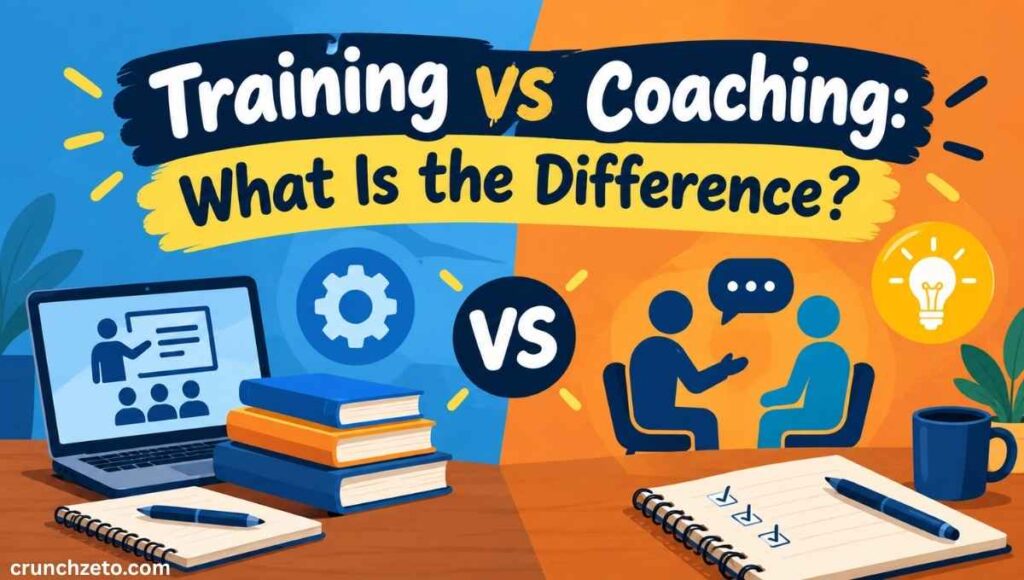
Training Focuses on Skills and Methods
Training vs coaching starts with focus. Training hands you skills and set methods.
It follows a plan. Everyone in the room learns the same steps.
Coaching Focuses on Guidance and Improvement
Coaching is personal. A coach watches you, asks questions, and nudges you forward.
The goal is steady improvement. It fits your pace.
Examples of Training and Coaching
A company trains all staff on a new app. Later, a manager coaches one person who struggles with it.
That’s coaching and training working together. Each one fills a gap.
Training Synonyms and Related Words
Instruction
Instruction means direct teaching. It’s formal and clear. “The pilot received instruction on safety.”
Of all the synonyms for training, it’s one of the closest.
Coaching
Coaching works as a softer match. It stresses guidance over lessons.
Use it when the support is personal and ongoing.
Education
Education covers wide learning. It suits schools and degrees.
It isn’t a perfect swap. Training is narrower.
Development
Development is common in HR. It points to growth over time.
You’ll see training development and professional development side by side.
Preparation
Preparation means getting ready for a task. “Her preparation for the exam was solid.”
It works when the goal is one event.
Conditioning
Conditioning fits athletes and animals. It builds stamina or habits.
You wouldn’t use it for office lessons, though.
Training Pronunciation Guide
How to Pronounce Training
Say it as TRAY-ning. The stress falls on the first syllable.
This pronunciation guide is easy once you hear it. Try saying it aloud twice.
UK and US Pronunciation
Both UK pronunciation and US pronunciation sound nearly the same. Small accent shifts exist, but the word stays steady.
No spelling change follows the accent. That keeps things simple.
Does the Pronunciation Have One or Two N Sounds?
There’s just one n sound in the middle. You don’t pronounce two.
That clue backs up the spelling. One sound, one letter.
Why Correct Spelling Matters
Training in Resumes and CVs
Hiring managers skim fast. A typo in resume writing can cost you the interview.
The word often sits in a skills line. Check it twice before you send.
Training in Business Writing
Business writing needs trust. A wrong spelling makes a company look careless.
Emails, reports, and proposals all deserve writing accuracy.
Training in Academic Writing
Teachers notice small errors. In academic work, spelling shows care.
Good proofreading protects your grade. It also builds confidence.
Training in Websites and Emails
Search engines read your text, and so do customers. A typo in a title can hurt clicks.
Fix it before you hit publish. Attention to detail pays off.
Common Training Spelling Mistakes
Trainning
This is the big one. The doubled n comes from habit.
Say “one n” to yourself as you type.
Traning
Here, the letter i goes missing. The word loses its long vowel sound.
Put the i back. Train needs both a and i.
Trainnig
This error swaps the last letters. It happens when you type quickly.
Slow down on the ending. It’s always -ing.
Incorrect Plural Forms
Some writers type trainnings or trainigs. Both are wrong.
If you need a plural, write training sessions. It’s safe and clear.
How to Remember the Correct Spelling of Training

The One Train, One N Memory Trick
Here’s a handy memory trick. One train runs on one track, so you need one n in the middle.
Picture that little engine whenever you type.
Compare Train With Rain
Train hides the word rain inside it. Just add a t at the front.
You’d never write rainning. So don’t write trainning either.
Remember the Base Word Train
Start from the base word. Train plus -ing gives you training.
Nothing gets added. That’s the beauty of it.
How Do You Spell Trainee?
Trainee vs Training
A trainee is the person. Training is the process.
So you can say, “The trainee finished her training.”
Correct Spelling of Trainee
The spelling is t-r-a-i-n-e-e. It has one n and two e’s at the end.
The -ee suffix often marks the person receiving something.
Trainee Meaning and Usage
A trainee is someone learning a job. “The new trainee shadowed the chef.”
This fits employee development and workplace skills well.
Types of Training
Workplace Training
Workplace training covers tools and teamwork. It helps staff do their jobs well.
Onboarding is a classic case.
Technical Training
Technical training builds technical skills. Think software, equipment, and repairs.
It’s often hands-on.
Safety Training
Safety training teaches people how to avoid harm. Safety instruction may cover fire drills or lifting rules.
Many jobs require it by law.
Leadership Training
Leadership training grows managers. It adds communication and decision skills.
It connects to leadership development.
Sports Training
Sports training builds speed, strength, and strategy. Athletic training also helps prevent injury.
It boosts sports performance over a season.
Why Training Matters for Your Career
Good training opens doors. It builds practical skills that employers want.
People who keep learning grow faster. That’s the heart of skill development.
Spelling the word right shows you care about detail. Small things shape first impressions.
Tips to Avoid English Spelling Mistakes
Read your work aloud. Your ear catches what your eyes miss.
Use a dictionary when unsure. Trusted dictionary spelling beats guessing.
Keep a short list of words you misspell. Review it often, and your common spelling mistakes will shrink.
Practice Exercises: Training vs Trainning
Fill in the Blanks
Pick the right word. Choose between training and trainning.
- Our safety ___ starts at nine.
- She is ___ for a 10K race.
- The new ___ course is online.
Multiple Choice Questions
- Which spelling is correct? (a) trainning (b) training (c) traning
- Which word names the person? (a) training (b) trainer (c) trainee
- Which is the safest plural form? (a) trainnings (b) training sessions (c) trainigs
Answers and Explanations
1 to 3: training. The word needs one n in the middle.
4: (b). 5: (c), since trainee is the learner. 6: (b). It’s the clearest choice.
FAQs About Training vs Trainning
Is It Trainning or Training?
It’s training. The spelling trainning is wrong.
Remember the rule: one n in the middle.
What Is Trainning?
Trainning is just a typo of training. It has no meaning in English.
No dictionary lists it.
What Is the Correct Spelling of Training?
The correct spelling is t-r-a-i-n-i-n-g. That’s eight letters in all.
There’s just one n in the middle.
How Do You Spell Training Correctly?
Start with train, then add -ing. Don’t double any letter.
Check it against the word rain if you’re unsure.
How Do You Spell Train Like You Are Training Someone?
It’s spelled t-r-a-i-n. The spelling doesn’t change if you train a person, a dog, or a team.
Only the ending changes, like trained or training.
What Are the Four Types of Training?
Common lists include on the job, classroom, online, and simulation training. Sources vary a little.
Each one fits a different learning style.
What Are the Seven Types of Training?
A longer list adds coaching, mentoring, and group discussion to the four above. Again, lists differ by source.
Use the one that matches your field.
What Are the Five Stages of Training?
A popular model has five steps: assess needs, design, deliver, test results, and follow up.
This cycle keeps learning useful and fresh.
What Is the Spelling for Training?
The spelling is t-r-a-i-n-i-n-g. One n sits in the middle.
Say TRAY-ning, and you’ll hear only one n sound.
Why Does Train Have Two Meanings?
The word comes from an old root meaning to pull or drag. That idea spread in two directions.
A line of cars pulled along became a rail train. Guiding someone along became the teaching sense.
How Do You Spell Train Training?
Write train for the base word and training for the -ing form. For example, “They train hard, and their training pays off.”
That sentence uses both correctly.
Conclusion
So here’s the final word in training vs trainning. Training is right, and trainning is a slip. Use one n, and you’re set.
Keep the memory trick close, and tell a friend who struggles. Got a tricky word of your own? Share it in the comments, and let’s sort it out together.

Oliver Matthew Wilson is a passionate English language and grammar writer who enjoys making grammar, spelling, vocabulary, and writing concepts simple and easy to understand. With a focus on clear explanations and practical examples, Oliver Matthew Wilson creates helpful content for students, writers, and everyday English learners. His goal is to make learning English more enjoyable, useful, and accessible to everyone.
