


Many people stop and think before typing this word. Should it be one word or two? The confusion is common because both forms look right and sound almost the same. Here is the exact answer. Use “everything” (one word) in almost every sentence. It means all things together.
Use “every thing” (two words) only when you mean each item one by one, or when another word sits in the middle, like “every little thing.” This guide explains everything vs every thing with simple rules, clear examples, and quick tests. By the end, you will always pick the right form.
Which Is Correct: Everything or Every Thing?
“Everything” is the right choice in most sentences. It is one word. It means all things, or all of it. “Every thing” (two words) is also correct, but it is rare. Use it only when you mean each item one at a time, or when another word sits between “every” and “thing.”
Here are two quick examples:
- Everything is ready for the trip.
- I checked every thing on the list, one by one.
When you weigh everything vs every thing, neither form is a typo. Each one has its own job. The first is common. The second is special.
What Does “Everything” Mean?
Everything is an indefinite pronoun. That is a grammar term for a word that stands in for things without naming them. Think of it as a big bag that holds all items at once.
It has three common meanings:
- All things in a group: “She cleaned everything before the guests came.”
- The full situation: “Everything is fine now.”
- The most important thing: “Family means everything to him.”
In each case, the word acts as one unit. You cannot split it, and you cannot place another word inside it.
What Does “Every Thing” Mean?
“Every thing” is two separate words. Every is a determiner, which is a word that comes before a noun. Thing is the noun. Together they mean each single item, counted one at a time.
Writers pick this form for two reasons.
First, they want to stress each item. “The inspector checked every thing in the kitchen.” The two words slow the reader down. They say, “Not just most items. Each one.”
Second, they need to add a word in the middle. You can write “every little thing,” “every single thing,” or “every good thing.” A one-word pronoun has no room for extra words, so the two-word form is the only choice.
In daily writing, most editors still pick “everything” unless one of these two reasons applies.
Everything vs Every Thing: Side-by-Side Comparison
This table shows the difference at a glance.
| Term | Correct? | Part of speech | Meaning | Best use |
| Everything | Yes, very common | Indefinite pronoun | All things, or all of it | Default choice in nearly every sentence |
| Every thing | Yes, but rare | Determiner + noun | Each single thing, one by one | To stress each item, or when a word sits between |
| Everythings | No | Not a word | None | Write “everything’s” for “everything is” |
How Can You Tell Which One to Use?

When you face everything vs every thing in a draft, try these three quick tests.
- The “all” test. Swap in “all of it.” If the sentence still works, use “everything.” “All of it is ready” makes sense, so “Everything is ready” is right.
- The “each” test. Swap in “each thing.” If you truly mean item by item, use “every thing.” “I checked each thing on the list” matches “I checked every thing on the list.”
- The “middle word” test. Can you add a word between “every” and “thing”? If yes, you need two words. “She noticed every little thing.”
Here is a memory trick. Picture “everything” as one bag. Picture “every thing” as a line of items. One bag, one word. A line of items, two words.
If you are unsure, choose “everything.” It will be right nearly every time.
Grammar Basics: Part of Speech, Verbs, and Possessives
The rules for everything vs every thing are the same in American and British English. Both use the one-word form as the standard.
Here are the key points:
- Part of speech: “Everything” is a pronoun. “Every thing” is a determiner plus a noun.
- Verb agreement: Both take a singular verb. Say “Everything is fine,” not “Everything are fine.”
- No plural: “Everythings” is not a word. The idea is already complete.
- Contraction: “Everything’s” is short for “everything is” or “everything has.” Example: “Everything’s ready,” and “Everything’s been packed.”
- Common partners: “Everything else,” “everything that,” and “everything but” all work well. Example: “I ate everything that she cooked.”
- Tone: “Everything” fits both formal and casual writing. “Every thing” also fits both, but it sounds a bit more emphatic.
Where Did the Word “Everything” Come From?
The word is a compound. That means two words grew together into one.
“Every” comes from an Old English phrase that meant “ever each.” “Thing” is also very old. In Old English, it could mean a meeting or a matter, not only an object. Over time, “thing” came to mean any item or idea.
As people said “every thing” more often, writers began to join the pair. The one-word spelling became the normal form. The two-word form stayed alive for cases that need emphasis.
How Do You Pronounce Everything and Every Thing?
Everything sounds like EV-ree-thing (/ˈɛvriˌθɪŋ/). The stress falls on the first part, “EV.” The word “thing” is soft and quick.
Every thing sounds like EV-ree THING. The speaker puts real stress on “thing” and often adds a tiny pause.
That small stress change is the only spoken clue. It is easy to miss in fast talk. That is why everything vs every thing confuses people in writing more than in speech. Sound cannot always guide you, so use the three tests from earlier.
Real Life Examples of Everything and Every Thing
Seeing everything vs every thing in real sentences makes the choice clearer.
Everyday talk
- “Did you pack everything?”
- “Everything’s fine, I promise.”
Workplace
- “Everything on the agenda is finished.”
- “Please review every thing in the shared folder, not only the first page.”
The second sentence stresses each item, so the two-word form fits.
- “Thanks for everything you did this week.”
- “I attached everything you need for Monday.”
Academic writing
- “The study covers everything from sleep to diet.”
- “The lab notes record every single thing the students observed.”
The word “single” sits in the middle, so two words are required.
Formal writing
- “We appreciate everything you have done for our organization.”
Casual writing
- “I love everything about this town.”
- “He notices every little thing.”
Again, “little” sits in the middle, so the two-word form is the only option.
Common Mistakes With Everything and Every Thing
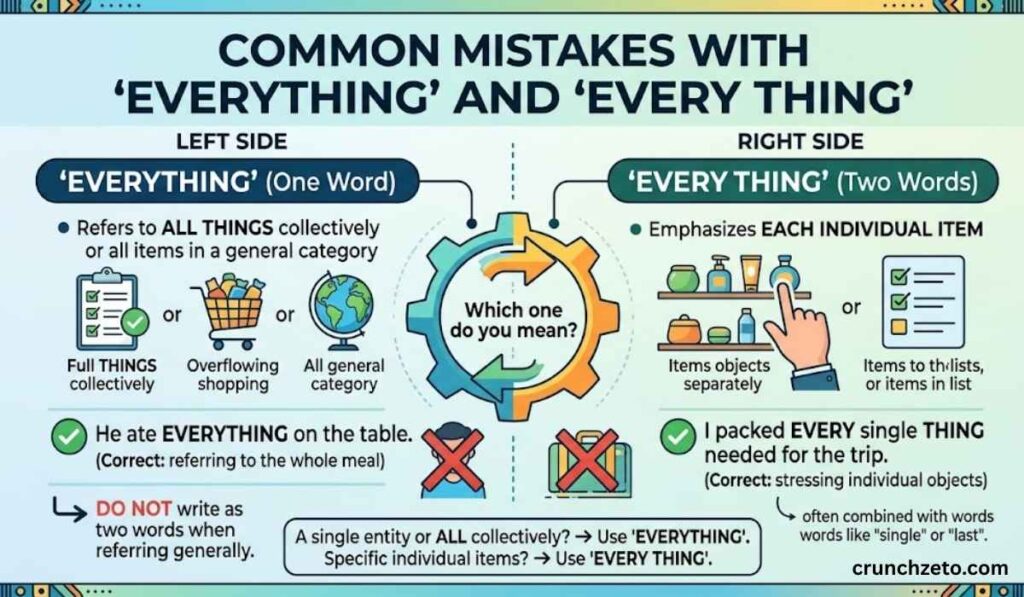
Almost every error with everything vs every thing comes from one of these slips. They are normal. Most writers make them at some point.
Mistake 1: Splitting the word without a reason
Incorrect: Every thing is going well.
Correct: Everything is going well.
The speaker means the whole situation, not each item one by one. So one word is best.
Mistake 2: Adding an “s”
Incorrect: Everythings ready.
Correct: Everything’s ready.
“Everything” has no plural. The apostrophe shows a shortened “is.”
Mistake 3: Using a plural verb
Incorrect: Everything are ready.
Correct: Everything is ready.
Even though “everything” covers many items, it is grammatically singular.
Mistake 4: Using “everything” before a noun
Incorrect: He fixed everything little problem.
Correct: He fixed every little problem.
Here “every” describes the noun “problem.” The pronoun “everything” cannot do that job.
Related Words and Phrases You Should Know
Similar patterns cause the same confusion. Here are the ones readers meet most.
- Everyone vs every one: “Everyone” means all people. “Every one” means each one in a group. “Everyone came.” “Every one of the players signed the ball.”
- Everyday vs every day: “Everyday” is an adjective that means ordinary. “Every day” means each day. “Wear everyday shoes.” “I walk every day.”
- Everybody: It means the same as “everyone,” but it feels a little more casual.
- Anything, something, nothing: These are sister pronouns. “Nothing” is the direct opposite of “everything.”
- Synonyms: “All,” “all of it,” “the whole lot,” and “each item.”
- Idioms: “Everything but the kitchen sink” means nearly all items. “Everything under the sun” means a huge range of things.
FAQ
Is “every thing” ever correct?
Yes. Use it to stress each item, or when a word sits between “every” and “thing,” such as “every little thing.” Otherwise, choose “everything.”
What is the main difference in everything vs every thing?
“Everything” is one pronoun that means all things together. “Every thing” is a determiner plus a noun that means each thing, one at a time.
Is “everything” singular or plural?
It is singular. Use a singular verb: “Everything looks great.”
How do I use “everything” in a sentence?
Use it as the subject or the object. “Everything is ready,” or “She packed everything.”
Conclusion
Choose everything when you mean all things together. Use every thing only when you mean each item one by one, or when another word sits in the middle, like “every little thing.” Not sure which one fits? Write the one-word form. It is right far more often than not. Keep the picture in mind: one bag, one word. A line of items, two words. Now you can write with confidence.

Oliver Matthew Wilson is a passionate English language and grammar writer who enjoys making grammar, spelling, vocabulary, and writing concepts simple and easy to understand. With a focus on clear explanations and practical examples, Oliver Matthew Wilson creates helpful content for students, writers, and everyday English learners. His goal is to make learning English more enjoyable, useful, and accessible to everyone.
