


Judgment vs judgement: which one is correct? Both are right. Judgment is the standard spelling in American English. Judgement is the usual form in British English. The meaning stays the same. The pronunciation stays the same. Only one letter changes, and that letter depends on your audience. This spelling confusion trips up many writers. Don’t worry, it’s easy to fix.
In this guide, you’ll learn the judgment definition, judgment usage, and legal writing rules. See how UK English and US English treat each word. You’ll also see good judgment examples, a judgment call, and a quick practice test. We’ll clear up the mix ups between verdict and ruling too. Ready to pick the correct spelling of judgment with total confidence?
Judgment vs Judgement: The Quick Answer
Here’s the short version. Judgment is the US English spelling. Judgement is the usual UK English spelling.
Neither one is a common spelling mistake by itself. The only mistake is switching between them for no reason.
Not sure which to use? Look at where your readers live. If they’re mostly in the United States, write judgment. If they’re in the UK, Australia, or India, judgement will feel more familiar.
What Does Judgment or Judgement Mean?
Let’s start with the word itself. Both spellings point to the same idea. It’s the ability to look at a situation and decide what’s wise.
Think of it as your mind’s final check before you act. You weigh the facts. Then you make a call.
Judgment Definition and Meaning
The judgment definition has a few layers. First, it means the ability to make sensible decisions. Second, it means an opinion or conclusion you reach after thinking something through.
Third, in law, it means a formal decision from a court. Same spelling, three jobs. Context tells you which one you’re reading.
Judgement Definition and Meaning
The judgement definition is exactly the same. Nothing changes except one letter. A British writer who says “she showed fine judgement” means what an American means by “she showed fine judgment.”
Dictionaries treat them as one word. Only the spelling variation is different.
What Is the Difference Between Judgment and Judgement?
The difference is small. It’s the letter e after the g. That’s all.
Still, this one letter causes a lot of spelling confusion. Let’s see where it came from and why it stuck.
Why Is Judgment Spelled Without the E?
American spelling often trims extra letters. Think of color and colour, or center and centre. Judgment follows that same habit of keeping words short and plain.
Over time, American writers and publishers made the shorter form the norm. Today it’s the standard American spelling. It also matches the rule in most American English conventions.
Why Does Judgement Have an Extra E?
The extra e helps the g sound soft. Without it, some readers might say “judg-ment” with a harder sound. The e acts like a small signpost.
That’s why many British writers kept it. It’s also why judgement looks natural in general British English. Old habits last, especially in spelling.
Do Judgment and Judgement Mean the Same Thing?
Yes, they do. Every sense of the word works with either spelling. A judgment call and a judgement call are the same thing.
Swapping one for the other won’t change your meaning. It will only change how local your writing feels.
Are Judgment and Judgement Pronounced Differently?
No. Both are said like “JUDJ-ment.” The e is silent. You can’t hear it at all.
So judgment pronunciation and judgement pronunciation match perfectly. Only the page shows the difference.
Read More: Mobil vs Mobile: Which Is Correct and How to Use Them?
Judgment in American English
Now let’s look at how Americans use the word. It’s simple. One spelling covers almost everything.
If you write for a US blog, school, or company, this is your section.
Is Judgment the American Spelling?
Yes. Judgment is the correct spelling in the United States. Major American dictionaries list it first.
You’ll also see it in newspapers, textbooks, and government documents. It’s the form American readers expect.
Judgment vs Judgement in US English
In US English, the e-less form wins. If an American reader sees judgement, they may pause. Some will think it’s a typo.
That pause matters. It can hurt trust, especially in professional or academic writing. So keep it clean and use judgment.
Common Judgment Examples in American English
Here are a few judgment examples you might hear every day:
- “Use your judgment before you sign that contract.”
- “She has sound judgment with money.”
- “That was an error of judgment.”
- “I’ll reserve judgment until I see the data.”
See how natural they sound? Each one shows the word doing real work in a sentence.
Judgement in British English
Across the Atlantic, the picture is a little different. The extra e feels normal there. Yet the story isn’t quite black and white.
Let’s walk through it.
Is Judgement the British Spelling?
Mostly, yes. Judgement is the usual form in British English. You’ll find it in UK newspapers, schools, and workplaces.
Australia, India, and other Commonwealth countries often follow the same habit. So judgement is a safe bet for those readers.
Judgment vs Judgement in UK English
In UK English, both forms exist. The e version is common in everyday writing. Meanwhile, the shorter form still appears, especially in formal settings.
Because of this, British readers rarely call either one wrong. They just notice which one feels more familiar.
Can Judgment Also Be Used in British English?
Absolutely. Judgment shows up in British legal writing all the time. UK courts often publish decisions under that spelling.
So no, it isn’t an Americanism. This surprises many people. We’ll come back to it in the mistakes section.
Judgment vs Judgement in Legal Writing
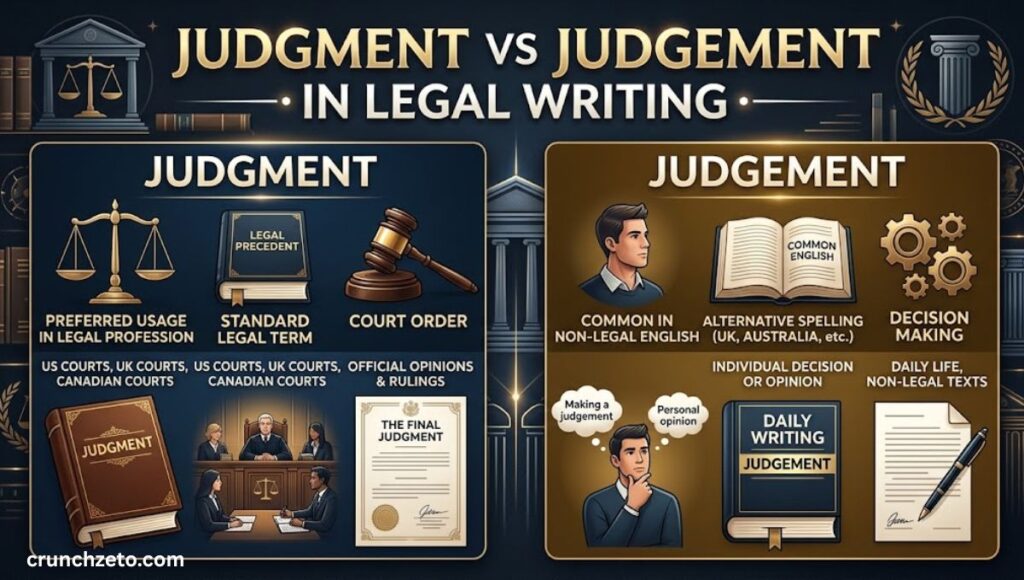
Law is where this word matters most. A single ruling can change someone’s life. So legal writing treats the term with care.
Let’s break down what it means in court.
Judgment Meaning in Law
In law, a judgment is the court’s final decision in a case. It says who wins and what happens next. It may order someone to pay money or follow a rule.
You might hear terms like default judgment or summary judgment. These are common legal terminology in civil cases.
Judgment, Verdict, and Decision: What Is the Difference?
These words overlap, but they aren’t twins. A verdict is what a jury decides. A judgment is the judge’s official order that follows.
A decision is a broader word. It can mean any choice at all. Meanwhile, a ruling often covers a single point during a case.
Which Spelling Should Appear in Court Documents?
Follow the court’s own rules. In the US, use judgment. In the UK, many courts also prefer judgment in formal papers.
When in doubt, check the style guide for your jurisdiction. Consistency matters more than guessing.
Is a Court Judgment the Same as a Verdict?
Not quite. A jury gives a verdict, such as guilty or not guilty. A judge then issues the court judgment, which makes it official.
In a defendant’s case, the verdict is the finding. The judgment is the legal outcome that follows, including any sentence.
Judgment vs Judgement in Academic and Professional Writing
Your teacher, editor, or boss may care about this. Many of them do. A small spelling slip can look careless.
So let’s make your choice easy.
Judgement or Judgment in Academic Writing
Check the school’s rules first. Many universities publish a style guide. Follow it, even if you prefer the other form.
If there’s no guide, match your audience. A US journal expects judgment. A UK journal may expect judgement.
Which Spelling Should I Use in an American Essay?
Use judgment. Your teacher is likely grading with American rules. The shorter form protects you from lost points.
It also keeps your essay clean. No one will question it.
Which Spelling Should I Use in British English?
Use judgement unless your guide says otherwise. It fits British English conventions and feels natural to UK readers.
If you’re writing about law, though, check the house style. Legal teams often prefer the shorter form.
Which Spelling Is Better for Professional Writing?
Neither one is better. What matters is the fit. A company in Chicago should use judgment. A firm in London may use judgement.
Global brands often pick one form and apply it everywhere. That keeps their publishing conventions tidy.
How Important Is Spelling Consistency?
Very important. Readers notice when one page uses both forms. It makes the writing feel sloppy.
So pick a spelling and stick with it. Spelling consistency shows care, and care builds trust.
Judgment Examples in Everyday English
Words come alive in sentences. So let’s look at how people really use this one. You’ll spot it in work chats, news stories, and family talk.
Here’s the everyday side of judgment usage.
Good Judgment and Good Judgement
Good judgment means making wise choices. A lifeguard who clears the pool before a storm shows it. So does a driver who waits out the ice.
In British writing, you’d see good judgement. The idea is the same. It’s about careful consideration and thinking ahead.
Common Expressions With Judgment and Judgement
English has many phrases built on this word. Here are some favorites:
- Pass judgment means to give an opinion on someone.
- Against my better judgment means doing something you doubt.
- Value judgment means a view based on personal beliefs.
- Use your judgment means decide for yourself.
Swap in judgement if you’re writing for a UK reader. The phrase works either way.
How Judgment Can Mean Discernment
Sometimes the word means discernment. That’s the skill of telling what matters from what doesn’t. A good editor has it. So does a good chef tasting a sauce.
It’s quiet, but it’s powerful. It’s also close to discretion, which means knowing when to act and when to hold back.
Judgment Does Not Always Mean Criticism
Many people hear “judgment” and think of blame. That’s only one side. The word can be neutral or even kind.
If someone trusts your judgment, they’re praising you. They believe you’ll weigh things well. That’s a compliment, not an attack.
Judgment vs Judgement Examples in Context
Let’s compare two short lines. American: “I trust her judgment on hiring.” British: “I trust her judgement on hiring.”
Same message. Same warmth. Only the spelling shifts to match the reader.
Judgment vs Judgement: Common Mistakes

Most errors here are small. Still, they’re easy to avoid once you know them. Let’s go through the usual slip-ups.
Treating Judgement as a Misspelling
Many Americans assume judgement is simply wrong. It isn’t. It’s a real, accepted variant used by millions of people.
So don’t “correct” it in a British writer’s work. Just match the style your project needs.
Treating Judgment as Exclusively American
Some people say the e-less form is only American. That’s not true. British courts and writers use it too.
It’s better to say each form has a stronger home. That’s more accurate and less likely to cause an argument.
Mixing Both Spellings Without a Reason
This is the most common problem. A writer types judgment in paragraph one and judgement in paragraph five. Readers feel the wobble.
Run a quick search before you publish. Make sure every instance matches.
Confusing Judgment With Verdict
A verdict is the jury’s finding. A judgment is the court’s formal order. They often come one after the other, but they aren’t the same.
Mixing them up in legal writing can embarrass you. Keep the roles clear.
Assuming the Pronunciation Changes
Some learners think the extra e changes the sound. It doesn’t. Both forms sound identical.
You can relax about speaking. The only decision is on paper.
Judgment vs Judgement: Comparison Table
Sometimes a table says it fastest. Here’s a side-by-side look at the two forms.
Spelling, Meaning, Pronunciation, and Regional Usage
| Feature | Judgment | Judgement |
| Spelling | No e after g | Extra e after g |
| Meaning | Same | Same |
| Pronunciation | JUDJ-ment | JUDJ-ment |
| Main region | United States | United Kingdom and Commonwealth |
| Legal use | Common in US and UK courts | Less common in formal law |
| Everyday use | Standard in America | Standard in Britain |
Judgment vs Judgement Plural Forms
The plural follows the singular. Add an s. So you get judgments and judgements.
Both are correct. Just keep the plural spelling in line with your singular. If you wrote judgement, write judgements.
How to Choose the Right Spelling
Picking a spelling shouldn’t feel hard. A few simple habits will guide you every time.
Let’s make it practical.
A Practical Rule to Remember
Here’s an easy rule. No e for the US. Extra e for the UK. Say it twice and it sticks.
If you write for both, choose one for the whole piece. Don’t blend them.
How to Spell Judgment Correctly
Spell it J-U-D-G-M-E-N-T. Notice there’s no e after the g. That’s the form most American readers expect.
A quick memory trick helps. Think “judge” loses its e when it gets “ment” in American English. It’s a neat little shortcut.
What Is Correct: Judgement or Judgment?
Both are right. Correct English spelling depends on where you write. One is not better than the other.
Choose by audience, then follow your chosen standard form all the way through.
Should You Follow a Dictionary or Style Guide?
Yes, when you have one. A style guide sets the rules for a whole team. A dictionary shows what’s accepted.
If the two disagree, the style guide wins for that project. It keeps every writer on the same page.
Judgment vs Judgement in Special Contexts
The word also appears in places you might not expect. Faith, reference books, and the web all use it. Each one adds a small twist.
Let’s check them out.
Judgment vs Judgement in the Bible
Many Bible translations use judgment. You’ll see it in passages about justice and final reckoning. Some UK editions use judgement.
The meaning there leans toward divine justice. So the word carries real weight in religious writing.
Judgment and Judgement in Dictionaries
Dictionaries often list one spelling as the main entry. The other appears as a variant. That’s how they show regional preferences.
Which form comes first depends on the dictionary’s home country. Always check the edition you trust.
Judgment vs Judgement on Oxford and Merriam-Webster
Merriam-Webster is American. It lists judgment as the main form. Oxford is British. It treats both forms as acceptable, and many UK users lean toward the e form.
That split mirrors real life. Each dictionary reflects its own readers.
Judgment vs Judgement in Online Usage
Online, you’ll find both everywhere. Search engines understand that they mean the same thing. So either form can bring readers to your page.
Still, match your US audience or UK audience. Local readers trust local spelling.
Practice Session: Judgment vs Judgement
Time to test yourself. Read each line and pick the spelling that fits. Assume the audience is noted in brackets.
Choose the Correct Spelling
- He used poor ______ when he invested. (US)
- Her ______ call saved the project. (UK)
- I’ll reserve ______ until I know more. (US)
- It was an error of ______. (UK)
- The court entered ______ against the company. (US)
- They made a ______ based on personal values. (UK)
- Trust your own ______. (US)
- She passed ______ too quickly. (UK)
Answers
- judgment
- judgement
- judgment
- judgement
- judgment
- judgement
- judgment
- judgement
How did you do? If you missed a few, don’t worry. Re-read the quick rule and try again.
FAQs About Judgment vs Judgement
Here are quick answers to the questions people ask most.
Is Judgment vs Judgement the Correct Spelling?
The phrase “judgment vs judgement” compares two valid forms. Neither is wrong. They just belong to different regions.
Is Judgement Wrong in American English?
It isn’t wrong, but it’s uncommon. Most American style guides prefer judgment. So stick with that for US readers.
Is Judgment Wrong in British English?
No. It’s accepted and often used, especially in law. Many British writers still lean toward judgement in daily writing.
Does Changing Judgment to Judgement Change the Meaning?
No. The meaning stays exactly the same. Only the look of the word changes.
Does Judgment Only Refer to a Court Decision?
No. It also means good sense, an opinion, or an assessment. The court sense is just one use.
What Does Good Judgment Mean?
It means making wise choices after thinking things through. It shows reasoning and critical thinking. People with good judgment avoid rash moves.
What Is a Judgment Call?
A judgment call is a choice with no clear right answer. You rely on experience and instinct. Managers and parents make them daily.
What Is the Difference Between Judgment and Opinion?
An opinion is what you think. A judgment is what you decide after weighing facts. Judgment is usually more careful and more final.
What Is the Difference Between Judgment and Decision?
A decision is the choice itself. Judgment is the thinking skill behind it. Good judgment leads to better decisions.
Are Judgmental and Judgemental Spelled Differently?
Yes, and it follows the same pattern. Judgmental is American. Judgemental is British. Both mean quick to criticize.
How Can You Remember the Difference?
Link the e-less form to the US and the extra e to the UK. You could also picture the e as “England.” It’s silly, but it works.
Are Judgments and Judgements Both Correct Plural Forms?
Yes. Use the plural that matches your singular spelling. Don’t mix them in one text.
What Are the Three Main Types of Judgments?
In law, common types include default judgment, summary judgment, and consent judgment. Each ends a case in a different way. In daily life, people also talk about factual, value, and personal judgments.
Conclusion
Judgment vs judgement comes down to your readers. Use judgment for US readers. Use judgement for UK readers. Both forms share one meaning, one sound, and one plural pattern. The key is spelling consistency. Pick one form, follow your style guide, and keep it the same from start to finish.
Remember, good judgment is more than spelling. It’s sound judgment, careful consideration, and smart decision making. It helps you weigh possible consequences before you act. Now you know. Got a spelling question? Share it in the comments. And send this guide to a friend who keeps second guessing their writing.

Oliver Matthew Wilson is a passionate English language and grammar writer who enjoys making grammar, spelling, vocabulary, and writing concepts simple and easy to understand. With a focus on clear explanations and practical examples, Oliver Matthew Wilson creates helpful content for students, writers, and everyday English learners. His goal is to make learning English more enjoyable, useful, and accessible to everyone.
