


Mobil vs Mobile confuses many writers. Which one is correct? Use mobile for anything that moves or works on the go. That includes a mobile phone, a mobile app, and a mobile number. Use Mobil only for the Mobil brand, the petroleum brand behind Mobil 1 motor oil. It always takes a capital M and never an E.
One missing letter changes the whole meaning. Mobile is an adjective and a common noun. Mobil is a proper noun and a trademark owned by ExxonMobil. In this guide, you’ll learn each mobile meaning and Mobil meaning, plus how mobile technology changed the word. You’ll also see pronunciation, American English and British English usage, examples, and easy memory tricks. You’ll never mix them up again.
Mobil vs Mobile: The Quick Answer
Use mobile for almost everything. A mobile phone, a mobile app, a mobile number, a mobile home. All of them end with an E.
Use Mobil only when you mean the company. Think Mobil 1 motor oil or a Mobil gas station. That’s the one place where the E goes missing.
Mobil vs Mobile: What Is the Difference?
The difference is simple. One is a regular word. The other is a name. Mobile describes things that move or can be moved. Mobil points to a specific petroleum brand.
Think of it like “apple” and “Apple.” One is a fruit. One is a company. The spelling and the meaning both change how you use them.
What Does Mobile Mean?
The mobile meaning is easy to grasp. It tells you something can move, or be moved, without much trouble. A food truck is mobile. So is a person who can travel freely.
The word also grew a second life in tech. Today most people hear it and think of a phone. We’ll cover both sides below.
Mobile as an Adjective
Most of the time, mobile works as an adjective. It describes a noun. A mobile library drives to your street. A mobile workforce works from many places.
You can also say a patient is mobile after surgery. That means they can walk around. The adjective meaning stays the same: able to move.
Mobile as a Common Noun
Sometimes mobile acts as a noun. In the UK, people say “I’ll ring your mobile.” They mean a cell phone. That’s a common noun use.
There’s another noun meaning too. A baby mobile hangs over a crib and spins. Artists also make mobiles from hanging shapes.
Mobile Definition
The standard mobile definition goes like this: capable of moving or being moved easily. Dictionaries list this first. Phone and tech meanings come right after.
So if you ask what mobile means in English, start there. Everything else grows from that root idea of movement.
What Does Mobil Mean?
Here’s a twist. Mobil meaning isn’t found in most standard dictionaries as a normal English word. It’s a name. People know it as a fuel and lubricant brand.
So when you ask what Mobil means, the answer is a company, not a general idea. Let’s look closer.
Mobil Definition
The Mobil definition is short. It’s a brand of gasoline, motor oil, and related products. The name nods to movement and cars on the road.
It’s not an adjective. You can’t say “a mobil person.” That sentence just looks wrong to English readers.
Mobil as a Proper Noun
Mobil is a proper noun. That means it names one specific thing. Proper nouns get capital letters, just like London or Nike.
So you write “Mobil” with a capital M. Writing “mobil” in lowercase looks like a typo to most readers.
Mobil Brand Meaning
The Mobil brand stands for energy and engine care. Drivers see its red and blue logo with a red letter O. Many trust it for Mobil fuel and oil.
The name itself plays on the idea of motion. It fits a company that keeps cars moving.
Is Mobil a Real Word?
People often ask, “is Mobil a word?” Sort of, but not in the way you’d hope. It exists as a name, not a regular English vocabulary word.
In some languages, though, a similar word is real. German and a few others use “mobil” to mean mobile. In English, stick to the brand use.
Is It Mobil or Mobile?
Here’s a handy rule. Ask yourself one question. Am I talking about the company? If yes, write Mobil. If not, write mobile.
That quick check solves Mobil or mobile, which is correct in nearly every case. Let’s see how it works in practice.
Use Mobile For
Use mobile when you mean movement or portability. Use it for mobile technology, a mobile device, a mobile office, or a mobile clinic.
Use it for any phone talk too. Your mobile number and your mobile app both take the E.
Use Mobil For
Use Mobil when you name the brand. “I filled up at the Mobil station.” “She buys Mobil 1 oil for her truck.”
Always capitalize it. And remember it stays tied to the Mobil trademark and its products.
Mobile Meaning in Technology
Tech changed this word forever. Years ago, mobile mostly meant “can move.” Now it often means “works on a handheld device.”
That’s why mobile technology meaning matters. It covers phones, tablets, apps, and wireless networks. Here’s the breakdown.
Mobile Phone
A mobile phone is a handheld phone that works without a cord. Americans usually say “cell phone.” Brits and many others say mobile.
The mobile phone meaning is the same either way. It’s a portable phone that connects through a network.
Mobile App
A mobile app is software built for phones or tablets. You download it from an app store. Maps, games, and banking tools are common ones.
The full term is mobile application. Most people shorten it to app. Both spellings include the E.
Mobile Device
A mobile device is any small gadget you can carry. Phones, tablets, and smartwatches all count. Some laptops fit the idea too.
The mobile device meaning focuses on portability and wireless use. If it fits in a bag, it likely qualifies.
Mobile Network
A mobile network is the system that carries calls and data to your phone. Towers send signals across areas called cells.
That’s where the term cellular comes from. When your bars drop, the mobile network is the thing struggling.
Mobile Internet
Mobile internet means getting online through your phone’s data plan instead of home Wi‑Fi. It lets you browse almost anywhere.
More people now use mobile internet than desktop computers. That shift changed how websites get built.
Mobile Phone vs Mobil Phone
“Mobil phone” is a common spelling mistake. The right form is mobile phone. The word describes the phone, so it needs the regular adjective spelling.
Check your mobile phone spelling before you publish. A missing E can hurt trust, especially in professional writing.
Mobile Number vs Mobil Number
The same rule applies here. Write mobile number, never “mobil number.” It means the phone number tied to your handheld device.
Many forms ask for it. Good mobile number spelling matters on resumes, websites, and business cards.
Read More: Wierd or Weird: Which Spelling Is Correct? (Easy Guide with Examples)
Mobile vs Mobil for Cars and Movement
Cars and movement make people pause. The brand Mobil sells fuel for cars. So the spellings feel close together in a driver’s mind.
But the words still work differently. Let’s clear this up with a few questions.
Can a Car Be Called a Mobile?
Not really. In everyday English, nobody calls a car “a mobile.” We say car, vehicle, or automobile. The word automobile actually shares the same root.
Some older terms, like “mobile unit,” describe vehicles built for a job. A mobile unit might be a news van or a clinic on wheels.
Mobile Meaning in the Context of Cars
With cars, mobile means able to move or equipped for travel. A mobile workshop is a van with tools. A mobile car wash comes to you.
It describes the service or setup, not the car itself. That small point clears up lots of confusion.
How to Spell Mobile When Referring to Movement
For movement, always spell it mobile. Add an E at the end. Say “the patient is mobile” or “a mobile crane.”
Never swap in Mobil here. Unless the sentence names the oil brand, the E stays.
Mobil vs Mobile Grammar and Capitalization

Grammar helps settle this fast. One word follows normal rules. The other follows the rules for names. Once you see the pattern, you won’t mix them up again.
Let’s look at how each one behaves.
Mobile as a Noun and Adjective
Mobile can be an adjective or a noun. As an adjective: “a mobile phone.” As a noun: “my mobile is ringing.”
It isn’t capitalized in the middle of a sentence. Only capitalize it at the start of a sentence or in a title.
Mobil as a Proper Noun
Mobil is a proper noun. It names a specific company and its products. Like other brand names, it keeps its own spelling.
Don’t add an E. Don’t turn it into an adjective. Treat it as a name only.
When to Capitalize Mobil
Capitalize Mobil every time. It’s a name. Examples: “Mobil gasoline,” “Mobil lubricants,” and “the Mobil station.”
This is part of good word capitalization. Lowercase “mobil” suggests a typo or a foreign word.
Why Do People Confuse Mobil and Mobile?
The mix-up is natural. The two words look nearly alike and sound close. Add busy typing, and mistakes follow.
Here are the four main reasons people slip.
The Missing Letter E
The only spelling difference is one letter. That’s easy to miss. Your eyes fill in the E without noticing.
Proofreading slowly helps. Read each word, not just the sentence.
Similar Pronunciation
The words sound alike when spoken fast. That blurs the line in memory. You hear one thing and write another.
We’ll cover the exact sounds in the pronunciation section below.
Brand Recognition
The Mobil brand shows up on huge signs. People see it often. That repeated view plants the spelling in their heads.
So when they write “mobile phone,” the brand spelling sometimes sneaks in.
Typing and Autocorrect Errors
Fast fingers drop letters. Autocorrect can also change a word you meant to type. It might even swap Mobil for mobile.
Give your final draft a quick check. A ten-second scan can catch it.
Mobil vs Mobile Pronunciation
Pronunciation can help you remember the difference. The two words don’t sound exactly the same, especially in American speech.
Let’s compare them one by one.
Mobile Pronunciation
In American English, mobile pronunciation is often “MOH-bul.” The last part is soft and quick.
In British English, many say “MOH-bile,” with a long I sound at the end. Both are normal.
Mobil Pronunciation
Mobil pronunciation is “MOH-bil” or “MOH-bəl.” The company says its own name with a short ending.
It rhymes closer to “noble” than to “smile.” That short ending is one clue.
American English vs British English
Americans lean toward “MOH-bul.” Brits often say “MOH-bile.” That’s why mobile pronunciation American English and British versions can differ.
The brand name stays “MOH-bil” in both places. So the brand sound is steady.
Mobil vs Mobile in American and British English

The spelling of mobile is the same in both countries. The real difference is in how people use it for phones.
So this isn’t a spelling split like color and colour. It’s a vocabulary split.
American English Usage
In the US, people say “cell phone” most often. They use mobile for things like mobile apps, mobile banking, and mobile homes.
You’ll hear “mobile phone” in tech or business talk. But “cell” is more casual.
British English Usage
In the UK, “mobile” alone often means phone. People say “What’s your mobile number?” without the word phone.
The spelling still keeps its E. British English doesn’t use Mobil as a general word either.
Mobil Brand History
The Mobil brand has a long story. It goes back over a century. Knowing a bit of history helps explain why the name looks different.
Let’s walk through the highlights.
The Origin of Mobil
The name began with Socony, the Standard Oil Company of New York. Its early lubricant was called Mobiloil. Later, the company shortened the name to Mobil.
The word was built to suggest movement and power. It was a smart brand choice.
Exxon and Mobil
Exxon and Mobil started as separate companies. Both grew out of the old Standard Oil family. They competed for many years.
They sold gas, oil, and chemicals around the world. Their logos became easy to spot.
ExxonMobil
In 1999, the two companies agreed to merge. The new giant became ExxonMobil. The deal finished in 1999 and created one of the largest oil companies ever.
The Mobil name stayed alive as a brand. You still see it on Mobil gas stations and Mobil 1 products.
Is Mobil the Same as Exxon?
Not exactly. Today both belong to ExxonMobil. But they remain separate brand names. Think of them as siblings under one roof.
In the US, some stations carry Exxon signs. Others carry Mobil signs. The fuel can come from the same parent firm.
Mobil 1 vs Mobile
This comparison trips people up. “Mobil 1” has a number. “Mobile” is a plain word. They don’t mean the same thing at all.
So searches like “mobile 1 or Mobil 1” have a clear answer: for the oil, it’s Mobil 1.
What Is Mobil 1?
Mobil 1 is a line of synthetic motor oil. It’s one of the best-known motor oil brands in the world. Many car owners use it.
People call it Mobil 1 oil for short. The name is a trademark, so keep the spelling exact.
What Does Mobile Mean?
Again, mobile means able to move. It isn’t tied to oil or fuel. It lives in everyday language.
So “mobile 1” is simply wrong when you mean the motor oil.
Mobile Technology and Modern Usage
Mobile has become one of the most-used words online. Almost every industry has a mobile side now. Let’s look at the main uses.
Each one keeps the E in its spelling.
Mobile Applications
Mobile applications run on phones and tablets. They serve games, chat, shopping, and more. Developers build them for iOS and Android.
Folks often say mobile app for short. Both forms are correct.
Mobile Communication
Mobile communication covers calls, texts, and messaging apps on portable devices. It lets people talk from nearly anywhere.
Businesses rely on it daily. A mobile workforce can answer clients while traveling.
Mobile Banking
Mobile banking lets you check balances and send money from your phone. You skip the trip to the branch.
It’s convenient and fast. Just make sure your bank’s app is secure.
Mobile Commerce
Mobile commerce, or m-commerce, means buying and selling through phones. Shopping apps and digital wallets are part of it.
The trend keeps growing. Many online stores now get most of their orders from phones.
Other Meanings of Mobile
Mobile has more meanings beyond phones. Some are older than any gadget. These show how flexible the word is.
Here are three more you may see.
Mobile Home Meaning
A mobile home is a house built in a factory and moved to a site. Some stay in place for years.
Today many people call them manufactured homes. Still, mobile home is a common phrase.
Mobile Clinic Meaning
A mobile clinic is a health service on wheels. Vans or buses carry doctors and supplies to people who need care.
They help rural areas and busy cities alike. Vaccination drives often use them.
Mobile Number Meaning
Your mobile number is the phone number linked to your handheld device. It’s used for calls, texts, and sign-ins.
The mobile number meaning stays simple. It’s your personal line on the mobile network.
Mobil vs Mobile Dictionary Comparison
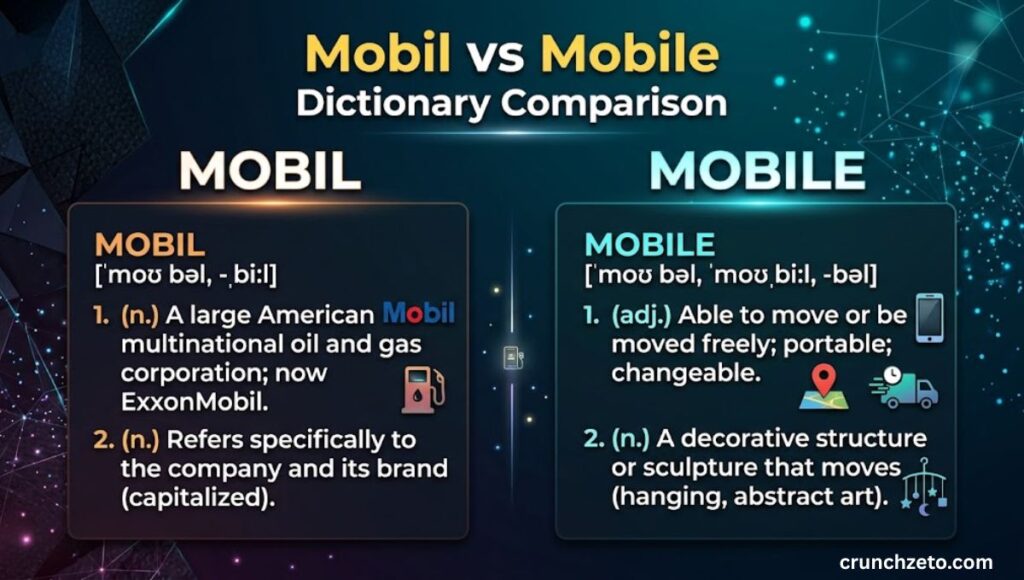
Dictionaries treat the two words differently. Mobile gets a full entry with several meanings. Mobil often appears only as a brand or not at all.
That tells you something. Standard English recognizes mobile. The other is a name. Check a trusted dictionary whenever you’re unsure about correct spelling.
| Feature | Mobile | Mobil |
| Type | Adjective and common noun | Proper noun (brand) |
| Meaning | Able to move; phone | Fuel and oil company |
| Capitalized? | Only at sentence start | Always |
| Ends with E? | Yes | No |
| Example | mobile phone | Mobil 1 oil |
Common Mobil vs Mobile Mistakes
A few errors show up again and again. Spotting them helps you fix them fast. Here’s a quick tour of the usual suspects.
Each one comes from the missing E.
Writing Mobil Phone
“Mobil phone” is wrong. The right form is mobile phone. This is the most common slip.
The mobil phone spelling mistake appears in texts, ads, and emails alike.
Writing Mobil App
Same problem here. It’s mobile app, not “mobil app.” The word describes the app, so it needs the adjective spelling.
Search for mobil app or mobile app, and the answer is always mobile.
Writing Mobil Number
The correct phrase is mobile number. Writing “mobil number” looks careless on forms.
If you’re asking mobil number or mobile number, pick the one with the E.
Lowercasing the Mobil Brand
When you mean the brand, don’t write “mobil” in lowercase. It’s a name. Keep the capital M.
Companies care about this. The Mobil trademark deserves proper handling.
Confusing Mobil With Mobile
The biggest mistake is mixing them up in meaning. Mobil is a company. Mobile is a general word.
If you’re not naming the brand, you almost surely want mobile.
Mobil vs Mobile Examples
Examples make rules stick. Here are sentences you can model. Read them aloud. They’ll feel natural fast.
We’ll start with correct ones.
Correct Mobile Examples
- She lost her mobile phone on the train.
- This mobile app saves me ten minutes a day.
- Please send your mobile number by noon.
- A mobile clinic visits the village every week.
- They bought a mobile home near the lake.
See the pattern? Each one deals with movement or portable tech.
Correct Mobil Examples
- He stopped at the Mobil station for gas.
- My mechanic recommends Mobil 1 motor oil.
- ExxonMobil is a giant in the energy world.
- That Mobil gas station has cheap coffee.
Here the word names a brand. The capital M gives it away.
Incorrect Examples
- ✗ I forgot my mobil phone at home.
- ✗ Download the mobil app today.
- ✗ I filled up at the mobile station. (when you mean the brand)
- ✗ Please add your mobil number.
Each mistake mixes the two words. Fix them by checking the meaning first.
How to Remember Mobil vs Mobile

Memory tricks save time. A tiny phrase can lock in the rule for good. You don’t need a long list.
Try these two simple hooks.
Mobile Ends With E
Think “mobile has an extra thing on the end, just like a phone has extras.” Or picture the E as a tiny phone antenna.
If the word describes movement or tech, add the E.
Mobil Has No Final E
Think “Mobil is short, like a logo.” Short name, short spelling. No E.
If it’s the brand on the sign, drop the E and use a capital M.
Quick Reference: Mobil vs Mobile
Bookmark this section. It gives you the whole lesson in a few lines. Use it when you’re in a rush.
- Mobile: adjective or noun, means movable, used for phones and tech.
- Mobil: proper noun, the oil and fuel brand, always capitalized.
- Phone, app, number, banking, home, clinic: all take mobile.
- Gas station, motor oil, Mobil 1: all take Mobil.
- Not sure? Choose mobile unless you mean the company.
Practice Session: Mobil vs Mobile
Time for a quick workout. Fill in each blank with Mobil or mobile. Cover the answers first. Be honest. No peeking.
Then check yourself below.
Fill in the Blanks
- I’ll call you on your ______ number.
- We stopped at the ______ station for fuel.
- This ______ app tracks my steps.
- He uses ______ 1 oil in his sports car.
- A ______ clinic visited the town today.
- Her ______ phone battery died.
Answers
- mobile
- Mobil
- mobile
- Mobil
- mobile
- mobile
How did you do? Five or six right means you’ve got it. Less than that? Reread the quick reference and try again.
Mobil vs Mobile in SEO and Online Searches
People search for both spellings online. Many type “mobil phone” by mistake. Search engines usually guess what they meant and show mobile results.
If you write web content, use mobile for tech topics. Use Mobil only for the brand. Clear spelling builds trust with readers and with search engines.
Mobil Around the World
In several languages, “mobil” is a real word. German speakers use it for mobile. Scandinavian languages use it too.
That explains why you might see it on foreign websites. In English writing, though, the E version wins every time.
Quick Tips for Writers and Students
Proofread slowly. Search your draft for “mobil” and check each hit. Ask yourself if it names the brand.
Set your spell checker to flag it. A small habit like this stops the mistake before it spreads.
FAQs About Mobil vs Mobile
Here are quick answers to the questions people ask most. Each one is short and clear. Skim the ones you need.
Which Is Correct, Mobil or Mobile?
Both can be correct, but in different places. Mobile is the general word. Mobil is the brand. Use mobile for phones, apps, and movement.
What Is the Meaning of Mobil?
Mobil is a brand name for fuel and lubricants. It’s owned by ExxonMobil. It isn’t a general English adjective.
What Does Mobile Mean in English?
Mobile means able to move or be moved. It also describes handheld tech like phones. It works as an adjective or a noun.
Are Mobile and Mobil the Same?
No. They look similar, but they’re not the same. One is a regular word. The other is a company name.
Is It a Mobil Phone or a Mobile Phone?
It’s a mobile phone. “Mobil phone” is a spelling mistake in English.
Is Mobil a Trademarked Word?
Yes. Mobil is a registered trademark linked to ExxonMobil. That’s why companies guard its use and spelling.
Is Mobil a Company?
Yes. It began as an American oil brand and is now part of ExxonMobil. It still sells fuel and oil under its own name.
Why Is Mobil Spelled Without an E?
It was a branding choice. A short name looked bold on signs. It also echoed the word “mobility” without copying the full word.
What Is Mobil Known For?
Mobil is known for gas stations and Mobil 1 synthetic oil. Its flying red horse logo, Pegasus, is also famous.
What Is the Difference Between Mobil and Mobile?
Mobil is a proper noun for a brand. Mobile is a common word for movement and phones. The final E marks the regular word.
Why Do People Confuse Mobil and Mobile?
They look and sound alike. Brand signs also reinforce the shorter spelling. Fast typing and autocorrect make slips more likely.
Is Mobile Always Spelled With an E?
In English, yes. The word mobile always ends in E. Only the brand name drops it.
What Is Another Word for Mobile?
Try movable, portable, transportable, or wireless depending on context. For phones, say cell phone or handset.
What Is the Original Meaning of Mobile?
The word comes from Latin “mobilis,” meaning movable. It passed through French into English and kept the idea of motion.
How Is Mobil Used in a Sentence?
“We bought oil at the Mobil station.” Or: “Mobil 1 protects your engine in cold weather.”
How Is Mobile Used in a Sentence?
“I’ll text your mobile tonight.” Or: “The mobile app makes ordering easy.”
Is Mobil a Valid Scrabble Word?
No, not in standard English Scrabble lists, because it’s a proper noun. Mobile is valid and scores well.
Conclusion
So, what’s the final word on Mobil vs Mobile? Use mobile for phones, apps, numbers, and anything that can move. Use Mobil only when you name the Mobil brand, its gas stations, or Mobil 1 oil. The brand always keeps its capital M and drops the final E.
Remember two simple tricks. Mobile ends with E, like the extras on your phone. Mobil is a short name on a sign. Check each word before you hit publish. A quick proofread stops the common spelling mistake. Keep this guide handy, and share it with a friend who keeps typing “mobil phone.”

Oliver Matthew Wilson is a passionate English language and grammar writer who enjoys making grammar, spelling, vocabulary, and writing concepts simple and easy to understand. With a focus on clear explanations and practical examples, Oliver Matthew Wilson creates helpful content for students, writers, and everyday English learners. His goal is to make learning English more enjoyable, useful, and accessible to everyone.
