


Dysphasia vs. dysphagia looks like a typo, but it is not. These two words differ by one letter, so many people mix them up. They also sound alike. Dysphasia is a language problem. Dysphagia is a swallowing problem. One affects speech and understanding. The other affects eating and drinking.
Both can follow a stroke, which adds to the confusion. A mix up in a medical note or an email can cause real trouble. This guide gives clear meanings, memory tricks, and examples so you can pick the right word every time.
What Is the Difference Between Dysphasia and Dysphagia?
Dysphasia is trouble with language. Dysphagia is trouble with swallowing. That is the whole difference in one line.
A person with dysphasia may struggle to find words, speak in full sentences, or understand what others say. A person with dysphagia may cough when they drink, feel food stuck in the throat, or take a long time to finish a meal.
Neither word is a wrong spelling of the other. Both are real medical terms. They simply describe different body systems.
What Does Dysphasia Mean?
Dysphasia is a language disorder. It happens when the brain has trouble using or understanding words. The mouth and throat work fine. The problem sits in the brain’s language areas.
Dysphasia can affect four skills:
- Speaking
- Understanding speech
- Reading
- Writing
Some people know what they want to say but cannot find the word. Others say words in the wrong order. Some hear speech clearly but cannot make sense of it.
Common causes include stroke, head injury, brain tumors, and some forms of dementia. The condition can be mild or serious. It does not mean a person has low intelligence. Their thinking is often intact. The language tools are what got damaged.
What Does Dysphagia Mean?
Dysphagia is a swallowing disorder. It means eating, drinking, or swallowing saliva takes extra effort or feels unsafe. The problem can start in the mouth, the throat, or the esophagus (the tube that carries food to the stomach).
Common signs include:
- Coughing or choking during meals
- A wet or gurgly voice after swallowing
- Food or pills that feel stuck
- Drooling
- Weight loss from eating less
- Repeated chest infections
Causes vary. Stroke, Parkinson’s disease, acid reflux, cancer treatment in the head or neck area, and aging can all play a part. Dysphagia matters because food or liquid can slip into the lungs. Doctors call this aspiration. It can lead to pneumonia.
Dysphasia vs. Dysphagia Comparison Table
This table shows the main points side by side.
| Term | Correct? | Meaning | Body System | Typical Signs |
| Dysphasia | Yes | Trouble with language | Brain (language centers) | Word finding problems, unclear sentences, trouble understanding |
| Dysphagia | Yes | Trouble with swallowing | Mouth, throat, esophagus | Coughing, choking, food sticking, drooling |
Both terms are correct. Use each one only for its own meaning. Never swap them.
Where Do the Words Dysphasia and Dysphagia Come From?
Both words come from Greek. They share the first part, dys. It means bad, hard, or difficult. You see it in other medical words too, like dyslexia.
The endings are different:
- Dysphasia uses a Greek root linked to speech. So it means “difficult speech” or “difficult language.”
- Dysphagia uses a Greek root linked to eating. So it means “difficult eating” or “difficult swallowing.”
The shared start explains why the words look alike. The different endings explain why the meanings split. Once you see the roots, the words stop feeling random.
How Do You Pronounce Dysphasia and Dysphagia?

American English speakers say these words in a similar way. The middle sound is what changes.
- Dysphasia: dis-FAY-zhuh (some say dis-FAY-zee-uh)
- Dysphagia: dis-FAY-juh (some say dis-FAY-jee-uh)
Listen to the middle. Dysphasia has a “zh” or “z” sound. Dysphagia has a “j” sound. That small sound is the difference you hear.
In fast speech, the words can blur together. This is a reason many doctors spell the word out in notes or say it with a clear pause. When clarity matters, say the meaning too. For example: “dysphagia, the swallowing problem.” Using the pair dysphasia vs. dysphagia in training notes can also help new staff keep them apart.
What Are the Grammar Forms of Each Word?
Both words are nouns. They name a condition. They are usually uncountable, so you do not say “a dysphasia” in everyday writing. You say “dysphasia” or “a case of dysphasia.”
Each word has an adjective form:
- Dysphasic describes a person or symptom linked to dysphasia.
- Dysphagic describes a person or symptom linked to dysphagia.
Example: “The dysphasic patient used short phrases.” Or: “The dysphagic patient needed thickened drinks.”
These adjectives sometimes become nouns in clinical talk, as in “a dysphagic.” Many writers avoid that. It can feel like it defines the person by the condition. A better choice is “a person with dysphagia.”
Neither word has a common verb or adverb form. Both are formal terms. You will see them mostly in medical, school, and health writing. Spelling is the same in American and British English. The difference is use, which the next paragraph explains.
In the US, doctors often use the word aphasia for most language disorders. In the UK, “dysphasia” is more common in everyday health talk. So you may see both across sources. They overlap a lot.
How Can You Remember Dysphasia vs. Dysphagia?
Use letters as clues. These tricks are quick and simple.
Trick one: the S and the G.
- Dysphasia has an S. Think S for speech.
- Dysphagia has a G. Think G for gulp.
Trick two: the sound.
- Dysphagia has a hard “j” sound, like “gulp” and “gag.”
Trick three: the body part.
- Language lives in the brain. Dysphasia is a brain language problem.
- Swallowing happens in the throat. Dysphagia is a throat problem.
Pick one trick and stick with it. The S for speech and G for gulp pair works for most people.
Dysphasia vs. Dysphagia in Real Sentences
Here are natural examples from different settings.
Everyday conversation
- “After his stroke, Dad had dysphasia. He knew what he wanted to say, but the words got stuck.”
- “Grandma has dysphagia, so she eats soft foods.”
Workplace email
- “Please note that the resident has dysphagia. Do not serve regular drinks without checking the care plan.”
Academic writing
- “Dysphasia can follow damage to the left side of the brain.”
Casual writing
- “I could not tell if the doctor said dysphasia or dysphagia. I had to ask her to spell it.”
Why these work: Each sentence pairs the word with a clue. “Words got stuck” points to language. “Soft foods” and “drinks” point to swallowing. When you write for a general audience, add a clue like this. It saves the reader a search.
What Mistakes Do People Make With These Words?
Mistakes here are normal. The words look almost the same. Here are the most common ones.
Mistake 1: Using dysphasia for swallowing
Incorrect: “He has dysphasia, so he chokes on water.”
Correct: “He has dysphagia, so he chokes on water.”
Choking on water is a swallowing issue. Use dysphagia.
Mistake 2: Using dysphagia for speech trouble
Incorrect: “Her dysphagia made it hard to find words.”
Correct: “Her dysphasia made it hard to find words.”
Finding words is a language skill. Use dysphasia.
Mistake 3: Calling slurred speech dysphasia
Incorrect: “His slurred speech is dysphasia.”
Correct: “His slurred speech may be dysarthria.”
Slurred speech often comes from weak mouth muscles. Dysphasia is about language, not muscle control.
Mistake 4: Treating them as spelling variants
Incorrect: “Dysphasia is just another way to spell dysphagia.”
Correct: “Dysphasia and dysphagia are two separate words.”
They are not variants. Each has its own meaning.
If you are ever unsure, check a medical dictionary or ask a health professional. When the pair dysphasia vs. dysphagia shows up in a document, double check each use.
What Related Terms Should You Know?
A few nearby words help you sort the whole topic.
- Aphasia: A loss or weakness in language ability. It is the more common term in the US. Some sources say aphasia means a severe loss and dysphasia means a milder one. In practice, many people use them the same way.
- Dysarthria: Slurred or slow speech caused by weak muscles in the mouth and throat. The words are formed poorly, but language itself is fine.
- Dysphonia: A voice problem, such as hoarseness. It affects sound, not language.
- Odynophagia: Pain when swallowing. It is different from dysphagia, though they can occur together.
- Speech disorder vs. language disorder: A speech disorder affects how sounds are made. A language disorder affects how words and ideas are used.
Knowing these terms makes it easier to read medical notes. It also helps you ask better questions at a doctor’s visit.
Who Treats Dysphasia and Dysphagia?
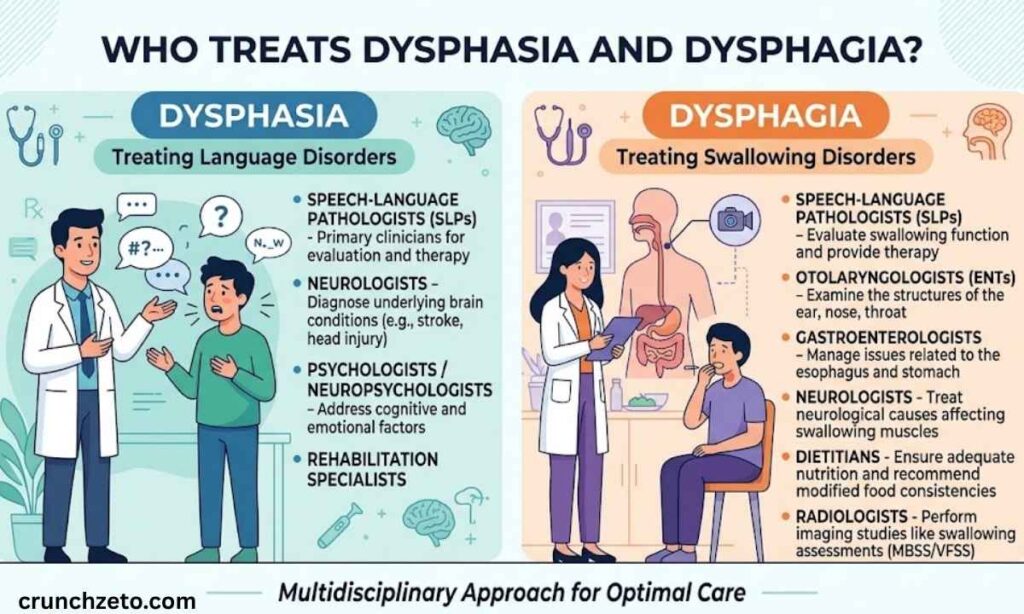
Both conditions are often handled by a speech-language pathologist, also called an SLP. This surprises many people. Swallowing is part of their training, not just speech.
For dysphasia, an SLP may use language exercises, picture cards, and communication tools. Family members often take part in practice.
For dysphagia, an SLP may test how a person swallows. They might use a special swallow study. Then they suggest exercises, safer eating positions, or changes in food texture. A doctor may also check for the cause, such as reflux or a nerve problem.
This article is for learning, not medical advice. If you or someone you know has trouble swallowing or speaking, see a doctor. Choking and breathing problems need quick care. Remember that the pair dysphasia vs. dysphagia can look similar on paper but needs very different care.
Frequently Asked Questions
Is dysphasia the same as dysphagia?
No. Dysphasia affects language. Dysphagia affects swallowing. They are different conditions with different causes and treatments.
What is the quick difference in dysphasia vs. dysphagia?
Think S for speech and G for gulp. Dysphasia is about speech and language. Dysphagia is about swallowing food and drink.
Can a person have both conditions?
Yes. A stroke can harm both language areas and swallowing control. A person may have one, both, or neither. A care team can test each skill separately.
Is dysphasia the same as aphasia?
They are closely related. Aphasia is the more common term in the US. Some experts use dysphasia for milder cases and aphasia for severe ones. Many doctors use them almost the same way.
How do I use dysphagia in a sentence?
“The nurse checked that the patient with dysphagia could swallow safely before the meal.”
Final Takeaway on Dysphasia vs. Dysphagia
Both words are correct, but they are not interchangeable. Dysphasia is about language. Dysphagia is about swallowing. Keep this simple rule in mind: S is for speech, G is for gulp.
Use that rule before you write or say either word. It will keep your notes, emails, and essays clear. Understanding dysphasia vs. dysphagia takes only a moment, and it prevents a mistake that can matter in health settings.

Oliver Matthew Wilson is a passionate English language and grammar writer who enjoys making grammar, spelling, vocabulary, and writing concepts simple and easy to understand. With a focus on clear explanations and practical examples, Oliver Matthew Wilson creates helpful content for students, writers, and everyday English learners. His goal is to make learning English more enjoyable, useful, and accessible to everyone.
