


You feel dizzy and lost, and you want the right word. Should you write disoriented or disorientated? The confusion is common because both words look right and mean the same thing. Here is the quick answer for disoriented vs disorientated: both are correct, but disoriented is the standard choice in US English. Disorientated is mostly British. This guide covers meaning, history, pronunciation, and examples. By the end, you will pick the right word every time.
Which Is Correct: Disoriented or Disorientated?
Both words are correct. Disoriented is the preferred form in American English, and disorientated is more common in British English.
Neither word is a spelling mistake. They are two forms of the same adjective. They share the same meaning, and they come from two matching verbs: disorient and disorientate.
If you write for a US audience, choose disoriented. It is shorter, cleaner, and what most American readers expect. Disorientated is not wrong in the US, but it can look odd to some readers.
What Does Disoriented Mean?
Disoriented describes someone who is confused about where they are, what time it is, or what is going on. It can also mean the person has lost their sense of direction.
You can feel disoriented in many situations:
- You wake up in a hotel room and forget which city you are in.
- You walk out of a movie theater into bright sunlight.
- You get off a long flight and cannot tell if it is morning or night.
Doctors also use the word. A person who is disoriented after a head injury may not know their name or the date. In that case, the word describes a medical sign, so it is more serious than simple confusion.
What Does Disorientated Mean?
Disorientated means exactly the same thing. It describes a person who is confused, lost, or unsure of their surroundings.
The only real difference is the form. Disorientated has one extra syllable, and it follows the verb disorientate. You will see it often in British newspapers, books, and everyday speech. Australians, New Zealanders, and Indians also use it.
So if you read “She felt disorientated after the crash” in a UK article, nothing is wrong. The writer simply used the British pattern.
Disoriented vs Disorientated: Is There Any Difference in Meaning?
No. In disoriented vs disorientated, the meaning stays the same. Both words describe confusion about place, time, direction, or identity. Both can be used for physical or mental states.
The real difference is where the word is popular. Think of it like “color” and “colour.” The word is the same, but the spelling and style change by region.
Some readers feel that disorientated sounds a bit longer and more formal. Others think disoriented sounds sharper. These feelings are about style, not rules. No dictionary treats them as different words.
Quick Comparison Table
Here is a short table to compare the two forms side by side.
| Term | Correct? | Meaning | Best Use |
| Disoriented | Yes | Confused about place, time, or direction | US English and most global writing |
| Disorientated | Yes | Confused about place, time, or direction | UK, Australian, and Indian English |
| Disorient | Yes | To make someone confused or lost | Verb, mainly US |
| Disorientate | Yes | To make someone confused or lost | Verb, mainly UK |
| Disorientation | Yes | The state of being confused or lost | Noun, used everywhere |
Notice that the noun is the same in both varieties. Only the verb and adjective forms change.
Where Do These Words Come From?
The root of both words is “orient.” In old English and French usage, orient meant the east. The word comes from a Latin term linked to rising, as in the rising sun. Long ago, many maps and churches were arranged to face east. To orient yourself meant to find the east, and then to find your way.
Add the prefix “dis,” which means “away from” or “not,” and you get disorient. It literally means to turn someone away from their proper direction. English borrowed the idea from French, which had a similar verb.
Disorientate came later. Many language sources describe it as a longer form built from the noun disorientation. The same pattern gave British English the verb “orientate,” which Americans usually shorten to “orient.” That is why the two regions ended up with different verb forms.
How Do You Pronounce Disoriented and Disorientated?
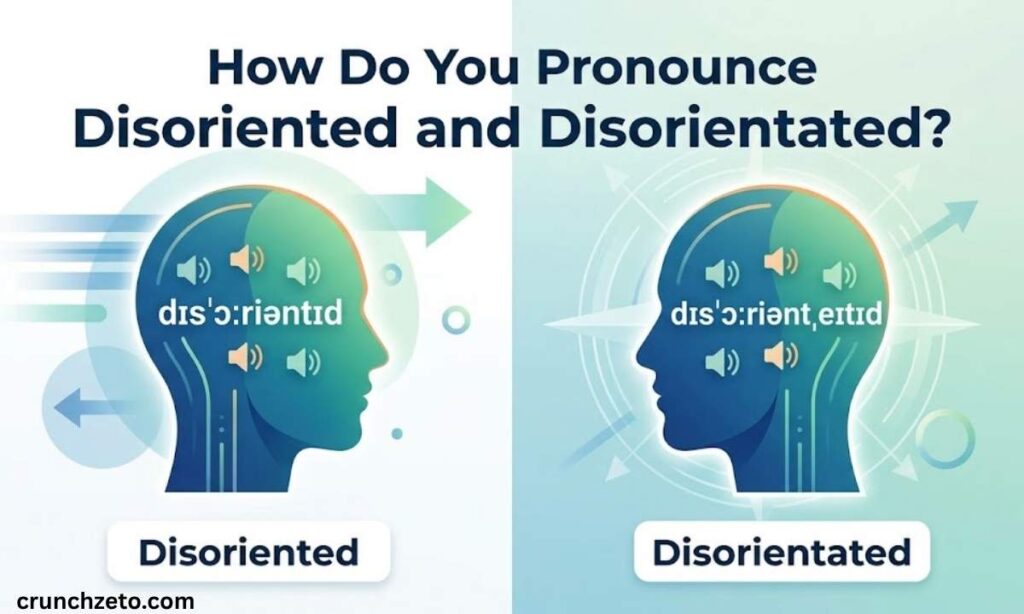
Both words start the same way. Only the ending changes.
- Disoriented: dis-OR-ee-en-tid (five syllables)
- Disorientated: dis-OR-ee-en-tay-tid (six syllables)
The stress falls on the second syllable in both. Say “OR” a little louder than the others.
Many speakers shorten the middle sound, so “ee-en” can blend into one soft sound. That is normal in fast speech. If you are learning English, say the words slowly first, then speed up.
Disoriented vs Disorientated in American and British English
Here is how the two forms are used around the world.
In the United States, disoriented is the clear favorite. American style guides and newsrooms use it, and spell checkers often accept it without a warning. Some US spell checkers also underline disorientated or treat it as less common.
In the United Kingdom, disorientated is very common. You will see it in everyday writing. Disoriented is also used there, so British readers will not be confused by it.
Many global publishers choose disoriented because it is shorter and works for both audiences. If your readers come from many countries, this is a safe pick.
Related Words: Verbs, Nouns, Synonyms, and Opposites
Let’s look at the full word family. Learning these forms helps you avoid mix-ups.
Verb forms
- Disorient (US): “The loud noise can disorient the dog.”
- Disorientate (UK): “The loud noise can disorientate the dog.”
Noun form
- Disorientation: “The patient showed signs of disorientation.”
Adjective forms
- Disoriented or disorientated
- Disorienting (describes the thing that causes the feeling): “The maze was disorienting.”
Synonyms
- Confused
- Lost
- Bewildered
- Dazed
- Muddled
- Befuddled
Opposites
- Oriented
- Grounded
- Aware
- Clear-headed
Notice the difference between “disoriented” and “disorienting.” A person is disoriented. A thing, place, or event is disorienting.
How to Use Each Word in a Sentence
Real examples make the difference clear. Here are sentences for different settings.
Everyday conversation
- “I felt disoriented when I woke up from my nap.”
- “After the fog rolled in, we were completely disorientated.”
Workplace and email
- “The new software left several employees disoriented during the first week.”
- “Please send a clear guide so new hires do not feel disorientated on day one.”
Academic writing
- “Participants in the study reported feeling disoriented after sleep loss.”
Formal or medical writing
- “The patient was alert but disoriented to time and place.”
That last sentence is correct because medical writers often use “disoriented to” before time, place, or person. It tells the reader exactly what the patient could not recall.
Business writing
- “Frequent changes to the plan left the team disoriented.”
All of these sentences sound natural. The first of each pair uses US style, and the second leans British, but each one would be understood anywhere.
Common Mistakes With Disoriented and Disorientated
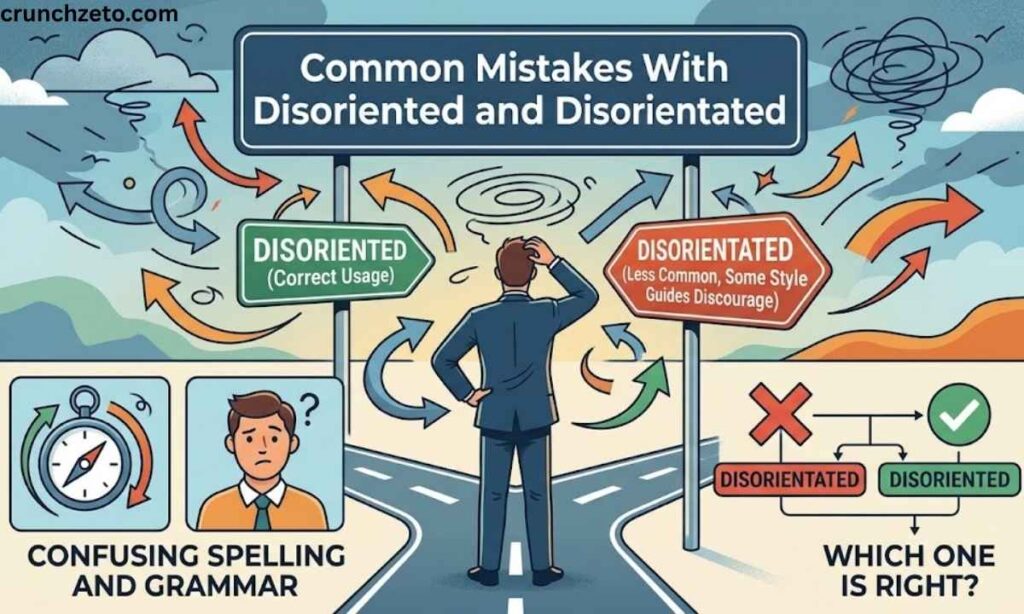
Mistakes happen to everyone. Here are the most common ones, with simple fixes.
Mistake 1: Calling disorientated a typo
Incorrect: “Disorientated is not a real word.”
Correct: “Disorientated is a real word, but it is more common in British English.”
Many American readers have never seen it, so it feels wrong. It is not.
Mistake 2: Mixing the verb and the adjective
Incorrect: “The storm disoriented me, so I felt disorientate.”
Correct: “The storm disoriented me, so I felt disoriented.”
“Disorientate” is a verb. After “felt,” you need an adjective.
Mistake 3: Using both forms in one article
Incorrect: “He was disoriented, and she was disorientated.”
Correct: “He was disoriented, and she was disoriented too.”
Pick one form and stay with it. Switching can make your writing look careless.
Mistake 4: Confusing disoriented and disorienting
Incorrect: “The crowded station was very disoriented.”
Correct: “The crowded station was very disorienting.”
The station causes the feeling, so it is disorienting. A person who feels the effect is disoriented.
Mistake 5: Writing “dis-oriented” with a hyphen
Incorrect: “She felt dis-oriented.”
Correct: “She felt disoriented.”
No hyphen is needed in standard writing.
Which Word Should You Choose for Your Writing?
Use this simple rule. Choose based on your readers, not on which word seems fancier.
- Writing for a US audience? Use disoriented.
- Writing for a UK, Australian, or Indian audience? Use disorientated, or use disoriented if your style guide allows it.
- Writing for a global audience? Use disoriented. It is shorter and understood everywhere.
- Writing for a company or school with a style guide? Follow the guide.
When you decide on disoriented vs disorientated, consistency matters most. Pick a form and use it throughout the whole piece. Also keep your verb in line: if you use disoriented, use the verb disorient. If you use disorientated, use disorientate.
Frequently Asked Questions
Is disorientated a real word?
Yes. Disorientated is a real word and is listed in major dictionaries. It is the common British form of the adjective. It means the same thing as disoriented.
Which is more common, disoriented or disorientated?
Overall, disoriented is more common, especially in American English. In British English, disorientated is also very common. Many writers there use both.
Can I use disoriented vs disorientated in the same article?
You should not mix them. Choose one form and keep it throughout. If you are unsure, pick disoriented. It works for most readers in the US and around the world.
What is the verb form of disoriented?
The verb is “disorient” in US English. In British English, it is “disorientate.” Example: “Bright lights can disorient a driver.”
Is disorientation the same in the US and the UK?
Yes. Disorientation is the noun in both varieties. It means the state of being confused or lost. Example: “The sudden move caused some disorientation.”
The Simple Takeaway
The question of disoriented vs disorientated has an easy answer. Both are correct, and they mean the same thing. The only difference is region. Americans prefer disoriented, and the British often prefer disorientated.
Remember this one line: when in doubt, use disoriented. It is shorter, widely accepted, and safe for almost any reader.

Oliver Matthew Wilson is a passionate English language and grammar writer who enjoys making grammar, spelling, vocabulary, and writing concepts simple and easy to understand. With a focus on clear explanations and practical examples, Oliver Matthew Wilson creates helpful content for students, writers, and everyday English learners. His goal is to make learning English more enjoyable, useful, and accessible to everyone.
