


Is it curb or kerb? Many writers freeze when they see both spellings. They look alike. They sound alike. Some people even think one is a typo.
Neither one is wrong. The difference depends on where you live and what you mean. In American English, the edge of a sidewalk is a curb. In British English, it is a kerb. When you mean “to hold back,” almost everyone writes curb. This guide shows you how to choose with confidence.
Curb or Kerb: What Is the Short Answer?
Curb is the American spelling for the edge of a street and for the verb “to limit.” Kerb is the British spelling for the street edge only.
Here is the rule in one line. Use “curb” for US readers. Use “kerb” for UK readers, but only when you mean the stone edge by the road. If you mean “control or restrain,” write “curb” everywhere.
What Does Curb Mean?
Curb has two main jobs in English. It works as a noun and as a verb.
As a noun, a curb is the raised edge where a sidewalk meets the street. It keeps cars and water away from the walkway. You step up onto it and down off it.
As a verb, to curb something means to hold it back or keep it under control. People curb spending, curb bad habits, and curb their appetite.
Here are two quick examples:
- The delivery truck stopped at the curb.
- The school wants to curb noise in the hallways.
What Does Kerb Mean?
Kerb means the edge of a pavement beside a road. It is the same object that Americans call a curb. The word has one job only. It names the raised stone or concrete edge.
You will see it in British and Irish writing. Australians and New Zealanders use it too. Canadian English usually follows the American spelling here.
Here is an example:
- She waited on the kerb until the bus arrived.
Notice that “kerb” is not a verb in standard English. A British writer who wants a verb writes “curb.”
Curb or Kerb: Side-by-Side Comparison
This table shows the difference at a glance.
| Term | Correct? | Meaning | Where to use it |
| Curb (noun) | Yes | Edge of a sidewalk or road | US and Canada |
| Curb (verb) | Yes | To restrain or limit | Everywhere |
| Kerb (noun) | Yes | Edge of a pavement or road | UK, Ireland, Australia, New Zealand |
| Kerb (verb) | No | Not used as a verb | Nowhere |
Look at the last row. That one catches many people. If you are limiting something, the word is always “curb.”
Why Do Americans and Britons Spell It Differently?
Both words come from the same old root. They trace back to an Old French word meaning “bent” or “curved.” That root goes back even further to Latin.
For a long time, writers used both spellings for every meaning. Over the centuries, the two kinds of English drifted apart. American English kept “curb” for everything. British English began using “kerb” for the street edge. It kept “curb” for the verb.
This is a common pattern in English. Many words split along the Atlantic. Think of “tire” and “tyre,” or “plow” and “plough.” The kerb story follows the same path.
How Do You Pronounce Curb and Kerb?
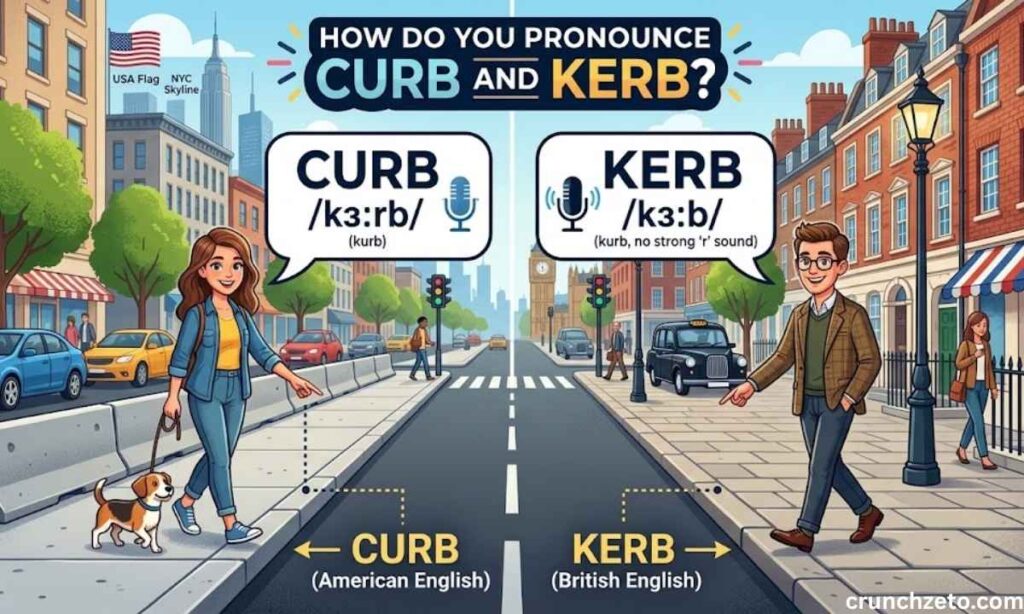
Both words sound the same. Say “kurb.” The vowel sounds like the “ur” in “burn.” In American English, you hear a clear “r” sound. In British English, the “r” is softer.
The two spellings are homophones. That means they sound alike but are spelled differently. This is why people mix them up when they write. Your ear cannot help you here. You have to rely on your audience.
Is Curb a Noun or a Verb? Grammar Made Simple
Let’s break down the grammar. It is easier than it looks.
Noun forms:
- Singular: curb (or kerb)
- Plural: curbs (or kerbs)
Verb forms of curb:
- Base form: curb
- Past tense: curbed
- Present participle: curbing
- Third person: curbs
Here is how the verb works in a sentence:
- The city curbed water use during the drought.
- We are curbing our spending this month.
- This rule curbs misuse of the system.
The verb is regular. You add “-ed” for the past tense and “-ing” for the continuous form. There is no irregular twist to memorize.
Curb also acts as part of a compound noun. Think of “curbside” or “curb cut.” You can read more on those below.
Curb or Kerb in Real Sentences
Examples help the rule stick. Here are natural sentences for different settings.
Everyday conversation (US):
- Don’t park on the curb. You will get a ticket.
- My kid tripped over the curb and scraped his knee.
Workplace (US):
- We need to curb overtime costs this quarter.
- The new policy should curb late deliveries.
Email (US):
- Please curb the use of personal devices in meetings.
Everyday conversation (UK):
- She tripped over the kerb outside the station.
- The council painted the kerb yellow.
Academic writing:
- Governments often try to curb inflation with higher interest rates.
Why is that last sentence correct? Because “curb” here means “to limit.” It is a verb. So the spelling is “curb” in every English variety.
What Are Common Phrases and Related Words With Curb?
Curb shows up in many phrases. Most of these use the American spelling.
- Curb appeal: how attractive a home looks from the street. Real estate agents love this phrase.
- Curbside pickup: picking up an order at the street edge. The British version is “kerbside collection.”
- Curb cut: a small ramp built into a curb for wheelchairs and strollers. The British phrase is “dropped kerb.”
- Curb weight: the weight of a car without passengers or cargo. In the UK, you see “kerb weight.”
- Curbstone: a stone along the street edge. The British form is “kerbstone.”
- Kicked to the curb: dropped or rejected. This is informal and American.
- Curb your enthusiasm: calm down a little.
Notice the pattern. The word for the street edge changes by region. The verb stays “curb.”
What Are the Most Common Curb and Kerb Mistakes?
These slips are normal. Even good writers make them. Here are the main ones.
Mistake 1: Using “kerb” as a verb.
Incorrect: The company wants to kerb its costs.
Correct: The company wants to curb its costs.
The verb always uses “curb.” Kerb names only the street edge.
Mistake 2: Mixing spellings in one document.
Incorrect: We will curb spending, and then repaint the kerb.
Correct (US): We will curb spending, and then repaint the curb.
Correct (UK): We will curb spending, and then repaint the kerb.
Pick one variety of English and stay with it. Consistency makes writing look polished.
Mistake 3: Writing “kurb.”
Incorrect: Park next to the kurb.
Correct: Park next to the curb.
“Kurb” is not a standard spelling. It comes from sounding the word out.
Mistake 4: Confusing curb with “curve.”
Incorrect: The car hit the curve and stopped.
Correct: The car hit the curb and stopped.
A curve is a bend in a road. A curb is the edge. The words look close, which is why they get swapped.
Which Spelling Should You Use for Your Audience?
Choose by reader, not by habit. This is the simplest way to decide between curb or kerb.
Write “curb” if your readers are in the United States or Canada. Write “kerb” for the street edge if your readers are in the UK, Ireland, Australia, or New Zealand. Write “curb” for the verb for everyone.
What if your audience is worldwide? Pick one style and use it all the way through. Most global websites follow the spelling of their main market. If your blog targets Americans, go with curb.
Spell checkers can help too. Set your editor to US or UK English. It will flag the spelling that does not match.
A quick memory trick may help. Think of the “K” in kerb as a “King’s road” in Britain. Think of the “C” in curb as “Country” for America, the “C” in “Cars” parking by the street. It is silly, but silly tricks stick.
Curb or Kerb: Frequently Asked Questions
Is it curb or kerb on a road sign?
It depends on the country. US signs say “curb.” UK signs say “kerb.” The meaning is the same.
Is kerb a real word?
Yes. Kerb is a real word. It is the standard British spelling for the edge of a pavement.
Can I use curb in British English?
Yes, for the verb. British writers use “curb” for “to restrain.” They use “kerb” for the street edge.
What does “curb” mean in a sentence?
It means to limit or hold back. For example: “Drinking water can curb your hunger.” It can also name the street edge: “The bike leaned against the curb.”
Is “kerb” ever a verb?
No. Standard English does not use kerb as a verb. Use “curb” instead.
Curb or Kerb: Your One-Line Takeaway
The answer is simple. Use curb in American English, and use kerb only for the British street edge. For the verb “to limit,” always write curb.
Before you publish, check your audience once. Then keep your spelling the same from start to finish. That one habit will keep you safe.

Oliver Matthew Wilson is a passionate English language and grammar writer who enjoys making grammar, spelling, vocabulary, and writing concepts simple and easy to understand. With a focus on clear explanations and practical examples, Oliver Matthew Wilson creates helpful content for students, writers, and everyday English learners. His goal is to make learning English more enjoyable, useful, and accessible to everyone.
