


Ever frozen before typing a sentence? Should it be “I run yesterday” or “I ran yesterday”? You are not alone. Run vs ran confuses many people because the two words look and sound alike. English verbs also break the usual rules. Here is the quick fix. Use “run” for the present. Use “ran” for the simple past. Today I run. Yesterday I ran. This guide shows you how it works, with easy examples you can copy.
What Is the Difference Between Run and Ran?
Run is the present tense. Ran is the simple past tense. That is the short answer.
Use “run” when something happens now, happens often, or will happen soon. Use “ran” when something already happened and is over.
- Present: I run before work.
- Past: I ran before work yesterday.
The word “run” has one more job. It is also the past participle, which you use after helper words like “have.” We will cover that soon.
For now, remember this: a finished action with no helper word needs “ran.”
What Does “Run” Mean?
“Run” is a verb. Its main meaning is to move on foot at a fast pace. But the word does much more than that. It can also mean:
- To operate something: “Can you run the printer test?”
- To manage something: “She runs a small bakery.”
- To flow: “Water runs down the hill.”
- To continue for a time: “The show runs for two hours.”
- To compete for a job or office: “He will run for mayor.”
“Run” can be a noun too. You can go for a run. A baseball player can score a run.
As a present tense verb, “run” goes with I, you, we, and they. With he, she, or it, add an s: “He runs every day.”
What Does “Ran” Mean?
“Ran” is the simple past tense of “run.” It tells the reader that the action is finished.
It keeps every meaning of “run.” Only the time changes.
- She ran to the bus stop.
- The meeting ran long.
- Water ran through the old pipe.
- He ran for mayor last year.
Here is the good news. “Ran” never changes for different subjects. I ran. You ran. She ran. They ran. It is the same word every time.
“Ran” works only as a verb. It is never a noun.
Run vs Ran at a Glance: Comparison Table
This table shows every common form in one place.
| Term | Correct? | Meaning | Use |
| Run | Yes | Present tense, base form, and past participle | I run daily. I have run twice today. |
| Ran | Yes | Simple past tense | I ran yesterday. |
| Runs | Yes | Present tense for he, she, it | She runs fast. |
| Running | Yes | Present participle or gerund | He is running. Running is fun. |
| Runned | No | Not a standard English word | Use “ran” instead. |
Look at the first row. “Run” appears in two roles. That double job is where most of the trouble starts.
What Are the Verb Forms of Run?
“Run” is an irregular verb. Regular verbs add “ed” to show the past. Walk becomes walked. Jump becomes jumped. “Run” does not follow that rule. It changes its vowel instead.
Here are all five forms:
- Base form: run
- Third person singular: runs
- Simple past: ran
- Past participle: run
- Present participle: running
Notice that the base form and the past participle look the same. That is why many learners mix up run vs ran. They see “run” in two places and assume it can show the past.
You may already know a verb with the same pattern. Come, came, come works the same way. So does become, became, become.
Some verbs use three different words. Begin, began, begun is one example. “Run” only needs two.
Where Do “Run” and “Ran” Come From?
“Run” is a very old English word. In Old English, verbs such as rinnan and iernan meant to run or to flow. Related words also appeared in other Germanic languages, including Old Norse.
Over many years, the sounds and spellings shifted. The vowel change from “run” to “ran” is part of an ancient pattern. Linguists call verbs like this strong verbs. They change the vowel inside the word instead of adding “ed.” Sing, sang and ring, rang follow a similar path.
Experts do not trace every step with full certainty. So the safest statement is this: “ran” is not a modern shortcut. It is a very old form.
American and British English use the same forms here. There is no spelling or tense difference.
You may hear some regional dialects use “run” for the past, as in “He run home.” That is common in speech in some places. In standard writing, use “ran.”
How Do You Pronounce Run and Ran?
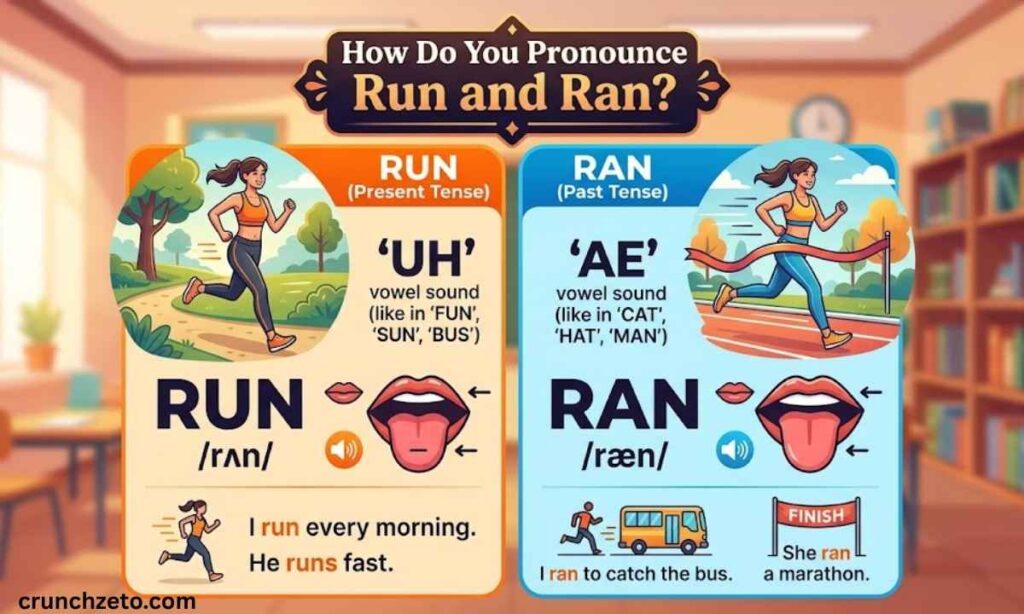
Both words have one syllable. Only the vowel sound changes.
- Run sounds like “ruhn.” It rhymes with fun, sun, and gun.
- Ran sounds like “rann.” It rhymes with can, plan, and man.
Here is a quick drill. Say “fun” and then “fan.” Now say “run” and then “ran.” You can hear the same small shift.
Clear pronunciation helps in speech. But the main job of the vowel is to tell your listener when the action happened.
How Do You Use Run and Ran in Real Sentences?
Seeing the words in different settings makes the rule stick. Here is how run vs ran works in real life.
Everyday conversation
- I run three times a week.
- We ran out of milk this morning.
Workplace communication
- Our team runs a sales report every Monday.
- The server ran a backup overnight.
Emails
- I ran the numbers again and found a small error.
- Please run the updated file and let me know what you see.
Academic writing
- The researchers ran the test three times.
- Students run the experiment twice a week.
Formal writing
- The agency ran the program for ten years.
- The committee runs the event each fall.
Casual writing
- I ran into Jake at the gym.
- We always run late on Fridays.
Let’s check two of these. “I ran the numbers again” is correct because the action is finished. “I ran into Jake” is correct too. “Ran into” means met by chance, and it already happened.
Have Run or Have Ran? Using the Past Participle
This is the trickiest part of run vs ran. After the helper words have, has, and had, you need the past participle. For “run,” that form is “run.”
- I have run this route many times.
- She has run two marathons.
- They had run out of time before lunch.
So “have ran” is not standard English. It is one of the most common slips, and it is easy to fix.
The same rule applies in passive sentences:
- The race was run in the rain.
- The program is run by volunteers.
Here is a simple test. If you see “have,” “has,” or “had” right before the verb, write “run.” If there is no helper word and the action is over, write “ran.”
Common Run vs Ran Mistakes (and Easy Fixes)
Everyone makes these mistakes at some point. They are a normal part of learning English. Here are the five most common ones.
Mistake 1: Using “run” for a finished action
Incorrect: Yesterday, I run five miles.
Correct: Yesterday, I ran five miles.
The word “yesterday” signals the past. Past time needs “ran.”
Mistake 2: Using “ran” after “have”
Incorrect: I have ran this race before.
Correct: I have run this race before.
Helper words like “have” call for the past participle, which is “run.”
Mistake 3: Adding “ed” to “run”
Incorrect: She runned to the store.
Correct: She ran to the store.
“Run” is irregular. It does not take “ed.”
Mistake 4: Using “ran” after “did”
Incorrect: Did you ran this morning?
Correct: Did you run this morning?
After “did,” the main verb goes back to its base form. The word “did” already shows the past.
Mistake 5: Forgetting the “s” with he, she, or it
Incorrect: He run every day.
Correct: He runs every day.
In the present tense, he, she, and it need the “s.”
What Other Meanings and Phrases Use Run and Ran?
“Run” shows up in many common phrases. Each one changes to “ran” in the simple past.
- Run out of: “The store ran out of bread.”
- Run into: “I ran into an old friend.”
- Run away: “The dog ran away last night.”
- Run down: “The battery ran down quickly.”
- Run late: “The train ran late again.”
- Run a test: “The lab ran a test on the sample.”
Some related words are built from “run” too. A runner is a person who runs. A runway is a strip where planes take off. A runny nose drips. The word running can be a verb or a noun: “Running is great exercise.”
If you need other words for the same action, try jog, sprint, dash, or race. Each one has its own feel. “Sprint” is faster than “jog,” for example. For the opposite action, “walk” is the closest match.
How Can You Remember Which One to Use?
Use a simple time check. Ask yourself three quick questions.
- Is the action finished, with no helper word? Use “ran.”
- Is it happening now, happening often, or coming soon? Use “run” or “runs.”
- Is there a “have,” “has,” or “had” before it? Use “run.”
Words like “will,” “can,” “should,” and “must” also take “run.” For example: “I will run tomorrow.”
The word “ran” has an “a,” just like “ago.” Think of “ran” as the “ago” word. If the action happened a while ago, “ran” is probably right.
When you are unsure, try swapping in a verb you know well. Say “walked” or “came.” If “walked” fits the sentence, you need “ran.” If “walk” fits, you need “run.”
Quick Answers About Run and Ran
Is it “I run” or “I ran”?
Both are correct. “I run” is present tense. “I ran” is past tense. Use the one that matches the time of your action.
Is “have ran” correct?
No. The correct form is “have run.” Use “run” after have, has, and had.
How do I choose between run vs ran in a sentence?
Look at the time. If the action is finished and no helper word comes before it, use “ran.” If the action is happening now, happens often, or follows “have,” “will,” or “can,” use “run.”
Is “runned” a word?
No. It is not standard English. The past tense of “run” is “ran.”
The Simple Takeaway
Run vs ran comes down to time. “Run” is for now, for habits, and for use after helper words. “Ran” is for something that already ended.
Remember one line: today I run, yesterday I ran, and I have run many times. Say it out loud a few times. Soon you will pick the right word without thinking.

Oliver Matthew Wilson is a passionate English language and grammar writer who enjoys making grammar, spelling, vocabulary, and writing concepts simple and easy to understand. With a focus on clear explanations and practical examples, Oliver Matthew Wilson creates helpful content for students, writers, and everyday English learners. His goal is to make learning English more enjoyable, useful, and accessible to everyone.
