


Have you ever stopped and wondered how to spell this word? You’re not alone. The writing vs writting mix-up trips up many people every day. The correct spelling is writing, with one T. Writting is a spelling error and isn’t a real word.
Why does this happen? It comes down to the silent e rule. When you add ing to the base verb write, you drop the e. The T stays single. Many learners double it by habit, because words like sitting follow the consonant doubling rule. In this guide, you’ll learn simple spelling rules, clear writing examples, and a quick memory trick. You’ll also see how writing differs from written. By the end, you’ll spell it right every time.
Quick Answer: Writing or Writting?
Use writing. It has one T in the middle. That’s the only correct spelling in standard English.
Writting is not a word. No dictionary lists it. If you see it, it’s a typo or a spelling mistake.
Here’s a quick way to check. Take the base verb “write.” Drop the silent e. Add “ing.” You get writing.
What Is the Correct Spelling: Writing or Writting?
The writing correct spelling is W-R-I-T-I-N-G. Count the letters. There are seven. Only one T sits in the middle.
People often add a second T by habit. They see words like “sitting” and “getting.” Those words do have double letters. So the brain copies the pattern.
Why Is It Writing and Not Writting?
Because “write” ends in a silent e. That e must go before you add “ing.” Once it’s gone, the T stays single.
Think of it like packing a bag. The e is extra weight. You drop it, and the word travels light.
Is Writing One T or Two?
One T. Just one. Say it with me: writing has one T.
Here’s the twist. The word sounds like it has a “tt” sound. But sound and spelling don’t always match in English. That’s where spelling confusion begins.
Read More: Tweek vs Tweak: Difference and Correct Usage
How to Spell Writing Correctly in English
Learning how to spell writing is easy once you know the steps. You only need to follow one small rule. It works for many other words too.
Here’s the process:
- Start with the base verb: write
- Remove the silent e: writ
- Add ing: writing
That’s it. Three steps. No extra T needed.
Write → Writing: The Spelling Rule
The write to writing change follows a clear pattern. When a verb ends in a silent e, you drop the e first. Then you add “ing.”
You can see this rule in many verbs. Make becomes making. Bake becomes baking. Write becomes writing. The verb transformation is the same each time.
Why Is Writing Spelled With One T?
The reason comes down to vowel sounds. English uses spelling to show if a vowel is long or short. A single consonant often signals a long vowel. A double consonant often signals a short one.
In “writing,” the “i” is a long vowel sound. It sounds like “eye.” So the T stays single.
Silent E Removal Rule
The silent e rule has a job. It makes the vowel before it say its name. In “write,” the silent e makes the “i” long.
When you add “ing,” the silent e dropping rule applies. The e leaves. But the long “i” sound stays. The word still sounds like “RY-ting.”
Why the T Is Not Doubled
Now look at the consonant doubling rule. It says you double a final consonant to keep a short vowel sound. Think of “sit” and “sitting.” The “i” there is short.
“Write” is different. It has a long vowel and ends in a silent e. So doubling does not apply. That’s why writting breaks the rules.
Here’s an easy way to see the contrast:
| Word | Vowel Sound | Add “ing” | Result |
| write | long i | drop e | writing |
| sit | short i | double t | sitting |
| bite | long i | drop e | biting |
| bit | short i | double t | bitting (not used, see “bitten”) |
The pattern is clear once you see it side by side.
Writing vs Writting Grammar Explained
Now let’s look at the English grammar side. Writing is a real word with real jobs. Writting has none.
Knowing the writing grammar rule helps you use the word with confidence. It also helps you spot mistakes in your own drafts.
Writing as a Present Participle
Writing is the present participle of “write.” It shows an action in progress. For example, “She is writing a letter.”
It can also work as a noun. “Writing is hard work” is a good example. Here the word names an activity, not just an action.
Common Grammar Mistakes With Writing
People slip up in a few ways. Here are the most common grammar mistakes:
- Adding a second T: writting
- Keeping the e: writeing
- Mixing it up with “written”
- Using “writing” when “written” fits better
Each one comes from the same place. The writer isn’t sure how the word formation works. A quick rule check fixes all four.
Difference Between Writing and Writting

There’s one real difference. Writing is correct usage. Writting is incorrect usage.
You don’t need to weigh them against each other. One is a word. The other is a typo. Simple as that.
Writing vs Writting at a Glance
Here’s a fast comparison you can screenshot:
| Feature | Writing | Writting |
| Correct? | Yes | No |
| In dictionaries? | Yes | No |
| Number of T’s | One | Two |
| Part of speech | Verb form or noun | None |
| Use in formal English | Always fine | Never |
Is Writting Ever Correct?
No. Not in American English. Not in British English. Not in any style guide.
Some people wonder if it’s a rare variant. It isn’t. It’s just a spelling error that spread because it looks natural. Always change it to writing.
Writing vs Written: What’s the Difference?
Here’s another mix-up. People also confuse “writing” with “written.” They sit close together, but they do different jobs.
You’ll also see written vs writen typos. The correct form has two T’s. We’ll cover that next.
Writing as the Present Participle
Writing shows action happening now. “I’m writing an email” is a good example. The action is still going.
You can also use it after “was” or “were.” “They were writing all night.” The action was ongoing in the past.
Written as the Past Participle
Written is the past participle. It’s an irregular past participle, so it breaks the usual pattern. You’d expect “writed,” but English says “written.”
Use it with “has,” “have,” or “had.” For example, “She has written three books.” And yes, written spelling needs two T’s. The writen spelling mistake (one T) is wrong.
Here’s a trick. The word “written” has a short “i” sound. That’s why the T doubles. Long vowel gets one T in “writing.” Short vowel gets two T’s in “written.”
Writting or Writing in British English

Does the UK spell this word differently? Many words change between US and UK English. Think of “color” and “colour.”
Good news. This one stays the same.
Is Writing Spelled the Same in British English?
Yes. Writing is spelled the same in both. There’s no British twist here. Writting is wrong in the UK too.
So whether you write for a US blog or a London magazine, use writing. It’s standard English spelling everywhere. That makes your life easier.
Writing in English: Meaning and Usage
Let’s talk about the writing meaning. A basic writing definition is this: the act of putting words on a page or screen. It can also mean the finished text itself.
It’s a flexible word. You can use it for a text message or a novel. That’s why writing usage shows up in so many places.
Writing in Different Contexts
The word fits many settings. Here are a few:
- Everyday communication: texts, notes, and emails
- Academic writing: essays and research papers
- Professional writing: reports, proposals, and memos
- Creative work: stories, poems, and scripts
In each case, the writing spelling in English stays the same. One T, every time.
Writing Styles and Examples
Writing comes in four main styles. Each one has its own goal:
- Narrative: tells a story
- Descriptive: paints a picture with words
- Expository: explains a topic
- Persuasive: tries to change a mind
For example, a recipe uses expository style. A movie review often uses persuasive style. Knowing the style helps you pick the right tone.
Common Writing Spelling Mistakes
Let’s be honest. Everyone slips sometimes. English spelling mistakes are normal, even for experienced writers.
Some common spelling mistakes with this word include:
- writting
- writeing
- writeing
- riting
- writen (when you mean written)
Spot the pattern? Most come from not knowing the silent e rule.
Why Does Writting Happen?
There are three main reasons. First, spelling based on pronunciation tricks us. We hear a crisp T sound and want to double it.
Second, other words nudge us. “Sitting,” “getting,” and “putting” all have double T’s. Third, fast typing hides small slips. Your fingers hit T twice before your brain catches up.
How to Avoid the Mistake
Here are some easy fixes:
- Say the base word first: “write”
- Drop the e on paper or in your head
- Add “ing” and stop
- Run a quick spell check
- Read your draft out loud
Little habits like these build writing accuracy fast. After a week, it feels automatic.
Writing vs Writting Examples
Rules help. But real sentence examples help more. Seeing the word in action makes it stick.
Let’s look at some examples of writing in everyday use.
Examples of Writing in Real Sentences
Here are ten writing examples you can copy:
- I’m writing a letter to my grandma.
- Writing every day improves your skills.
- She loves writing poems on weekends.
- Are you writing the report tonight?
- His writing is clear and easy to follow.
- We’re writing a new blog post.
- Writing takes patience.
- The teacher praised her writing.
- They spent hours writing the script.
- Good writing starts with good reading.
Notice how the word moves. Sometimes it’s a verb. Sometimes it’s a noun. Either way, the writing in sentences keeps one T.
I Am Writing or Writting
The right phrase is “I am writing.” It’s one of the most common uses. You’ll see it at the start of many emails.
For example, “I am writing to ask about your order.” Never “I am writting.” If you see that, fix it right away. It can make a message look careless.
Writing Spelling Table
Here’s a handy table for quick review. Save it for later.
| Word | Status | Note |
| writing | Correct | Present participle and noun |
| writting | Incorrect | Common spelling error |
| writeing | Incorrect | Forgot to drop the e |
| written | Correct | Past participle |
| writen | Incorrect | Missing a T |
| wrote | Correct | Simple past tense |
| writes | Correct | Third person present |
Notice the verb family. Write, wrote, written, and writing all work together. Each has its own job.
Memory Trick to Spell Writing Correctly
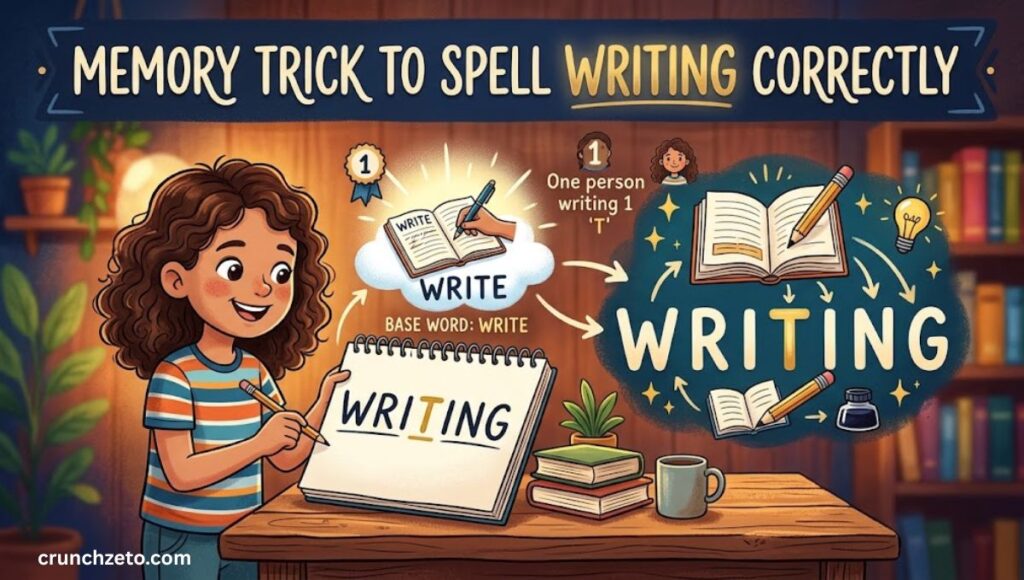
Want a trick that sticks? Here’s one. Think of a writer holding a pen. The pen has one tip. Writing has one T.
Another idea. The word has one T because the “e” left the building. Without the e, nothing is left to push the T into doubling.
Write → Writing, Not Writting
Try this short chant: “Drop the e, add ing, one T is the thing.”
It sounds silly. That’s the point. Silly rhymes stay in your head. Say it a few times and you won’t forget.
Writing vs Writting Quiz
Time to test yourself. This is a quick writing quiz. It’s also a mini writing vs writting quiz. Try to answer before you check.
No pressure. It’s a friendly spelling practice round.
Quick Practice Test
Fill in the blanks. Pick the right word.
- I enjoy ______ stories. (writing / writting)
- She is ______ an email. (writing / writting)
- He has ______ five letters. (written / writen)
- ______ is a useful skill. (Writing / Writting)
- Are you ______ the report? (writing / writting)
Answers:
- writing
- writing
- written
- Writing
- writing
How did you do? If you got all five, great. If not, review the silent e rule one more time.
Why Spelling Matters in Professional Writing
You might ask if one extra T really matters. It does. Small errors hurt trust.
Imagine reading a job application with “writting” in it. You’d notice. A reader may think the writer isn’t careful. That’s fair or not, but it happens.
Good spelling shows care. It matters most in formal English and professional writing. Resumes, emails, and reports all need clean spelling.
It matters online too. Search engines and readers both prefer clear, correct text. Clean writing accuracy builds credibility.
Tips for English Learners
If you’re one of the many English learners, this word can feel tricky. English spelling doesn’t always follow sound. That’s normal.
Here are a few tips:
- Learn the silent e rule early
- Study word families, like write, wrote, and written
- Practice with fill in the blanks exercises
- Keep a small list of words you often miss
- Read short texts daily
Be patient with yourself. Every learner makes spelling errors. Over time, the rules start to feel natural.
Other Words That Follow the Same Rule
The silent e rule isn’t just for “writing.” It works for many verbs. Learning it once helps you spell dozens of words.
Here are some examples:
- make → making
- take → taking
- hope → hoping
- use → using
- bite → biting
- ride → riding
In each case, drop the e. Add “ing.” No doubled consonant needed.
Some verbs do double the final letter. Those end in a single vowel plus a consonant, like “run” and “stop.” That’s why you get “running” and “stopping.” Check the vowel sound, and you’ll know which rule to use.
FAQs
How Do You Spell Writing?
Spell it W-R-I-T-I-N-G. It has seven letters and one T in the middle. Start with “write,” drop the e, and add “ing.”
Which Is Correct, Writting or Writing?
Writing is correct. Writting is a spelling error. You won’t find it in any trusted dictionary.
What Is the Difference Between Writing and Writting?
Writing is a real word. Writting is not. The only difference is the extra T, and that extra T makes it wrong.
Is It Writing or Is Writting?
The right form is “is writing.” For example, “She is writing a book.” Never use “is writting.”
Conclusion
So, writing vs writting has one clear winner. Writing is the correct spelling in standard English. Just drop the silent e, add ing, and keep one T. Remember that writting is a common spelling mistake, not a real word. Use the memory trick whenever you feel unsure.
Now it’s your turn. Try the writing quiz again in a few days. Practice with real sentence examples to build writing accuracy. Small habits matter. Share this guide with a friend who struggles with English spelling. Got a tricky word of your own? Drop it in the comments, and let’s solve it together.

Oliver Matthew Wilson is a passionate English language and grammar writer who enjoys making grammar, spelling, vocabulary, and writing concepts simple and easy to understand. With a focus on clear explanations and practical examples, Oliver Matthew Wilson creates helpful content for students, writers, and everyday English learners. His goal is to make learning English more enjoyable, useful, and accessible to everyone.
