


You are typing a sentence and stop. Is it wreckless or reckless? Both look right. Both sound the same. That is why so many people pause here. The confusion comes from the word wreck. It begins with a silent w, so your brain adds a w to reckless too.
Here is the quick answer for Wreckless vs Reckless: the correct spelling is reckless. It means careless about danger or what might happen next. Wreckless is a misspelling. Once you know why, the mix-up is easy to fix. Let’s walk through it step by step. It only takes a few minutes.
What Is the Correct Spelling?
Reckless is the correct spelling. It is spelled R-E-C-K-L-E-S-S. There is no “w” at the start.
Use it when you describe a person, an action, or a choice that ignores risk. A reckless driver speeds through a red light. A reckless plan puts everyone in danger.
In the debate of Wreckless vs Reckless, only one spelling appears in standard dictionaries. That spelling is reckless.
What Does Reckless Mean?
Reckless is an adjective. It describes someone who acts without thinking about danger. It can also describe the action itself.
Here are a few easy ways to say it:
- Careless about risk
- Not caring about what might go wrong
- Acting without caution
The word is usually negative. It suggests the person should have been more careful. Still, it can be gentle in casual talk. A friend might call your last-minute road trip “a little reckless,” and you might smile.
Example: “Passing a truck on a blind curve is reckless.”
The sentence works because the driver cannot see oncoming traffic. The risk is high, and the choice ignores it.
Is Wreckless a Real Word?
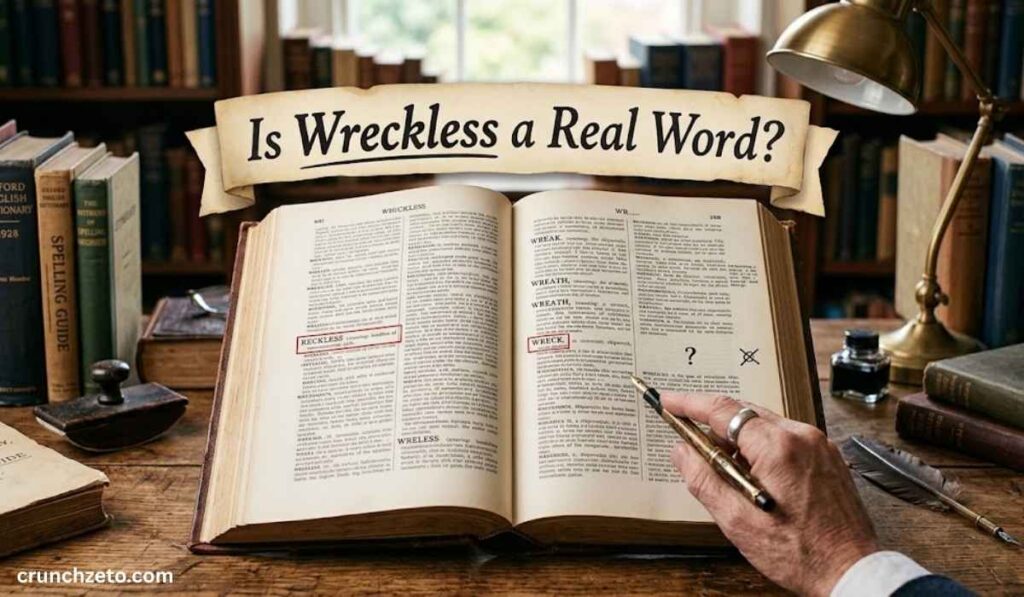
Not in standard English. “Wreckless” is a misspelling of reckless. You will not find it as a regular entry in major American dictionaries.
Some writers use it on purpose as wordplay. The idea is “without wrecks.” A driving school might joke about a “wreckless record,” meaning no crashes. That is a pun, not standard spelling.
Puns can be fun. But readers may think you made a typo. In school, work, or formal writing, choose reckless every time. That settles Wreckless vs Reckless for nearly every situation.
Wreckless vs Reckless: Quick Comparison Table
This table shows the difference at a glance.
| Term | Correct? | Meaning | Use |
| Reckless | Yes | Careless about danger or results | Standard writing and speech |
| Wreckless | No (misspelling) | Not a standard word. Sometimes a pun meaning “without wrecks” | Avoid, except for deliberate wordplay |
| Wreck | Yes | A crash, or to damage badly | Noun and verb |
Notice that “wreck” is a real word. It is just not part of “reckless.” That is where the confusion starts.
Why Do These Words Sound Alike?
The first syllable of reckless sounds like “wreck.” In wreck, the “w” is silent. So both words begin with the same “rek” sound.
Many English words start with a silent “w” before “r.” Think of write, wrong, wrist, and wrap. Because of these words, adding a “w” to reckless feels natural.
There is another reason. A reckless act often leads to a wreck. A reckless driver may cause a car wreck. The two ideas connect in our minds, so the spelling gets mixed up too.
But the words are not related in spelling or history. They just live near each other in real life.
How Do You Pronounce Reckless?
Say it like this: REK-lis.
The stress falls on the first syllable. The ending “less” sounds like “lis.” It does not sound like the word “less” on its own.
Wreck is pronounced “rek.” Reckless starts the same way. Then you add “lis.”
American and British English pronounce it almost the same way. The spelling is the same in both too.
What Are the Grammar Rules for Reckless?
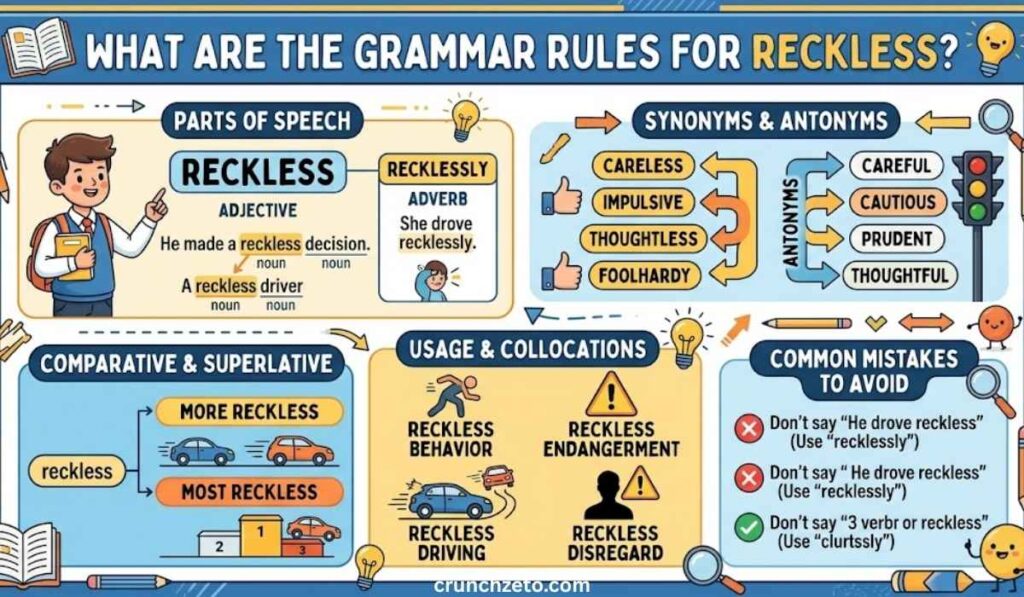
Reckless is an adjective. It describes a noun. For example: reckless driver, reckless behavior, reckless spending.
It has related forms:
- Recklessly is the adverb. It describes how someone acts. “He drove recklessly.”
- Recklessness is the noun. It names the quality. “Her recklessness worried her parents.”
- More reckless and most reckless are the comparison forms.
Reckless is not a verb. You cannot “reckless” something. It also has no plural form.
Now compare wreck. It works as both a noun and a verb. “The car was a wreck.” “Don’t wreck my plans.” The forms are wrecks, wrecked, and wrecking.
So the parts of speech differ, too. Reckless describes. Wreck names or acts.
Where Does the Word Reckless Come From?
Reckless comes from Old English. The old form meant “careless.” It was built from an old word, “reck,” which meant to care or to pay attention. Then the ending “less” was added, meaning “without.”
So reckless originally meant “without care.” That fits the modern meaning well.
Here is the key point for spelling. The “reck” in reckless is not the same as “wreck.” The old word reck is rare today. Wreck has a different history. That is why the “w” does not belong in reckless.
How Do You Use Reckless in a Sentence?
Reckless fits many settings. These examples show a few.
Everyday conversation:
“Riding a bike without a helmet is reckless.”
Workplace:
“The manager warned that reckless spending could hurt the budget.”
Email:
“I think skipping the safety check would be reckless. Can we schedule it first?”
Academic writing:
“The author describes the king’s reckless decision to invade.”
Casual writing:
“Texting while walking across a busy street? A bit reckless, my friend.”
Reckless also appears in common phrases:
- Reckless driving: a traffic offense in many places. The exact rules vary by state.
- Reckless endangerment: a legal term for actions that put others at risk.
- Reckless abandon: doing something with no restraint, as in “danced with reckless abandon.”
In each sentence, someone is ignoring risk. If you can swap in “careless about danger,” the word fits.
What Are the Common Mistakes With Wreckless vs Reckless?
Everyone makes spelling slips. Here are the most common ones.
Mistake 1: Adding a “w”
Incorrect: He was a wreckless driver.
Correct: He was a reckless driver.
Reckless has no silent “w.” Only the word wreck does.
Mistake 2: Using reckless when you mean wrecked
Incorrect: The storm left the boat reckless.
Correct: The storm left the boat wrecked.
Reckless describes careless behavior. Wrecked describes damage.
Mistake 3: Spelling it “reckliss” or “recless”
Incorrect: That was a recless move.
Correct: That was a reckless move.
Keep the “ck” and the double “s.” Say it slowly: reck, less.
Mistake 4: Using “wreckless” in formal writing as a pun
Incorrect (in a report): The company has a wreckless safety record.
Correct: The company has an accident-free safety record.
Unless the pun is clearly on purpose, readers will see an error.
What Related Words Can You Use Instead?

Sometimes another word fits better. Here are some options.
Similar words (synonyms):
- Careless
- Rash
- Impulsive
- Irresponsible
- Foolhardy
- Daredevil (for bold, risky people)
Opposite words (antonyms):
- Careful
- Cautious
- Prudent
- Responsible
- Sensible
Words often confused with reckless:
- Wreck: a crash or ruin
- Wrecked: badly damaged
- Wreckage: the broken pieces left behind
- Reckon: to think or calculate (it shares the “reck” letters but has its own meaning)
Choose the word that fits your point. “Rash” suggests a quick, unwise choice. “Reckless” suggests ignoring serious risk.
How Can You Remember the Right Spelling?
Try one of these simple tricks.
Trick 1: Think “reck + less.” Say it as two parts. Reck means care. Less means without. Without care.
Trick 2: Ask if it fits “wreck.” Does your sentence describe a crash or damage? Use wreck. Does it describe careless behavior? Use reckless.
Trick 3: Picture the first letter. Reckless begins with R, as in “risk.” Both words start with R. That can help you skip the extra “w.”
Trick 4: Read it aloud. If you can say “careless about danger,” you want reckless.
With a little practice, Wreckless vs Reckless stops being a problem. Your hand will write the right one.
Frequently Asked Questions
Is wreckless spelled correctly?
No. The correct spelling is reckless. “Wreckless” is a common misspelling. It appears only as an intentional pun.
What does reckless mean?
Reckless means acting without caution and ignoring danger. A reckless choice puts you or others at risk.
Is it “reckless driving” or “wreckless driving”?
It is reckless driving. That is also the standard legal wording in many areas.
Can I ever use wreckless?
Only as deliberate wordplay, such as a joke about a crash-free record. In formal or professional writing, avoid it. In a quick check of Wreckless vs Reckless, reckless always wins.
How do I use reckless in a sentence?
Use it to describe a careless person or action. Example: “It was reckless to swim during the storm.”
The Simple Takeaway
The answer to Wreckless vs Reckless is short. Reckless is the real word. It means careless about danger. “Wreckless” is a misspelling, though sometimes a pun.
Remember this: reckless means “without care.” No silent “w” needed. If your sentence is about crashes, use wreck. If it is about careless choices, use reckless.

Oliver Matthew Wilson is a passionate English language and grammar writer who enjoys making grammar, spelling, vocabulary, and writing concepts simple and easy to understand. With a focus on clear explanations and practical examples, Oliver Matthew Wilson creates helpful content for students, writers, and everyday English learners. His goal is to make learning English more enjoyable, useful, and accessible to everyone.
