


Have you ever paused while typing and wondered how to spell the word for a person who comes to a place? You are not alone. The two spellings sound almost the same when you speak. Here is the quick answer to visiter vs visitor: “visitor” is the correct spelling. “Visiter” is a common misspelling. The ending is -or, not -er. This guide explains why, shows simple examples, and gives you easy tricks to get it right every time.
Which Is Correct: Visiter or Visitor?
Visitor is the only correct spelling in standard English. It is a noun. It names a person who visits a place, a person, or an event.
Standard dictionaries list “visitor.” They do not list “visiter” as an English word. If you type “visiter” in an email or an essay, most spell checkers will flag it right away.
So the rule is simple. Use visitor every time. There is no special case, no regional spelling, and no British or American split. Both US and UK writers spell it the same way.
What Does Visitor Mean?
A visitor is someone who goes to see a person or a place for a short time. The stay is usually brief. The person does not live there.
The word covers many situations:
- A guest who comes to your home
- A tourist who tours a new city
- A parent who comes to a school or a hospital
- A person who opens your website
- A sports team that plays away from home (the “visiting team” is also called “the visitors”)
Each use shares the same idea. The person is passing through, not staying for good.
Why People Mix Up Visiter vs Visitor
There are three easy reasons for this mistake.
First, the sound. In normal speech, the last syllable is soft. Say it out loud: “VIZ-it-er.” Both endings sound the same.
Second, English has many words that end in -er. Teacher, writer, runner, and baker all follow that pattern. The brain expects the same ending here.
Third, typing fast hides the error. Your fingers type what you hear. The mistake slips by when you do not slow down to check.
This is a normal learning moment. Even native speakers make this slip.
Visiter vs Visitor at a Glance
This table shows the whole picture in one quick look.
| Term | Correct? | Meaning | Use |
| Visitor | Yes | A person who visits | Use in all writing |
| Visiter | No | A misspelling of visitor | Avoid it |
| Visit | Yes | To go and see (verb), or the act of going (noun) | “We visit Gran often.” |
| Visiting | Yes | Describes something temporary or away | “A visiting nurse” |
Notice that every correct form starts with “visit.” The -or ending appears only when we name the person.
Is Visiter Ever Correct?
In English, no. “Visiter” is not an accepted spelling.
There is one thing that may confuse you. In French, visiter is a real verb. It means “to visit.” So you may see it in a French sentence or on a French website. That is a different language with different rules.
The English word for the person is spelled with -or. So in the debate between visiter and visitor, English has only one winner.
Read More: Carat vs Caret vs Karat: What’s the Difference?
Is Visitor a Noun or a Verb? Grammar Basics
Visitor is a noun. It is a countable noun, so it has a singular and a plural form.
- Singular: one visitor
- Plural: two visitors
It also has possessive forms:
- Singular possessive: the visitor’s badge (one visitor)
- Plural possessive: the visitors’ lounge (many visitors)
The word “visit” is the verb. Its forms are visit, visits, visited, and visiting. You can also use “visit” as a noun, as in “a short visit.”
Visitor is what grammar teachers call an agent noun. An agent noun names the person who does an action. A visitor is a person who visits. An actor is a person who acts. An editor is a person who edits. The -or ending is common for this job in words that come from Latin.
“Visitor” does not have an adverb form. It also has no true adjective form. People use “visiting” or the word “visitor” before another noun, as in “visitor parking.”
How Do You Pronounce Visitor?
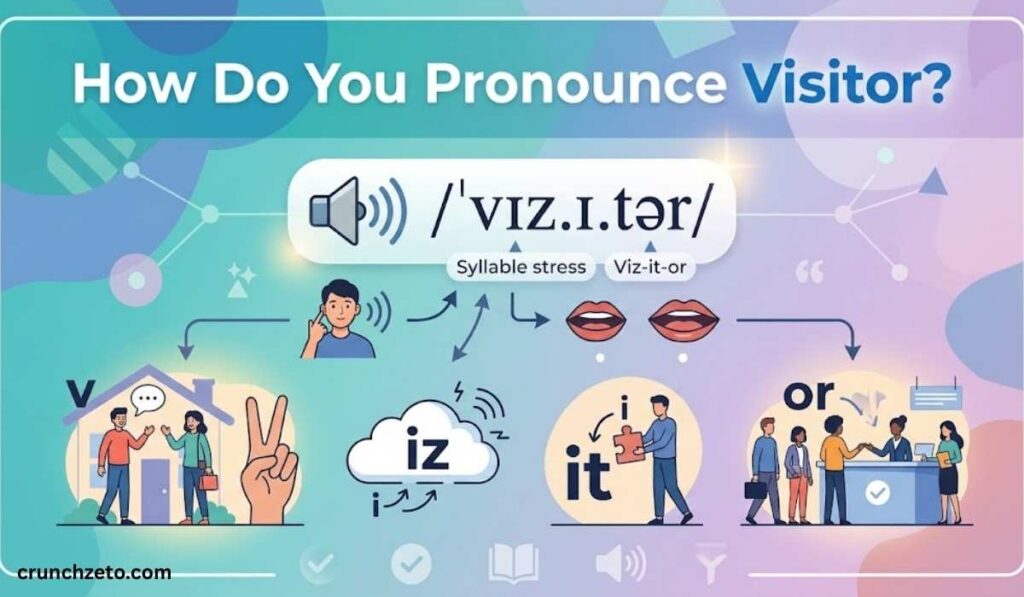
In American English, visitor sounds like VIZ-ih-ter. The stress falls on the first syllable. The middle syllable is quick. The last syllable is soft.
Here is the catch. The -or ending sounds like “er” in this word. That is exactly why visiter vs visitor trips up so many writers. Your ear cannot tell you the spelling. You have to learn it by sight.
British English sounds nearly the same. The spelling stays the same too.
Where Does the Word Visitor Come From?
The word has a clear path. It comes from the Latin verb visitare, which means “to go to see.” That Latin verb is linked to videre, which means “to see.” English also borrowed related words through French.
This tells us something helpful. A visit is about going to see someone or something. The word’s root meaning still fits how we use it today.
The -or ending also comes from Latin. It was used to name the person doing an action. Many English words copied this pattern, such as director, inventor, and spectator.
How to Use Visitor in Real Sentences
Seeing the word in context helps it stick. Here are natural examples from different settings.
Everyday conversation
- “We have a visitor, so please turn the music down.”
Workplace
- “All visitors must sign in at the front desk.”
- “Please give the visitor a badge before the meeting starts.”
- “Our guest speaker is a visitor from the Chicago office. Please greet her at the lobby.”
Academic writing
- “The museum counted over two thousand visitors during the exhibit.”
Business writing
- “The website had more repeat visitors this quarter.”
Formal writing
- “Visitors are asked to remain in the designated areas.”
Casual writing
- “Guess who was our first visitor at the new house? My dog’s best friend.”
Why are these correct? In each sentence, the word names a person who comes to a place. That is the job of the noun “visitor.” The plural “visitors” works the same way, just for more than one person.
Common Mistakes With Visitor and Visiter
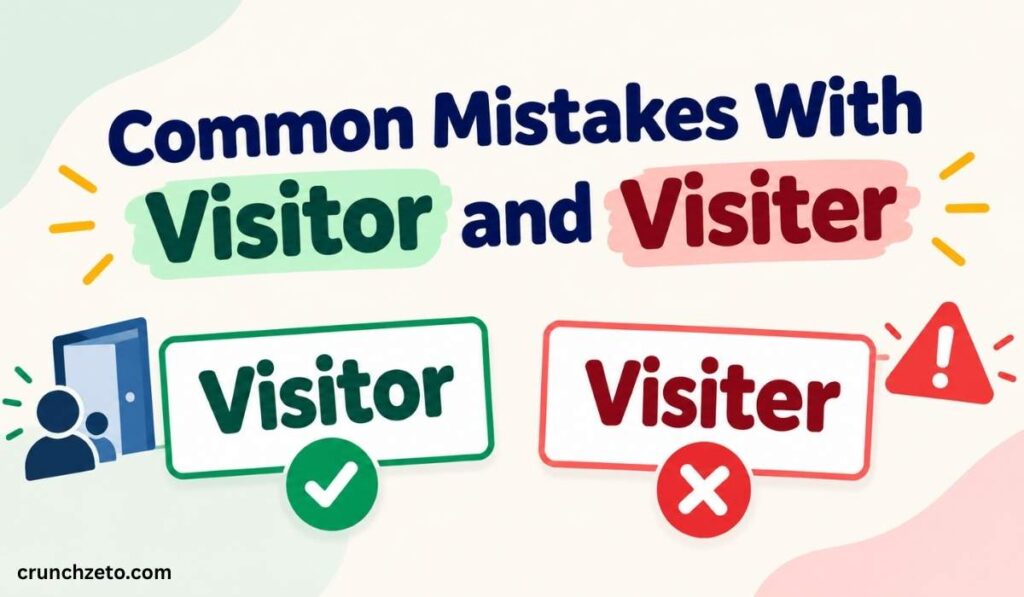
Mistakes happen to everyone. Here are the ones to watch for.
Mistake 1: Using the wrong ending
- Incorrect: Every visiter must wear a name tag.
- Correct: Every visitor must wear a name tag.
The correct ending is -or. Check this each time you proofread.
Mistake 2: Mixing up the plural
- Incorrect: Two visiters arrived early.
- Correct: Two visitors arrived early.
Keep the -or and add an s. Do not change the ending.
Mistake 3: Misplacing the apostrophe
- Incorrect: The visitors parking is full. (when you mean the lot belongs to visitors, the sign usually uses an apostrophe)
- Correct: The visitors’ parking is full.
Many signs drop the apostrophe, but formal writing keeps it.
Mistake 4: Confusing the verb and the noun
- Incorrect: I will visitor my aunt on Sunday.
- Correct: I will visit my aunt on Sunday.
“Visit” is the action. “Visitor” is the person. The visiter vs visitor spelling error often shows up right next to this one.
Visitor Related Words and Phrases
Learning nearby words helps you write with more variety.
Similar words (synonyms)
- Guest
- Caller
- Tourist
- Sightseer
- Attendee
Opposite ideas (antonyms or contrasts)
- Host
- Resident
- Local
- Native
Common phrases
- Visitor center
- Visitor badge
- Visitor parking
- Visiting hours
- First-time visitor
- Repeat visitor
- Website visitor
Each word has a slightly different feel. “Guest” is warm and personal. “Tourist” is about travel for fun. “Visitor” is neutral and works almost everywhere.
Simple Tricks to Remember the Spelling
Here are quick ways to lock in the right spelling.
Trick 1: Think of other -or words. Actor, doctor, director, and editor all end in -or. Visitor joins the same group.
Trick 2: Break it into parts. Say it as “visit” plus “or” when you type. It helps your eyes catch the ending.
Trick 3: Add a quick proofread step. Search your draft for “visiter” before you hit publish. It takes five seconds.
Trick 4: Keep a short list. If you write often, keep a note of words you mix up.
One honest warning: the -or and -er rule is not perfect. Some words, such as advisor and adviser, accept both endings. Visitor is not one of them. When in doubt, check a trusted dictionary.
Frequently Asked Questions About Visitor Spelling
Is visiter a real word?
No. “Visiter” is not a standard English word. It is a misspelling of visitor. The only place you will see it as a real word is in French, where it means “to visit.”
What is the difference between visiter vs visitor?
There is no difference in meaning in English. One spelling is right and one is wrong. Visitor is correct. Visiter is an error.
What is the plural of visitor?
The plural is visitors. Add an s to the end. Keep the -or ending. For example: “Three visitors signed the guest book.”
Is “visitor” used for people only?
Mostly, yes. It names a person who visits. It is also used for website traffic, as in “a site visitor,” and for sports teams that play away from home. In those cases the word still points back to the idea of someone passing through.
A Simple Rule to Remember
Here is your takeaway: the person who visits is a visitor, with -or at the end. The spelling visiter vs visitor can feel confusing because both sound alike, but only one is right. Check the ending, and you are done. Keep this one small rule in mind, and you will spell it correctly in emails, essays, and everyday notes.

Oliver Matthew Wilson is a passionate English language and grammar writer who enjoys making grammar, spelling, vocabulary, and writing concepts simple and easy to understand. With a focus on clear explanations and practical examples, Oliver Matthew Wilson creates helpful content for students, writers, and everyday English learners. His goal is to make learning English more enjoyable, useful, and accessible to everyone.
