


Have you ever stopped mid-sentence and wondered how to spell a word? Many writers do this with unaffected vs uneffected. The two words look almost the same. But only one is right. Unaffected is the correct word. It means not changed or not touched by something. Uneffected is not a standard word today. Spell checkers often flag it.
This guide makes the choice easy. You will learn what each word means. You will see simple examples. You will also get a few memory tricks to help you remember. We will also look at affected and effected, since they cause trouble too. Each tip is short and easy to follow. By the end, you will write with confidence.
Unaffected vs Uneffected: Quick Answer
Use unaffected. It starts with the verb “affect,” which means to influence or change. Add the prefix “un,” and you get “not influenced.”
Uneffected looks close, but it breaks the pattern. As a verb, “effect” means to bring something about. So uneffected would mean “not brought about.” Hardly anyone writes that.
Here’s the rule in one line. If you mean “not changed,” write unaffected. If you mean something else, rewrite the sentence.
What Does Unaffected Mean?
The word unaffected has two main jobs. It can describe something that stays the same after an event. It can also describe a person who acts naturally, without showing off.
Think of a rock in a river. The water rushes past, but the rock stays put. That rock is unaffected.
Unaffected Meaning and Definition
The unaffected meaning is simple. Something is not affected. It stays unchanged even when pressure, news, or weather hits it.
The second meaning is about manner. A person with an unaffected manner is natural, genuine, and sincere. They don’t put on an act. This sense is a bit more formal, but you’ll still meet it in books and reviews.
A good unaffected definition to remember: “not changed, not influenced, and not fake.” Pick the sense that fits your sentence.
Contextual Uses of Unaffected
You’ll see the word in many places. News stories say a region stayed unaffected by change or storms. Doctors say a healthy organ is unaffected by a disease.
People use it for feelings too. “She was unaffected by criticism” means the comments didn’t bother her. “He seemed unaffected by stress” means he stayed calm under pressure.
The word also works for things. A town can be unaffected by noise from a new highway. A computer file can be unaffected by a software update. Good unaffected usage always names what did not change the subject.
Unaffected Synonyms
Need a different word? Try unchanged, uninfluenced, untouched, or unharmed. For people, try calm, composed, or unmoved.
For the “natural” sense, use genuine, sincere, or natural. Each unaffected synonym has a slightly different feel, so match it to your point. The unaffected antonym is affected, as in “changed” or “fake.”
What Does Uneffected Mean?
Uneffected is a tricky one. It looks like a real word because it has the right parts. Yet it almost never shows up in good writing today.
Most people who type it are trying to spell unaffected. That makes it a classic English spelling mistake.
Is Uneffected a Real Word?
Not in everyday English. You won’t find it in most common dictionaries as a normal entry. Spell checkers will usually flag it.
In theory, you could build it from “effect” plus “un.” It would mean “not brought about.” But clearer phrases like “not carried out” or “unfulfilled” do the job better. So the uneffected meaning is rare and shaky at best.
Historical and Archaic Usage of Uneffected
English once had looser spelling rules. Older writers sometimes spelled words in odd ways. You may spot rare forms like this in old letters or historical documents.
Even then, it was uncommon. Treat it as an archaic word at most. You don’t need it for modern English spelling, and using it today looks like an error.
Uneffected vs Unaffected in Modern English
In contemporary English, the gap is clear. Unaffected is in. Uneffected is out. Editors will fix it every time.
So what’s the correct spelling of unaffected? It’s u-n-a-f-f-e-c-t-e-d. And the correct spelling of uneffected? There isn’t a safe one to recommend. Just don’t use it.
Unaffected vs Uneffected: Key Differences

Let’s put the two side by side. The gap is bigger than one letter. It touches meaning, usage, and age.
Think of it like a coin and a button. They look alike from far away. Up close, only one of them works as money.
Meaning Comparison
Unaffected means unchanged, unmoved, or natural. It’s the word you want in 99 percent of cases.
Uneffected would mean “not brought about,” if it meant anything. That’s a very different idea. Mixing them up changes your whole sentence.
Modern Usage Comparison
Today, unaffected usage is common in news, school, and business. You’ll hear it at work and read it in reports.
Uneffected usage is close to zero. If you use it, readers may think you made a typo. That hurts trust fast.
Historical vs Modern Usage
Old texts played by looser rules. Modern writing follows English grammar rules and style guides. That shift pushed odd forms out.
So the outdated word usage of uneffected stays in the past. Unaffected carried on and grew stronger.
Unaffected vs Uneffected Examples
Examples make the rule stick. Read them out loud. Your ear will pick up the right fit.
Below, you’ll see sentence examples for both words, plus a quick comparison table.
Examples of Unaffected in Sentences
Here are some unaffected examples you can steal:
- The storm hit the coast, but our village stayed unaffected.
- She was unaffected by criticism and kept on working.
- My phone was unaffected by the cold during our hike.
- His unaffected manner made everyone feel at ease.
See how each sentence shows something that didn’t change? That’s the heart of the word. Try the unaffected in a sentence test yourself whenever you’re unsure.
Read More: Withdraw or Withdrawal: Meaning and Correct Usage Explained
Examples of Uneffected in Historical Texts
You might find rare forms of this word in very old writing. Writers back then often spelled things by sound. Spelling wasn’t locked down yet.
So any uneffected examples you meet are best treated as old-style spelling. Don’t copy them. A modern reader won’t get the joke.
Comparative Examples Table
| Sentence | Verdict |
| The report was unaffected by the delay. | Correct |
| The report was uneffected by the delay. | Incorrect |
| Her unaffected charm won the room. | Correct |
| Her uneffected charm won the room. | Incorrect |
| The plan was not effected until May. | Correct (means “not carried out”) |
How to Use Unaffected Correctly
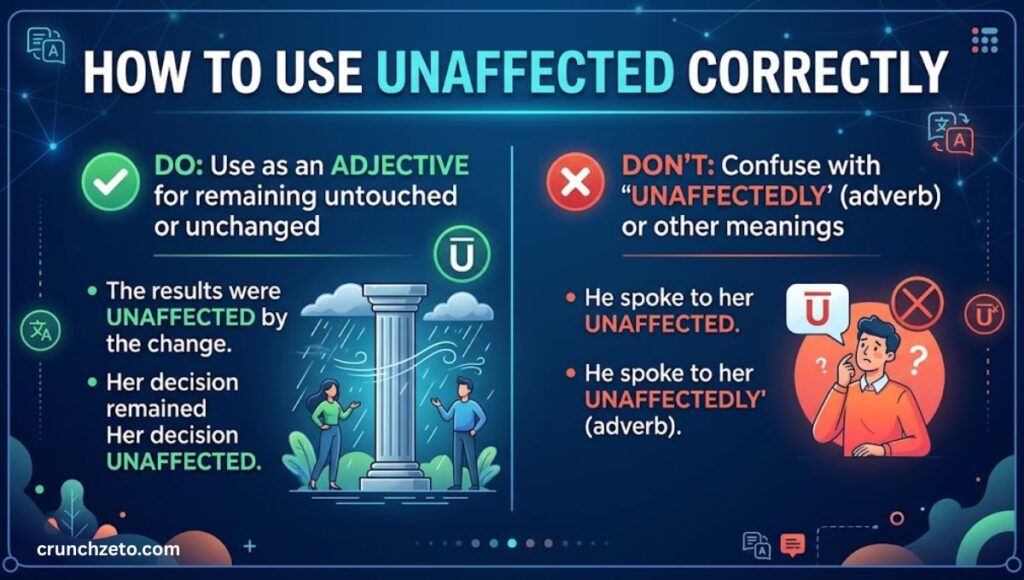
Good usage depends on your setting. A formal writing piece needs a different touch than a text to a friend. Still, the spelling stays the same.
Let’s walk through the main situations.
Unaffected in Professional Writing
In professional writing, be exact. Name what stayed the same. “Sales were unaffected by the price change” beats a vague line.
In academic writing, pair the word with data. “Results were unaffected by sample size” sounds sharp and clear. Good professional English keeps things short and specific.
Unaffected for Emotions and Personality
For feelings, unaffected often means emotionally stable or emotionally unaffected. A calm person keeps cool when things get rough. That’s emotional resilience at work.
It also fits unaffected personality or unaffected behavior. The person comes across as genuine and neutral. They’re not trying to impress anyone.
Unaffected for Physical Objects
Things can be unaffected too. A wooden table stays fine in the rain if it’s sealed. A metal tool stays strong after a drop.
This ties to physical resilience and being resistant to influence. An unaffected object or unaffected condition simply holds its shape and works as before.
Unaffected Clothing and Style
Style writers use the word for a look that feels easy. An unaffected outfit doesn’t shout for attention. It’s simple, natural, and comfortable.
Example: “Her unaffected style, jeans and a plain white shirt, looked effortless.” It’s a soft compliment about being real, not flashy.
Affected vs Unaffected vs Effected
These three words cause real headaches. They sound close, yet each does its own job. Let’s sort them out.
Once you see the pattern, it clicks for good.
Affected Meaning and Usage
Affected meaning has two parts. As a verb, “affect” means to change or influence. As an adjective, “affected” can mean fake or showy.
Example: “The cold affected my sleep.” Also: “He spoke in an affected accent.” Context tells you which one you’re reading.
Effected Meaning and Usage
Effected meaning is more specific. It’s the past form of “effect” as a verb, and it means “brought about” or “made happen.” You’ll see it in legal documents and business talk.
Example: “The board effected a major change.” It sounds stiff, so most people use “made” or “caused” instead.
Effect vs Affect
Here’s the classic trick. Affect is usually a verb, an action. Effect is usually a noun, a result.
Think: Affect is Action. Effect is End result. The wind affects the trees. The effect is falling leaves.
Effected vs Affected
This pair trips up many writers. Affected vs effected comes down to “influenced” versus “brought about.” They aren’t swappable.
“The rule affected workers” means workers felt its impact. “The rule was effected last year” means someone put it in place. Same sounds, different jobs.
Ineffective vs Unaffected
Ineffective means not working well. Unaffected means not changed. One is about results, the other is about impact.
A cough syrup can be ineffective, meaning it doesn’t help. A patient can be unaffected by the flu, meaning they never got sick. Don’t mix them up.
Common Mistakes to Avoid
Most slip-ups come from sound alikes. You say the word fast, and your fingers guess the spelling. It happens to everyone.
A few habits can save you from grammar mistakes and common spelling error traps.
Common Errors and Correct Usage
The top error is writing uneffected for unaffected. Another is using “unaffected” when you mean “ineffective.” A third is adding “non” out of habit.
Fix each one by checking the meaning first. Ask: did something stay the same? Then pick unaffected. This habit supports correct word choice every time.
Unaffected vs Non-Affected
Non-affected vs unaffected is a fair question. “Non-affected” shows up in some technical and medical papers. It simply means not impacted.
In plain writing, unaffected sounds smoother. It’s the better pick for blogs, emails, and essays. Save non-affected for fields that already use it.
Confusing Unaffected With Affected or Effected

Here’s a quick fix. Unaffected has the same root as “affect.” That means it’s about change, not about results or creation.
You’ll often see unaffected vs affected mixed up because the words are opposites. And unaffected vs effected gets mixed up because of the sounds. Slow down, and read the sentence twice.
Related Words and Synonyms
Good writers keep a few alternatives handy. Variety keeps your content fresh. It also helps readers stay engaged.
Let’s explore some options.
Synonyms for Unaffected
Common synonyms for unaffected include unchanged, untouched, unharmed, and uninfluenced. For emotions, try calm, composed, or unmoved.
For the “natural” sense, reach for sincere, genuine, or plain. Pick the word that matches your tone.
Related Words and Their Meanings
| Word | Meaning |
| Unchanged | Stayed the same |
| Untouched | Not handled or harmed |
| Unmoved | Not stirred emotionally |
| Composed | Calm and in control |
| Sincere | Honest and real |
Better Alternatives to Unaffected
Sometimes a plain phrase works best. “Didn’t change” can beat “was unaffected.” “Stayed calm” can beat “remained emotionally unaffected.”
Casual writing loves short words. Casual writing and chatty blogs sound warmer with simple phrases.
When Is Uneffected Ever Correct?
Honestly, almost never. But a fair guide covers the edge cases. Let’s look at the few places it might pop up.
Even there, you have better choices.
Historical and Legal Contexts
Legal and business English sometimes uses “effect” as a verb. For example, someone may “effect a transfer.” In that narrow world, “not effected” can appear.
You’ll usually see it as two words, “not effected.” That keeps the meaning clear. A one-word version still looks like a typo.
Exceptions in Older Texts
If you’re quoting an old source, keep its spelling. Add “[sic]” if needed. That tells readers the old spelling is intentional.
Outside quotes, use modern spelling. Your readers will thank you.
Memory Tricks to Keep Them Straight
Here’s one that works. Unaffected has a double f, like “affect.” Picture two f’s as two flags standing still in the wind. They’re unaffected.
Another trick: if you can swap in “unchanged,” you want unaffected. If you can swap in “not made to happen,” you’re in rare “effected” land.
Try saying the sentence out loud. If it sounds odd, rewrite it. Simple wins.
Practice Exercises
Ready to test yourself? These short drills take only a few minutes. Answers are at the end of each section.
Fill in the Blank
Pick unaffected or affected for each blank:
- The old bridge stayed ______ by the flood.
- The loud music ______ my focus.
- She was ______ by his rude comments.
Answers: 1. unaffected. 2. affected. 3. unaffected.
Identify the Correct Word
Which spelling is right?
- unaffected or uneffected?
- The new rule was (affected / effected) in June.
Answers: 1. unaffected. 2. effected, since it means “put in place.”
Rewrite the Sentence
Fix this: “He remained uneffected by the news.”
Better: “He remained unaffected by the news.” You can also say, “The news didn’t faze him.”
Contextual Application
Read this line: “The town was ____ by the storm, but the farms suffered.” Does the word mean unchanged or hurt?
If the town was fine, write “unaffected.” If the town took damage, write “affected.” Context decides.
Create Your Own Sentences
Write three sentences using unaffected. Try one about weather, one about feelings, and one about a gadget.
Then swap each with “unchanged” to check. If it still works, you nailed it.
Practice Exercise Summary
You practiced spelling, meaning, and context. The big lesson is simple. Write unaffected when something stays the same.
Review the commonly confused words from time to time. It builds confidence fast.
Unaffected vs Uneffected: Quick Reference Table
| Feature | Unaffected | Uneffected |
| Status | Standard word | Not standard |
| Meaning | Unchanged, natural | “Not brought about” (rare) |
| Use today | Very common | Almost none |
| Safe to use? | Yes | No |
| Better option | n/a | Unaffected |
FAQs
Is It Uneffected or Unaffected?
It’s unaffected. That’s the word in dictionaries and style guides. Uneffected is not a standard choice.
What Does Uneffected Mean?
If it means anything, it means “not brought about.” That’s rare and awkward. Most people who type it meant unaffected.
Which Is Correct: Unaffected or Non-Affected?
Both exist, but unaffected is the everyday choice. Non-affected fits some science and medical writing.
What Is Another Word for Unaffected?
Try unchanged, untouched, calm, or genuine. Choose based on your sentence.
What Does It Mean When Someone Is Unaffected?
It means the person isn’t bothered or changed. It can also mean they act in a natural, real way.
Can Unaffected Describe Physical Objects?
Yes. A sealed wooden table can be unaffected by rain. Tools, files, and materials can be unaffected too.
How Do You Pronounce Unaffected?
Say “un-uh-FEK-tid.” The stress falls on the third syllable. Say it slowly at first.
What Is the Difference Between Unaffected, Affected, and Effected?
Unaffected means unchanged. Affected means influenced. Effected means brought about. Each does a different job.
Can a Person’s Personality Be Described as Unaffected?
Yes. It describes someone who’s natural and doesn’t put on airs. It’s a kind compliment.
Is Uneffected Correct in Modern Writing?
No. Modern editors will mark it as an error. Use unaffected instead.
What Does Unaffected Mean in Psychology?
In psychology, it can mean a person shows no change in mood or behavior after an event. It can also describe someone not impacted by a condition. Researchers often say a group was “unaffected” to mean no change was found.
How Can I Avoid Confusing Unaffected and Uneffected?
Remember the double f. Link it to “affect,” the action word. And when in doubt, swap in “unchanged.”
Conclusion
So, unaffected vs uneffected has a clear winner. Unaffected is the real, useful word. Uneffected is a rare, shaky form that most readers will see as a typo.
Keep the double f in mind. Check your meaning. Then write with confidence. Got a tricky word pair you want covered next? Drop a comment, and share this guide with a friend who writes a lot.

Oliver Matthew Wilson is a passionate English language and grammar writer who enjoys making grammar, spelling, vocabulary, and writing concepts simple and easy to understand. With a focus on clear explanations and practical examples, Oliver Matthew Wilson creates helpful content for students, writers, and everyday English learners. His goal is to make learning English more enjoyable, useful, and accessible to everyone.
