


You have two words that sound the same. You stop and wonder which spelling to use. Skull or scull? English has many pairs like this, and this one trips up writers every day. They are homophones, so your ear cannot help you. Skull is the bony frame of the head. Scull is a type of oar, or the act of rowing with one. Once you know that split, the choice is easy. This guide gives you meanings, examples, and tricks to get it right.
What Is the Correct Answer? Skull or Scull Explained Fast
Both spellings are correct, but they mean different things. Use “skull” for the bones of the head. Use “scull” for rowing. That is the whole rule.
Here is a quick test. Are you talking about a head, a bone, a pirate flag, or Halloween? Write skull. Are you talking about oars, a rowing boat, or a rowing race? Write scull.
Neither word is a mistake. People only get into trouble when they swap them. A writer who says “she broke her scull” has picked the wrong word. A writer who says “he rowed a single skull” has done the same.
What Does Skull Mean?
A skull is the set of bones that forms the head. It protects the brain. It also gives the face its shape. Doctors, artists, and scientists all use this word.
The word also has other uses. A skull is a common symbol for death or danger. You see it on warning labels, pirate flags, and Halloween decorations. People also use it as a casual word for the head, as in “a thick skull.”
Here are a few ways people use it:
- The museum had a skull from a dinosaur.
- She wore a shirt with a skull on it.
- The helmet protects your skull in a crash.
- He has a hard head, or as his mom says, a thick skull.
“Skull” is a noun. It names a thing. You can count skulls, so the plural is skulls.
What Does Scull Mean?
A scull is about rowing. It has a few related meanings, and they all connect to boats and oars.
First, a scull can be a short oar. In this style of rowing, each rower holds two oars, one in each hand. Second, a scull can be a long oar used at the back of a boat. A rower moves this oar side to side to push the boat forward. Third, a scull can mean the light racing boat itself. Rowers say “single scull” for a boat with one rower. They say “double scull” for two rowers.
“Scull” is also a verb. To scull means to move a boat with sculls. The verb forms are scull, sculls, sculled, and sculling. A person who does it is a sculler.
Rowing has two main styles. In sculling, each rower holds two oars. In sweep rowing, each rower holds one oar. That is why the word “scull” appears in rowing news and Olympic coverage.
Read More: Whether It Be vs. Whether It Is: .Which One Is Correct?
Skull vs Scull Comparison Table
This table puts the key facts side by side. Use it as a quick check when you are in a hurry.
| Term | Correct? | Meaning | Use |
| Skull | Yes | Bones of the head, or a symbol of death | Anatomy, art, warning signs, everyday talk |
| Scull | Yes | An oar, a racing boat, or to row with oars | Rowing, boating, sports writing |
| Skull (as a rowing word) | No | Not used for oars or rowing | Avoid |
| Scull (as a head bone) | No | Not used for anatomy today | Avoid |
Both words are fully correct. Each one just has its own job. When you ask yourself skull or scull, you are really asking which job you need done.
How Do You Pronounce Skull and Scull?

Here is the surprise. They sound exactly the same. Both words rhyme with “dull” and “gull.” Say them out loud and you will hear no difference.
That is why they are called homophones. Homophones are words that sound alike but have different meanings and spellings. Other pairs include “sole” and “soul,” or “flour” and “flower.”
American and British English also match here. The spelling and sound are the same on both sides of the Atlantic. You do not need to worry about a regional rule. Context is the only thing that tells you which word is meant when you hear it.
What Part of Speech Is Each Word?
Grammar can feel heavy. Here it is simple.
Skull is a noun. It names a thing. It has a singular form (skull) and a plural form (skulls). It does not usually work as a verb in standard writing.
Scull works as both a noun and a verb. As a noun, it names an oar or a boat. As a verb, it describes the action of rowing.
Look at these examples:
- Noun: The team carried the scull to the dock.
- Verb: They scull across the lake every morning.
- Past tense: She sculled to the end of the river yesterday.
- Ongoing action: He is sculling in the early light.
If you need a word for an action on the water, scull is your choice. If you need a word for a thing in the body, skull is your choice.
Where Do the Words Skull and Scull Come From?
Word history can help you remember meanings. It also needs care, because some origins are uncertain.
Skull appeared in English during the Middle English period. Many language experts think it was borrowed from a Scandinavian source. Older books sometimes spell skull in other ways, and you may even spot “scull” used for it in very old texts. Modern writing does not do this.
The origin of scull is less clear. It also shows up in Middle English. Experts have not settled where it first came from. It is fair to say its history is uncertain.
You do not need the history to use the words well. The modern rule is clean. Skull is for the head. Scull is for rowing.
How to Use Skull in a Sentence
Real examples help most. Here are skull sentences from different settings.
Everyday talk: “My son wants a skull cake for his Halloween party.”
Workplace: “The lab team scanned the skull to measure its size.”
Academic writing: “The study compared the skull shapes of two bird species.”
Email: “Please send me the image of the skull from the exhibit.”
Casual writing: “That movie poster has a giant skull on it.”
Notice how each sentence names a physical thing or an image. If your sentence points to a head bone or a symbol, skull fits. In the academic example, the word names a body part that scientists measure. That is the classic use.
How to Use Scull in a Sentence
Now look at the rowing side. Here are scull sentences.
Everyday talk: “My neighbor rows a single scull on the lake every Sunday.”
Workplace: “Our company sponsors a double scull team at the regatta.”
Academic writing: “The college offers a class on how to scull safely.”
Email: “Can you book the dock for our scull practice at 6 a.m.?”
Casual writing: “We watched the Olympic sculls cross the finish line.”
In the verb form, you might write: “She sculled around the bend and picked up speed.” This sentence is correct because “sculled” is the past tense of the verb. Each example here has a boat, water, or oars somewhere in the picture. That is your clue to use scull.
Common Skull or Scull Mistakes and How to Fix Them
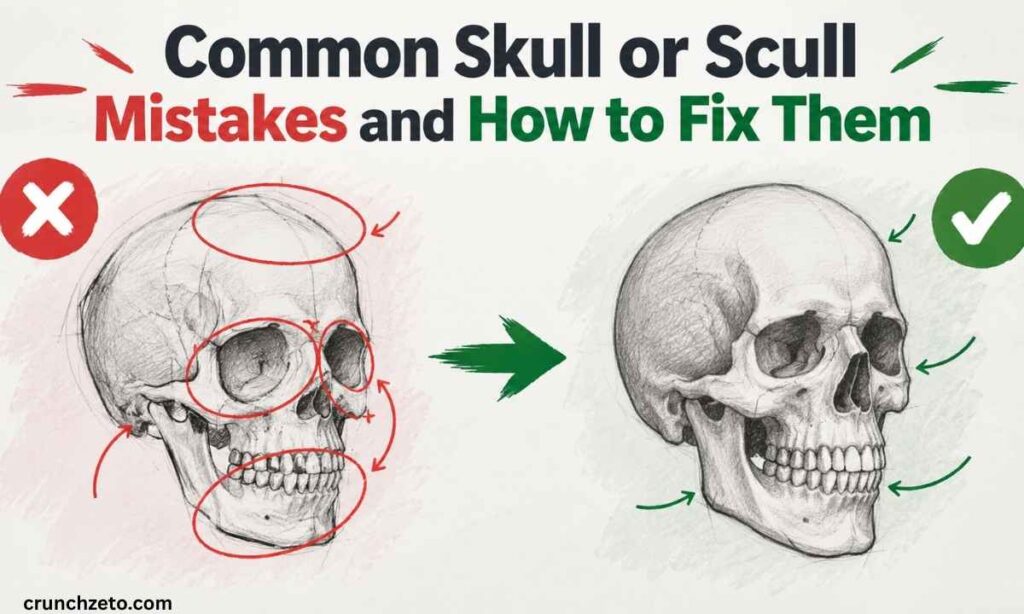
Mixing these words is a very normal slip. Spell check will not catch it, because both are real words. Here are the mistakes people make most often.
Incorrect: The doctor studied the X-ray of the patient’s scull.
Correct: The doctor studied the X-ray of the patient’s skull.
The doctor is looking at a head bone. That is a skull.
Incorrect: The rower pulled hard on her skull.
Correct: The rower pulled hard on her scull.
She is using an oar, so the rowing word is right.
Incorrect: The pirate flag showed a scull and crossbones.
Correct: The pirate flag showed a skull and crossbones.
A pirate flag uses the head symbol.
Incorrect: Our club bought a new double skull for the race.
Correct: Our club bought a new double scull for the race.
A double scull is a rowing boat.
If you ever feel stuck on skull or scull, ask one question: is this about a head or about rowing? That one question solves nearly every case.
Related Words: Skullcap, Sculler, Sculpt, and More
Some nearby words can add to the confusion. Here is a clear list.
- Skullcap: a small, close-fitting cap worn on the head. It uses the skull spelling.
- Cranium: a scientific word for the part of the skull that holds the brain.
- Sculler: a person who rows with sculls.
- Sculling: the act or sport of rowing with sculls.
- Oar: the pole used to move a boat. A scull is a type of oar.
- Sweep rowing: a style where each rower holds a single oar.
- Sculpt: to carve or shape art. It looks similar to scull but has a different meaning.
- Skulk: to move around in a sneaky way. It is another look-alike, but not related.
Words that start with “skul” usually point to the head. Words that start with “scul” often point to rowing, though “sculpt” is the one exception that belongs to art.
Simple Tricks to Remember the Difference
Memory tricks work well for homophones. Try these.
Trick one: Skull starts with “sk,” like skeleton. A skull is part of a skeleton.
Trick two: Scull has a “c,” like crew. Rowers on a crew use sculls.
Trick three: Picture a pirate flag for skull. Picture a boat on a lake for scull.
Pick the one that sticks and use it every time you write. After a week or two, you will not need the trick at all. Many writers also like to scan their finished drafts for these two words, just to be sure. Skull or scull is a small choice, but readers notice when it goes wrong.
Frequently Asked Questions About Skull and Scull
Is it skull or scull when talking about the head?
Use skull. It is the only correct spelling for the bones of the head.
What does scull mean in rowing?
A scull is an oar, a light racing boat, or the act of rowing with oars. In sculling, each rower holds two oars.
Do skull and scull sound the same?
Yes. They are homophones. Both rhyme with “dull,” in American and British English.
How do I use scull as a verb?
Use “scull” for the present tense and “sculled” for the past. For example: “They sculled across the bay at sunrise.”
Skull or Scull: The Simple Takeaway
You now know that skull or scull comes down to one question. Is your sentence about a head or about rowing? Skull belongs to the body. Scull belongs to the water.
Remember one thing: skull for bones, scull for boats. If you keep that short rule in mind, you will write the right word every time.

Oliver Matthew Wilson is a passionate English language and grammar writer who enjoys making grammar, spelling, vocabulary, and writing concepts simple and easy to understand. With a focus on clear explanations and practical examples, Oliver Matthew Wilson creates helpful content for students, writers, and everyday English learners. His goal is to make learning English more enjoyable, useful, and accessible to everyone.
