


You typed a sentence, paused on one word, and now you’re not sure if it needs one L or two. This confusion between realy or really happens all the time, especially when typing fast on a phone where autocorrect doesn’t always catch it.
The short answer: “really” is the only correct spelling, and “realy” is simply a common misspelling, not a real word in standard English. Once you understand where “really” comes from and how it’s built, you’ll never second guess this spelling mistake again.
Is It Realy or Really? The Direct Answer
“Really” is correct. “Realy” is a misspelling.
There is no situation in standard American or British English where “realy” is the accepted spelling. It shows up mostly from typos, autocorrect slips, or someone dropping a letter while typing quickly. If you are ever unsure, default to “really” with two L’s, since that is the only form recognized by dictionaries and style guides.
What Does “Really” Mean?
“Really” is an adverb that means “in reality” or “truly.” It is also used informally to add emphasis, similar to “very.”
Here are its two main jobs in a sentence:
- Expressing truth or fact: “She really did finish the marathon.”
- Adding emphasis: “That movie was really good.”
Both uses are common in everyday speech and writing, and both rely on the same two L spelling.
Why Do People Misspell Really as Realy?
Most people who write “realy” are not confused about the word itself. They know what it means and how to say it. The mistake usually comes from one of these habits:
- Typing quickly and skipping a letter
- Assuming shorter equals simpler, similar to how “truly” drops the E from “true”
- Autocorrect failing to catch a single dropped letter
- Non-native English speakers applying spelling patterns from other languages
This is a small, common slip, not a sign of poor grammar overall. Plenty of fluent writers type “realy” by accident and fix it on a reread.
Really: Grammar Breakdown
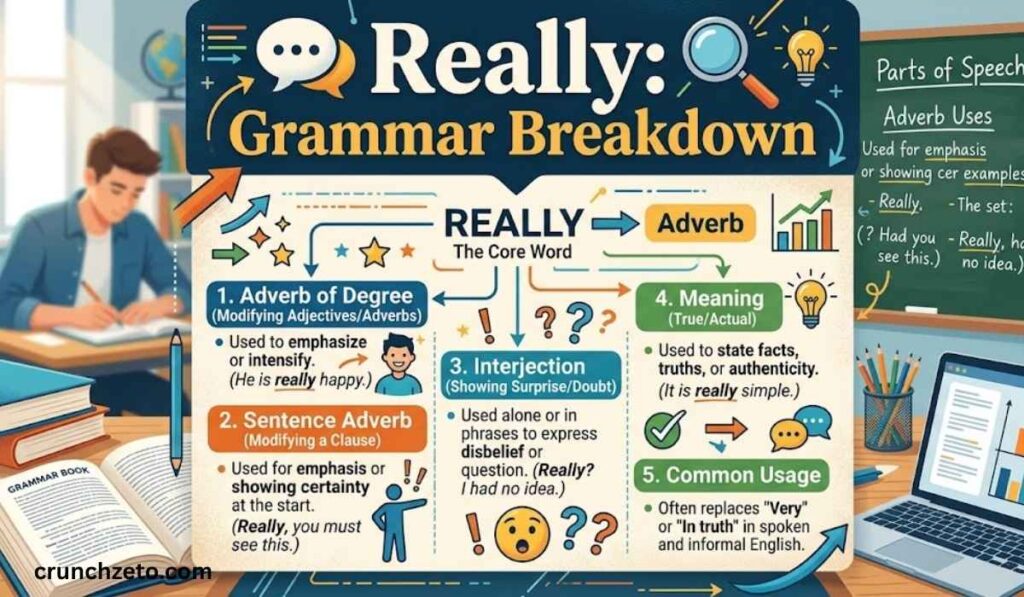
Understanding the grammar behind “really” makes it easier to remember the correct spelling.
Part of speech: Adverb (though it is sometimes used informally as an intensifier, almost like an adjective in casual speech, such as “a really nice guy”).
Root word: “Really” comes from the adjective “real” plus the adverb forming suffix “ly.” That is exactly why it keeps both L’s: one from “real,” and one from “ly.”
Formality: “Really” works in both formal and informal writing. However, using it repeatedly as a filler word (“It was really, really good”) reads as casual and is best trimmed in professional writing.
American vs British English: There is no spelling difference between American and British English here. Both use “really” with two L’s. The only variation is tone: British speakers may lean slightly more on “really” for polite emphasis or mild surprise, as in “Really? I had no idea.”
Where Does the Word “Really” Come From?
“Really” traces back to the Middle English adjective “real,” borrowed from Old French “reel,” which itself came from the Late Latin “realis,” meaning “actual” or “relating to things.” Adding the adverbial suffix “ly” turned the adjective “real” into “really,” giving English a word that means “in a real or actual manner.”
This origin explains the spelling pattern. Since “real” already ends in one L, attaching “ly” naturally creates the double L in “really.” Recognizing this connection is one of the easiest ways to stop misspelling it.
How Do You Pronounce Really?
“Really” is pronounced REE-uh-lee or REE-lee, depending on the speaker’s accent and speaking speed. In casual American speech, it often gets compressed to sound closer to “reelly.”
No matter the pronunciation, the spelling stays the same: two L’s, no exceptions.
Realy vs Really: Quick Comparison
| Term | Correct? | Meaning | Use |
| Really | Yes | In reality, truly, or used for emphasis | Standard adverb in all forms of English |
| Realy | No | Not a recognized word | Common typo or misspelling of “really” |
If you remember only one thing from this table, remember that “realy” has no legitimate use in standard writing, formal or informal.
How to Use Really Correctly in a Sentence
Seeing “really” in natural contexts helps the correct spelling stick. Here are examples across different settings.
Everyday conversation
“I really appreciate you picking me up from the airport.”
Workplace communication
“We really need to finalize the budget before Friday’s meeting.”
Academic writing
“The data does not really support the initial hypothesis.” (Note: in formal academic writing, many editors prefer replacing “really” with a stronger word like “substantially” or removing it entirely for a more precise tone.)
Email
“Thanks again, I really enjoyed our call this morning.”
Business writing
“The client was really impressed with the revised proposal.”
Casual texting
“That show was really funny, you have to watch it.”
In each example, “really” adds emphasis or confirms something is true. Swap in “realy” anywhere in these sentences, and it becomes an obvious typo.
Common Mistakes With Really
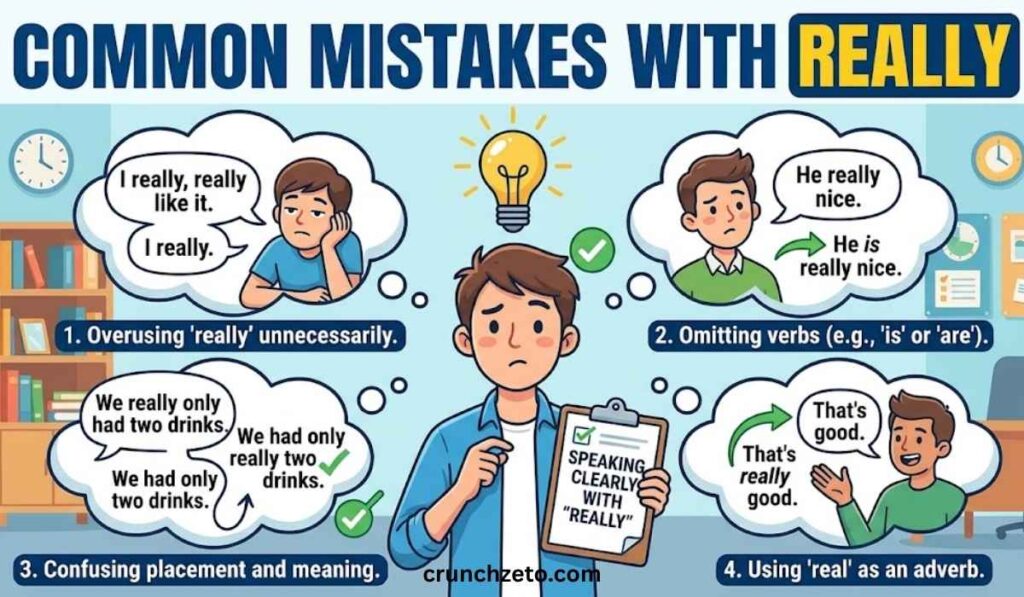
Incorrect: I realy think we should leave earlier.
Correct: I really think we should leave earlier.
This is the most common version of the mistake: a single dropped L, usually from typing speed rather than confusion about spelling.
Incorrect: She was realy happy about the promotion.
Correct: She was really happy about the promotion.
Autocorrect sometimes misses this error because “realy” is close enough to other real words that it does not always get flagged.
Incorrect: Realy, I don’t mind waiting.
Correct: Really, I don’t mind waiting.
Even at the start of a sentence, where “really” expresses mild disbelief or reassurance, the double L stays the same.
Incorrect: This is a realy big deal.
Correct: This is a really big deal.
When “really” functions as an intensifier before an adjective, writers often rush through the sentence and drop the second L without noticing.
Words Related to Really
A few related terms can help you understand “really” more fully and avoid similar mix ups:
- Real: the root adjective meaning genuine or actual
- Truly: a close synonym, often interchangeable with “really” for emphasis
- Actually: another adverb used to confirm truth or correct a misunderstanding
- Genuinely: a more formal alternative to “really” in professional writing
- Very: often used alongside or in place of “really” as an intensifier
None of these words share the exact spelling pattern of “really,” so they will not help you remember the double L, but they are useful alternatives when you want to avoid overusing “really” in your writing.
Quick Tips to Never Misspell Really Again
- Remember that “really” is built from “real” plus “ly,” so it naturally has two L’s.
- If your sentence sounds informal or repetitive with “really,” try swapping in “truly” or “genuinely” instead.
- Turn on spell check, but do not fully rely on it, since “realy” sometimes slips past basic autocorrect tools.
- Read your sentence aloud. If you are pronouncing two L sounds, you should be typing two L’s.
Frequently Asked Questions
Is realy a word?
No. “Realy” is not recognized as a standard English word. It is a common misspelling of “really.”
Is really one word or two?
“Really” is a single word, spelled with two L’s: r-e-a-l-l-y.
What is the difference between really and real?
“Real” is an adjective meaning genuine or actual, as in “a real diamond.” “Really” is the adverb form, used to mean “truly” or to add emphasis, as in “I really love this song.”
Can I start a sentence with really?
Yes. Starting a sentence with “Really” is grammatically correct and common in conversational English, especially to express surprise or emphasis, such as “Really, I had no idea.”
Is it okay to use really in formal writing?
Yes, in moderation. “Really” is acceptable in formal writing, but many style guides suggest replacing it with a more precise word like “significantly” or “genuinely” when writing academic or professional content.
Final Answer: Realy or Really
“Really” is correct, always spelled with two L’s, and “realy” has no legitimate place in standard English writing. The confusion usually comes down to speed, not a real gap in knowledge. The easiest way to remember it is thinking of “really” as “real” plus “ly,” which naturally gives you the double L. Keep that connection in mind, and this common spelling mistake won’t trip you up again.

Oliver Matthew Wilson is a passionate English language and grammar writer who enjoys making grammar, spelling, vocabulary, and writing concepts simple and easy to understand. With a focus on clear explanations and practical examples, Oliver Matthew Wilson creates helpful content for students, writers, and everyday English learners. His goal is to make learning English more enjoyable, useful, and accessible to everyone.
