


You are typing a note, and your fingers stop. Is it label or lable? The second one looks right for a moment. Many writers pause here, and that is normal. The word sounds like LAY-bul, so the spelling feels like it could go either way. Spell check may not always save you, and typing fast makes the slip even easier.
Label is the correct spelling. Lable is a common misspelling, not a real English word. Label means a tag, a sticker, or a word that names something. US writers use one L in labeled, and UK writers use two. This guide explains the meaning, the pronunciation, and the word forms. It also gives easy tips, so you spell it right every time.
What Does Label Mean?
A label is a small piece of paper, cloth, or plastic attached to an item. It gives information about that item. It may show a name, a price, a size, or a warning.
The word also has a wider meaning. A label can be a word or phrase that describes a person, a group, or an idea. A movie called a “comedy” or a “thriller” has a genre label.
Label works as a verb too. To label something means to attach a tag to it or to give it a name. You can label a box, a jar, or a folder. You can also label an idea, though people sometimes do that too quickly.
Why Do People Spell It Lable?
The label or lable mix-up has a few clear causes. The first one is sound. The last syllable is a soft “bul.” Many English words end with that sound, and many of them are spelled with “-able.” Think of table, cable, and fable.
The second cause is pattern copying. The brain sees a familiar ending and uses it. Label, table, and cable all rhyme, so lable feels like a natural match.
The third cause is speed. When you type fast, the E and the final L can swap places. Almost everyone does this at some point. It is a small slip, not a sign of weak English.
Label or Lable: Quick Comparison
Here is the full answer in one table.
| Spelling | Correct? | Meaning | Use |
| Label | Yes | A tag, a sticker, or a descriptive name. Also, to attach one or to name something. | Use it in all writing. |
| Lable | No | None. It is a misspelling. | Do not use it. |
The label or lable question has one clear answer. Choose label every time.
Is Lable a Real Word?
No. Lable is not a standard English word. It has no definition, no plural, and no verb forms. Dictionaries list label only.
You may see lable as a brand name or a username. Owners sometimes pick odd spellings on purpose to stand out. That is a style choice, not correct spelling. In normal writing, such as emails, school papers, and reports, it counts as an error.
If you searched for the right form of label or lable to settle a doubt, you can stop now. The spelling is label.
How to Spell Label Correctly Every Time
The correct spelling is L-A-B-E-L. The word starts and ends with L. In the middle, you will find the name Abe. So you can think of it as L, ABE, L.
Here are three easy tricks:
- Picture Abe between two L’s. Whenever you doubt label or lable, this image gives the answer fast.
- Match it with level. Label and level both end in “-el.” A sentence helps: “The label shows the level.”
- Remember other “-el” words. Model, travel, panel, and channel use the same ending.
Proofreading also helps. Read your final draft once, only to check spelling. Look at every label, labeled, and labeling in the text.
Read Related Post: Steer vs Stear: Which Spelling Is Correct? (Meaning and Examples)
How Do You Pronounce Label?
Say it as LAY-bul. The first syllable gets the stress. The second syllable is short and weak. Dictionaries often show it as /ˈleɪbəl/.
The sound is nearly the same in US and UK English. Australian speakers say it in a very similar way. The word rhymes with table and cable. In fast speech, the second syllable can shrink to a quick “bl.”
Label as a Noun and as a Verb
As a noun, label names a thing. For example: “The label on the jar is peeling.” Here, label is the tag itself.
As a verb, label describes an action. For example: “Please label each box before you move it.” Here, label is a transitive verb, so it takes an object. You label something.
You can also use the pattern “label X as Y.” For example: “The manager labeled the file as urgent.” This pattern is common in workplaces and in school writing.
Label can also sit before another noun. Think of a label maker or a label printer. In these phrases, the first word describes the second.
Label Plural and Other Word Forms
The plural of label is labels. Just add an S. There are no special rules here. For example: “The labels on these bottles are hard to read.”
The same spelling works for the verb in the third person. For example: “She labels every shelf on Monday.” So labels meaning depends on the sentence. It can mean more than one tag, or it can describe what someone does.
Other forms follow the label rule, and they depend on US or UK spelling. The next section shows them side by side.
Labeled vs Labelled: US and UK Spelling
Both spellings are correct. They belong to different styles of English.
American English doubles a final consonant only when the stress falls on the last syllable. In label, the stress falls on the first syllable. So US writers use one L: labeled and labeling.
British English usually doubles the final L in verbs like this, no matter where the stress falls. So UK writers use two: labelled and labelling. Australian English usually follows the British style.
| Form | US English | UK English |
| Past tense | labeled | labelled |
| Present participle | labeling | labelling |
| Person who labels | labeler | labeller |
| Wrong label | mislabeled | mislabelled |
| Not labeled | unlabeled | unlabelled |
The meaning stays the same in both styles. Pick the style your readers use, and stay consistent through the whole piece. For a US audience, write labeled.
Where Does the Word Label Come From?
Label entered English in the Middle Ages. It came from Old French, and it also appears in Anglo-French. At that time, it meant a ribbon or a narrow strip, often of cloth or parchment.
Its older roots are less certain. Some sources point to a Germanic origin, but it is wise to be careful with bold claims beyond Old French.
Over time, the meaning grew. First it described a strip attached to something. Later it covered any tag fixed to an object. Today it also means a word that names or describes a person or an idea. The “ribbon” idea still survives in the picture of a tag tied or stuck onto something.
Common Types of Labels You See Every Day
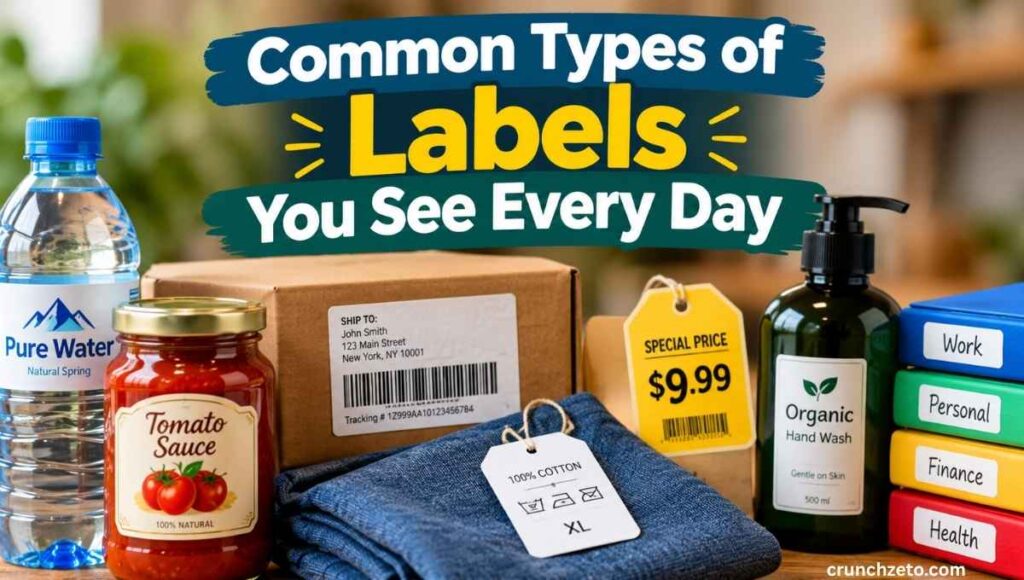
The word shows up in many places. These are the most common ones:
- Shipping label: A sticker on a package. It shows the address and a tracking code.
- Product label: A tag that gives the name, brand, and basic details of an item.
- Food label and nutrition label: A panel that lists ingredients and nutrition facts.
- Clothing label and care label: A tag inside a garment. It shows size, fabric, and washing steps.
- Medication label: A tag on a medicine. It gives the dose and safety warnings.
- Record label: A company that produces and sells music. The name comes from the paper label in the center of a record.
- Off-label: A phrase for using a medicine in a way not listed in its official approval.
Real-Life Examples of Label in Sentences
Here are natural sentences for different settings.
Everyday conversation
- “Can you read the label on that jar?”
- “I forgot to label the leftovers again.”
Workplace
- “Please label all cables before the move.”
- “The warehouse team labeled every pallet by noon.”
- “Attached is the shipping label for your return.”
- “I will relabel the folders and send you the list on Friday.”
Academic writing
- “The researchers labeled each sample with a number.”
- “The author warns against putting a label on every student.”
Business and music
- “Our private label line launches in the spring.”
- “She signed with an independent record label.”
British English
- “The chemist labelled the bottles carefully.”
Why do these work? In the workplace and academic lines, label is a verb, and labeled is its past tense in US spelling. In the British line, the same past tense takes two L’s. In “private label” and “record label,” the word is a noun that names a brand or a company.
Common Label Spelling Mistakes
These mistakes are normal parts of learning English. Here are the most frequent ones.
Incorrect: Please put a lable on the box.
Correct: Please put a label on the box.
The word ends in “-el,” not “-le.”
Incorrect: The lables were printed wrong.
Correct: The labels were printed wrong.
Fix the base word first, then add the S.
Incorrect: She lableed every jar.
Correct: She labeled every jar.
Even in the past tense, the base spelling stays label.
Incorrect: The boxes were mislabled.
Correct: The boxes were mislabeled.
Keep the full word label inside the longer word.
Incorrect (mixed styles): We labeled the boxes and checked the labelling.
Correct: We labeled the boxes and checked the labeling.
Do not mix US and UK spelling in one text.
The label or lable slip is the most common of these. It is also the easiest to fix once you know the pattern.
Label or Lable FAQs
Is it label or lable?
Label is correct. Lable is a misspelling and has no meaning in standard English. Always write label with the letters L-A-B-E-L.
What does label mean?
A label is a tag or sticker attached to an item to give information. It can also be a word that names or describes someone or something. As a verb, it means to attach a tag or to name.
Is labeled or labelled correct?
Both are correct. Use labeled in US English and labelled in UK English. Choose one style and keep it the same throughout your writing.
How do you spell the plural of label?
Add an S: labels. For example: “The labels on the shelf are clear.” No other spelling change is needed.
How do you use label in a sentence?
Use it as a noun or a verb. Noun: “Check the label before you buy it.” Verb: “Please label the box with your name.”
What does off-label mean?
Off-label describes using a medicine in a way that is not listed in its official approval. The word label here points to the approved information that comes with the drug.
The Takeaway: Always Write Label
The label or lable question has a simple answer. Label is correct, and lable is only a typo. The word works as a noun and a verb, and its plural is labels. In the US, write labeled and labeling. In the UK, write labelled and labelling. Both are right for their audience.
Keep the middle letters in mind: L, ABE, L. Picture Abe sitting between two L’s, and the spelling stays safe. Next time you write a shipping label, a food label, or a note for a box, you will not need to pause. One word, one spelling: label.

Oliver Matthew Wilson is a passionate English language and grammar writer who enjoys making grammar, spelling, vocabulary, and writing concepts simple and easy to understand. With a focus on clear explanations and practical examples, Oliver Matthew Wilson creates helpful content for students, writers, and everyday English learners. His goal is to make learning English more enjoyable, useful, and accessible to everyone.
