


You’re writing fast, and then you freeze. Is it one M or two? Here’s the quick answer: dilemma is correct, and dilema is a common misspelling. The dilemma spelling needs a double m, and it never takes an N. That settles the dilemma vs dilema debate for good.
In this guide, you’ll learn the dilemma meaning, the right pronunciation, and simple memory tricks. You’ll also see real dilemma examples and how a moral dilemma differs from a predicament. We’ll also cover the plural, the Greek origin, and a quick practice quiz at the end. Each section is short, simple, and easy to follow. Ready to fix this spelling confusion and write with confidence? Let’s start with the basics today.
Quick Answer
The correct form is dilemma. It has two Ms in the middle. Write it like this: D-I-L-E-M-M-A.
Both dilema and dilemna are wrong. Spell checkers flag them for a reason. If you want standard English spelling, stick with the version that has the double m.
What Is a Dilemma?
A dilemma is a difficult situation where you must pick between two competing options. Each choice has a cost. None of them feels perfect.
Think of a tough decision you’ve faced. Maybe you had to choose between a safe job and a risky dream. That’s the heart of a dilemma.
Dilemma Definition
The dilemma definition is simple. It’s a choice between alternatives, and every path brings conflicting consequences. You lose something no matter what you pick.
Dictionaries describe it as a situation that needs a choice between two or more options that are equally unwelcome. That’s why a dilemma feels so heavy.
Is Dilemma a Noun?
Yes, it is. Dilemma is a noun. You can’t use it as a verb or an adjective.
You can say, “She faced a dilemma.” You can’t say, “She dilemmaed over it.” Treat it like any other thing you can name, such as a problem or a plan.
What Does Dilemma Mean?
The dilemma word meaning centers on a difficult choice. You feel stuck because every option has a downside. Your decision making slows down.
People use the word in everyday English and in formal English. You’ll hear it in news stories, schools, offices, and family talks.
Dilemma vs Dilema: What Is the Difference?
Here’s the truth about dilemma vs dilema. There’s no difference in meaning, because dilema isn’t a real English word. It’s just a typo that sneaks in.
So if you see dilema spelling in a draft, fix it. The only accepted dilemma correct spelling keeps both Ms. Readers notice this kind of slip fast.
Read More: Togather vs Together: Which Is the Correct Word to Use?
Dilemma vs Dilemna: Which Spelling Is Correct?
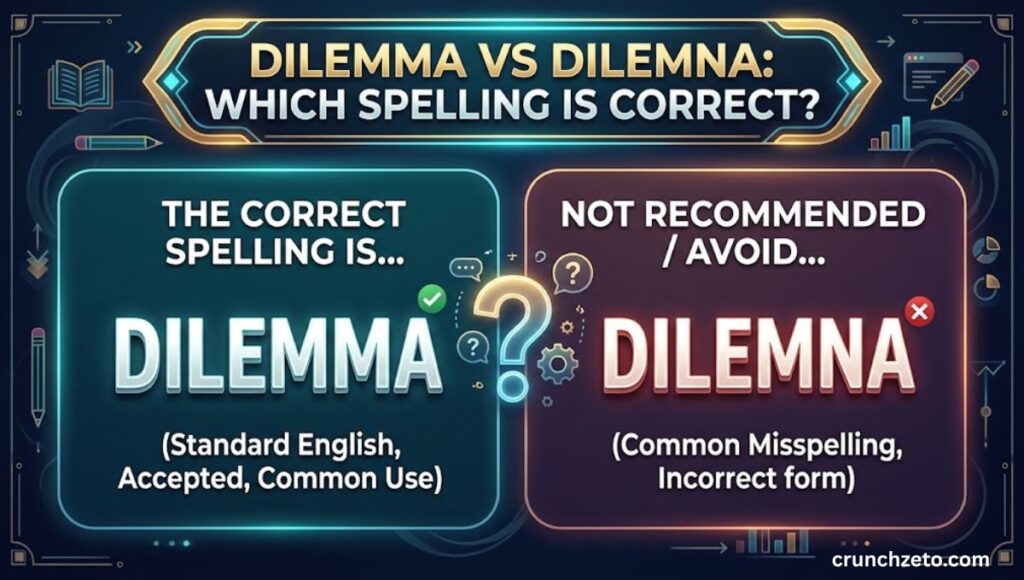
Again, dilemma wins. Dilemna is the other incorrect spelling you’ll see online. The dilemna spelling swaps an M for an N.
It looks close, so your eyes may skip over it. Don’t trust that quick glance. Check the word letter by letter before you hit publish.
Why Is Dilemma Commonly Misspelled?
The word is long, and the middle sounds like one beat. When you say it aloud, you don’t hear two Ms. Your brain writes what it hears.
There’s another reason. Many English words end in “emma” or “emna” sounds that feel alike, so spelling confusion grows. Practice fixes it, though.
Common Dilemma Spelling Mistakes
Most errors fall into two groups. Both are common spelling mistakes. Once you spot them, you can dodge them.
Let’s look at each one with a simple fix. You’ll remember them faster that way.
Forgetting the Second M
This is the dilema error. Writers type one M and move on. The word then looks short and wrong.
Here’s a trick. Picture the two Ms as two competing alternatives standing side by side. Two choices, two Ms.
Adding an N
This is the dilemna error. Some writers think an N belongs near the end, like in “column” or “autumn.” It doesn’t.
Remember the rule of no n in dilemma. The word ends in “mma,” not “mna.” Say it out loud once and the pattern clicks.
How to Spell Dilemma Correctly
Want to know how to spell dilemma every time? Break it into chunks: di, lem, ma. Then double the M after “le.”
Here’s another quick tip. Write the word five times on paper. Your hand will learn the shape of the double m in dilemma.
| Spelling | Correct? | Note |
| Dilemma | Yes | Standard English spelling |
| Dilema | No | Missing the second M |
| Dilemna | No | Extra N, wrong letter order |
Dilemma Pronunciation
The dilemma pronunciation has three beats. Most people say it as dih-LEM-uh. The stress lands on the middle part.
You might also hear dy-LEM-uh. Both are accepted in speech. The pronunciation and spelling don’t match perfectly, which explains some of the confusion.
How Do Americans Pronounce Dilemma?
In the United States, most speakers say dih-LEM-uh. Others say dy-LEM-uh, and that’s fine too. Neither one is wrong.
The key is the strong middle syllable. Put your weight on “lem” and the word sounds natural.
Dilemma Spelling in American and British English
Good news here. American English spelling and British English spelling match for this word. Both use dilemma.
You won’t need to switch between versions like you do with color and colour. One spelling works worldwide, so your academic writing stays safe.
Dilemma Meaning in English
In English, a dilemma is more than a hard day. It’s a meaningful decision point with stakes. You can’t dodge it without a cost.
People use it for personal dilemma moments and professional dilemma moments alike. The word fits both.
Dilemma Meaning With Example
Here’s a simple case. Maya got two job offers. One paid more, and the other offered a shorter commute and more family time.
That’s a dilemma. Both options help her, but each one costs her something. She can’t have it all.
Dilemma Examples
Real life gives you plenty of dilemma examples. A student may pick between a part-time job and extra study time. A manager may choose between cutting costs and keeping staff.
Or think about a driver who sees a pothole at the last second. Swerve and risk a crash, or hit it and wreck a tire. Tough, right?
Dilemma in a Sentence
Looking for dilemma in a sentence models? Try these:
- He faced a dilemma when two friends asked for help on the same night.
- She was in a dilemma about moving abroad or staying near family.
- The team had a dilemma over which bid to accept.
- I have a dilemma about whether to tell my boss the truth.
Notice how each sentence shows two sides. That’s the pattern you want.
Common Phrases With Dilemma
Certain phrases show up often. You can face a dilemma. You can be in a dilemma. You can also have a dilemma about or a dilemma over something.
Other handy ones include “solve a dilemma,” “resolve a dilemma,” and “a real dilemma.” Use them to sound natural.
Is Dilemma Always About Two Choices?
The Greek roots point to two. The prefix “di” means two, so the classic idea is two alternatives. That’s the strict meaning.
In modern use, though, people stretch the word. Many writers use it for any tough pick, even with three options. Careful editors may still prefer the two-option sense.
Dilemma vs Problem
A problem has a solution you can work toward. A dilemma has no clean answer. Every fix leaves a cost behind.
So, problem vs dilemma comes down to the cost of choosing. A flat tire is a problem. Choosing between two flights that both hurt your budget is a dilemma. Think of dilemma and problem as cousins, not twins.
Dilemma vs Predicament
A predicament is an awkward or tricky spot. You may not have a choice to make at all. You’re just stuck.
With predicament vs dilemma, ask yourself: do I have to choose? If yes, it’s a dilemma. If you’re simply in a mess, it’s a predicament.
Dilemma vs Quandary
A quandary is a state of doubt. You feel puzzled about what to do. The focus is on your confusion.
With quandary vs dilemma, the dilemma stresses the conflicting choices. The quandary stresses your mental state. They overlap, but the shades differ.
Moral Dilemma and Ethical Dilemma
These two terms often get swapped. Both involve right and wrong. Still, each has its own flavor.
Let’s break them down with plain examples. You’ll see why the two terms sit close together.
What Is a Moral Dilemma?
A moral dilemma pits one moral principle against another. You might believe in honesty and loyalty, but they clash. Say your friend cheats on a test, and you saw it.
What do you do? Telling the truth hurts your friend. Staying quiet breaks your honesty. That’s a classic personal choice with weight.
What Is an Ethical Dilemma?
An ethical dilemma often shows up at work or in a profession. It deals with ethical responsibilities and rules. A nurse who must balance patient privacy against safety faces one.
These cases usually involve a code of conduct. A professional decision can affect many people, so the pressure runs high.
Dilemma Synonyms
Need synonyms for dilemma? Try these: quandary, predicament, bind, catch-22, and tough spot. Each carries a slightly different feel.
You can also say difficult alternatives or challenging choices in plain talk. Pick the word that matches your tone and audience.
Dilemma Plural: Dilemmas
The dilemma plural is easy. Just add an S. You get dilemmas, with no extra letters.
The plural form keeps the double m. Write “moral dilemmas” or “workplace dilemmas.” The dilemmas meaning stays the same, just for more than one situation.
Did Dilemma Used to Be Spelled Dilemna?
Not really. Some older texts show odd spellings, but dilemna was never the accepted standard. It stayed a slip.
The word origin matters here. Late Latin borrowed the term from Greek, and the Greek form ends in “mma.” That’s why the modern spelling keeps it.
Where Does the Word Dilemma Come From?
The Greek origin is clear. It comes from Greek “di” (two) and “lemma” (premise or something taken). Together they point to two alternatives.
Logicians used the term for arguments with two bad outcomes. Over time, everyday speakers adopted it. Now it covers any difficult choice or situation.
Dilemma in Spanish
In Spanish, the word is dilema. It has one M. That’s the spelling Spanish speakers use daily.
Here’s a likely reason for the mix-up. Spanish speakers who write in English may carry over the single M. It’s a natural slip, so don’t feel bad about it.
Is Dilemma Appropriate for Formal Writing?
Yes. The word works well in formal writing, academic writing, and professional communication. Essays, reports, and legal pieces all use it.
Just keep the correct form and use it in the right sense. Save it for real difficult decisions, not small annoyances.
Memory Tricks to Never Misspell Dilemma Again
Here’s a fun one: “A dilemma has two M’s because you have two Moods about it.” Silly, but it sticks.
Another trick pairs the Ms with two choices. Picture two letters standing for two conflicting choices. Each time you type it, add both.
How to Use Dilemma in Everyday Writing
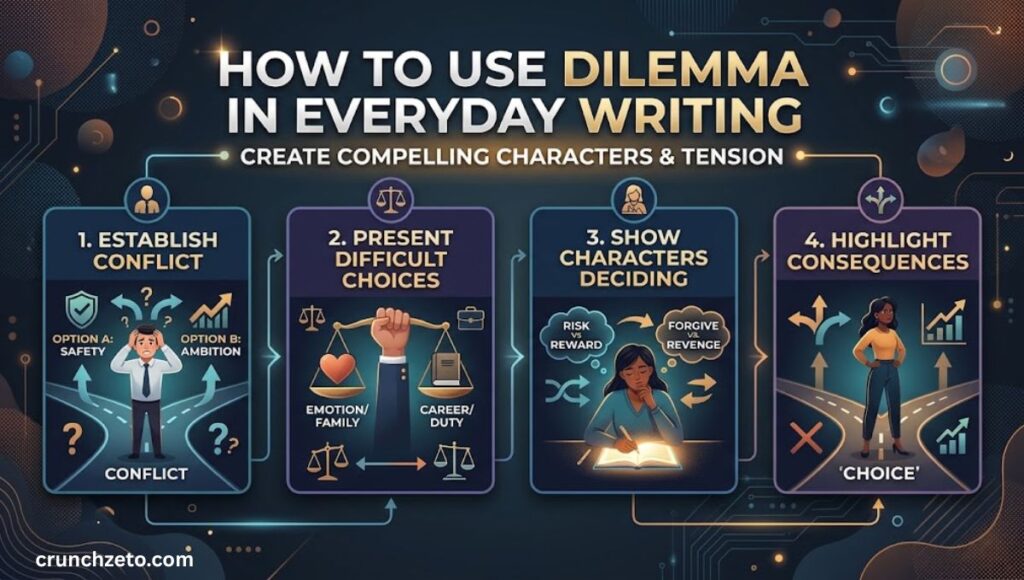
Use it for a real clash of options. Say “I’m in a dilemma” when both paths cost you something. Don’t use it for a simple chore.
In everyday English, keep your sentence short. Name the two choices when you can. That makes the point clear fast.
Practice Session: Dilemma vs Dilema
Ready to test yourself? Pick the correct spelling in each line. Don’t peek at the answers first.
- She was in a (dilemma / dilema) about her career.
- The (dilemna / dilemma) left him unable to sleep.
- A (moral dilema / moral dilemma) tests your values.
- Which is the right plural form: dilemmas or dilemnas?
- Choose the right word: Losing my keys is a (problem / dilemma).
- True or false: dilemma is a verb.
- Is the British spelling different from the American one?
- Fill in: I have a dilemma (about / dilema) which offer to take.
Answers
- Dilemma.
- Dilemma.
- Moral dilemma.
- Dilemmas.
- Problem, since there’s no hard choice involved.
- False. It’s a noun.
- No. Both use dilemma.
- About.
FAQs
Is dilema the correct spelling?
No. Dilema is a common misspelling. It drops one M, so use dilemma instead.
Is dilemna spelled correctly?
No. Dilemna is wrong. The correct word ends in “mma,” not “mna.”
Why do people spell dilemma as dilemna?
It happens because the sounds feel similar to words like “column.” The brain guesses an N and moves on. A quick check fixes it.
How do you spell dilemma correctly?
Spell it D-I-L-E-M-M-A. Think of it as di, lem, ma with a double m.
Does dilemma have two m’s?
Yes. It has two Ms in the middle and no N anywhere.
What does dilemma mean?
It means a difficult situation where you must choose between competing options. Every choice has a downside.
Is a dilemma always about two choices?
Traditionally, yes. Modern speakers also use it for any tough pick, though strict editors may prefer the two-option sense.
Can I say I am in a dilemma?
Yes. “I’m in a dilemma” is natural and correct. It tells readers you’re stuck between choices.
What is a simple example of a dilemma?
Choosing between a high-paying job far away and a lower-paying job close to home is a simple one. Both options help and hurt you.
What is the difference between a dilemma and a problem?
A problem can be solved without a painful trade-off. A dilemma forces a trade-off, since each option has a cost.
How is a dilemma different from a predicament?
A predicament is an awkward spot, and you may have no choice at all. A dilemma needs you to choose.
What are some common expressions with dilemma?
Popular ones include face a dilemma, be in a dilemma, dilemma about, and dilemma over. Add “moral” or “ethical” for more precision.
Is dilemma spelled differently in American and British English?
No. Both American English spelling and British English spelling use dilemma.
Where does the word dilemma come from?
It traces back to Greek, built from “di” for two and “lemma” for premise. That’s the Greek origin behind the two alternatives idea.
What are some synonyms for dilemma?
Try quandary, predicament, bind, or tough spot. Choose based on tone and meaning.
Is dilemma appropriate for formal writing?
Yes. It fits essays, reports, and professional communication well when you spell it right.
Conclusion
So, what’s the final word on dilemma vs dilema? It’s dilemma, always, with a double m and no N. The other forms are simply typos. Remember the Greek origin and the idea of two alternatives, and the spelling sticks.
You now know the meaning, the plural form, and the pronunciation. You know when to say moral dilemma or ethical dilemma in formal writing. Next time you face a tough decision, spelling won’t be the hard part. Got a tricky word you’d like explained? Share it in the comments, and pass this guide to a friend who struggles with common spelling mistakes.

Oliver Matthew Wilson is a passionate English language and grammar writer who enjoys making grammar, spelling, vocabulary, and writing concepts simple and easy to understand. With a focus on clear explanations and practical examples, Oliver Matthew Wilson creates helpful content for students, writers, and everyday English learners. His goal is to make learning English more enjoyable, useful, and accessible to everyone.
