


You are typing a quick message. Then you stop. Is it “decision” or “descission”? Many people freeze at this point. The spelling looks simple, but the sounds can fool you. Even careful writers slip here. Typing fast makes it worse. That is why the decision vs descission question comes up so often.
Here is the short answer. Decision is the only correct spelling. Descission is a common mistake. In this guide, you will learn the spelling rule, the word origin, and simple tricks to remember it. You will also see how decision differs from choice and decide. You will also get practice exercises to test yourself. Each tip is short and easy to follow. So, let us begin now.
Decision vs Descission: Quick Answer
The correct spelling of decision is d-e-c-i-s-i-o-n. It has one “c” and one “s” in the middle. That’s it.
“Descission” adds extra letters that don’t belong. Spell checkers flag it right away. So do editors and teachers.
So when someone asks, “is descision a word”, the answer is no. The same goes for is decission a word. Neither one is. Always write decision.
What Does Decision Mean?
A decision is a choice you make after thinking about it. You weigh your options. Then you pick one.
You make decisions all day long. Some are tiny, like what to eat for lunch. Others change your life, like moving to a new city.
Decision Definition in English
The decision definition is simple. It’s a conclusion or resolution reached after evaluating alternatives. It can also mean the quality of being firm and sure.
In grammar terms, the decision noun or verb question has an easy answer. Decision is a noun. It is never a verb.
So when you ask what does decision mean, think of a final judgment after consideration. That’s the heart of it.
Decision Meaning and Synonyms
A decision synonym can help you avoid repeating yourself. Good ones include choice, verdict, ruling, resolution, and conclusion.
But they aren’t always perfect swaps. A judge gives a ruling. A jury gives a verdict. You and I just make a decision.
Pick the synonym that fits the setting. Courts, offices, and kitchens all use different words.
Real-Life Examples of Decisions
Picture a friend deciding between two job offers. One pays more. The other lets her work from home.
She makes lists. She calls her mom. Three days later, she makes her decision. That’s a real one.
Here are more decision examples in sentences:
- Choosing a college was a tough decision.
- The team announced its decision on Monday.
- Buying a used car wasn’t an easy decision.
Is Descission a Correct English Word?
No, descission isn’t correct. It doesn’t appear in any major dictionary. It’s an incorrect spelling of decision.
You may see it in texts and social posts. That doesn’t make it right. Lots of people repeat the same error, and it spreads.
The same is true for decission. It looks close, but it’s wrong. And desicion is a common misspelling too. Use decision every time.
Why Do People Misspell Decision?
English spelling can feel like a trick. Many words sound one way and look another. Decision is one of them.
The good news? Once you see the pattern, the descision spelling mistake goes away for good.
Common Causes of Spelling Confusion
The biggest cause is sound. When you say the word out loud, you hear a “zh” sound in the middle. Your brain wants to match that sound with letters.
So you might add a double “s” or an extra “c.” This is phonetic spelling confusion. The sound doesn’t match the spelling, so you guess.
Typing fast also plays a part. Letters swap places. That’s how desicion vs decision happens. The “c” and “i” trade spots.
Similar Words That Cause Mistakes
Other words confuse the brain. Think of “mission,” “session,” and “discussion.” They all have double “s” sounds.
Your mind sees those and copies the pattern. That’s why decission vs decision comes up so often.
Also, words like “descend” and “describe” start with “des.” So some writers start decision with “des” by mistake. But decision starts with “dec,” just like decide.
The Spelling Rule Behind Decision
Here’s the secret. Decision isn’t random. It follows a clear pattern. And it’s tied to its base verb.
Learn this once, and you’ll never doubt it again. This is one of the best decision spelling rules out there.
From Decide to Decision
Start with the verb decide. Drop the “e.” Then add “sion.” You get decision.
That’s the decide to decision word transformation. The noun form of decide is decision. Simple as that.
Look at the first letters. Decide starts with “dec.” So does decision. If you spell the verb right, the noun follows.
Word Formation and Transformation Patterns
Many verbs follow this exact path. It’s a pattern in English spelling patterns. Check these out:
- decide becomes decision
- divide becomes division
- collide becomes collision
- invade becomes invasion
- explode becomes explosion
See the trend? These are words ending in ide (and a few ending in similar sounds). They lose the “e” and gain “sion.” Spotting this is part of good decision word formation knowledge.
The pattern also gives us decisive. The decisive meaning is firm, quick, and sure. A decisive person doesn’t dither.
Read More: Reinforce vs Reenforce: Which One Is Actually Correct?
Easy Ways to Remember the Correct Spelling
Wondering how to remember the spelling of decision? Try a trick. Break it into three chunks: DE-CI-SION.
Another trick: “Decide cuts off the e, and the decision comes next.” Silly? Yes. But silly sticks.
One more. Remember why decision is spelled with one s in the middle. The word has just one “s,” like “vision” and “division.” If you can spell vision, you can spell decision.
Decision Word Origin and Etymology
Words have family trees. Decision’s roots go way back. Knowing them makes the spelling feel logical.
The decision word origin is Latin. It comes from “decisio,” which means a cutting off. That comes from the verb “decidere.”
That Latin verb joins “de” (off) and “caedere” (to cut). So the decision etymology is a story about cutting. When you decide, you cut off other options.
The word moved into French, then into English. Many English words took this path. That’s why the Latin origin of decision shows up in so many related words, like “incision” and “precise.” You’ll find the same “cis” chunk in them all.
Decision Pronunciation and Spelling
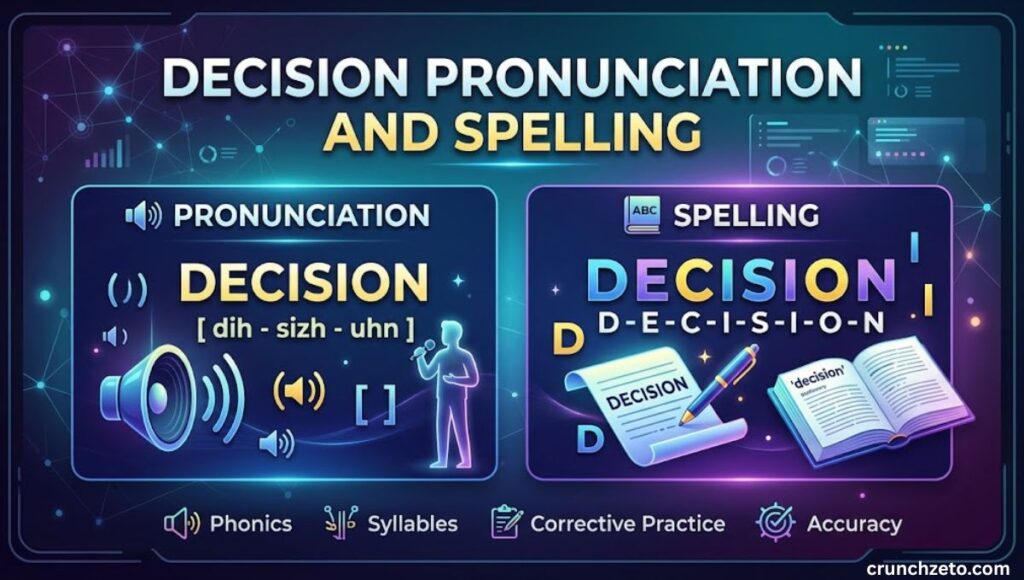
Say it out loud. It helps you spot the trouble. The sound and the spelling don’t line up perfectly.
Let’s look at both sides.
How to Pronounce Decision
The decision pronunciation is “dih-SIZH-un.” The stress lands on the second syllable. The middle sound is a soft “zh,” like in “vision.”
That’s decision pronunciation in English. It sounds the same in the US and the UK. No big difference there.
Say it slowly three times. You’ll hear that the middle has no “sh” sound and no double letters.
Common Misspellings of Decision
Here are the common decision spelling errors you’ll see most:
- descision (extra “s,” wrong start)
- decission (double “s”)
- desicion (letters flipped)
- decicion (“c” instead of “s”)
Every one of these is wrong. Good proofreading spelling mistakes habits will catch them. Read your text one more time before you hit send.
Decision vs Decide: What Is the Difference?

It’s about word type. Decide is a verb. Decision is a noun. That’s the core of the decision vs decide question.
You decide something. Then you have a decision. One is the action. The other is the result.
The difference between decide and decision shows up in sentences. “I need to decide today.” Now flip it: “My decision is final.” See how each fits its role?
People also search decide vs decision the other way around. The answer is the same. Verb for action, noun for outcome. Don’t swap them.
Decision vs Choice: Meaning and Usage
These two words feel like twins. They aren’t. Decision vs choice is a popular search for good reason.
A choice is an option you can pick. A decision is the act of picking, usually after thought. Choice is the menu. Decision is the order.
Decision vs Choice Examples
Here’s how it plays out:
- You have two choices: tea or coffee. Your decision is tea.
- Pizza was my choice. Skipping dessert was my decision.
- The store offers many choices. Picking one takes a decision.
Notice the flow. Choices come first. A decision comes after.
When to Use Decision or Choice
Use decision when thinking, weighing, or judging is involved. Use choice when you talk about options or a simple pick.
Often, choosing between different options is a quick act. A decision tends to carry more weight. Big life moves are decisions. Flavors of ice cream are choices.
Both words work in many cases. Still, this decision versus choice difference helps you sound sharper and more precise.
Decision vs Decision-Making: Key Differences
A decision is one result. Decision-making is the whole journey. That’s the key split.
Think of it like baking. The cake is the decision. Mixing, tasting, and baking are the decision-making.
Decision-Making Meaning
The decision-making meaning is the act or skill of reaching a choice. It covers the steps, the thinking, and the weighing.
Which is correct, decision-making or decision making? As a noun, many style guides prefer “decision-making” with a hyphen when used as a modifier. Check your style guide. Stay consistent.
Follow some decision-making grammar rules. Use the hyphen before a noun: “decision-making skills.” Skip it when the phrase stands alone as a verb phrase: “She is good at making decisions.”
Decision-Making Psychology
Psychologists study how people choose. Feelings, habits, and mental shortcuts all play a role. We’re not as logical as we think.
Tired people often make weaker calls. Hungry people do too. That’s why big talks go better after lunch.
Stress also narrows our thinking. We grab the nearest option. Slow down, and you’ll often decide better.
The Decision-Making Process
The decision-making process has clear steps. Many guides list them in roughly this order:
- Spot the problem or goal.
- Gather facts.
- List your options.
- Weigh pros and cons.
- Pick one.
- Act, then review the result.
This is the decision-making process in English that most schools and offices teach. It works for small and big calls alike.
Make a Decision vs Take a Decision
Here’s a classic puzzle. Do you make a decision or take a decision? Both phrases exist. But they aren’t equal everywhere.
Let’s sort it out.
Take a Decision Meaning
The take a decision meaning is the same as make a decision. It means you reach a conclusion. The phrase is common in some regions and in formal settings.
You’ll hear it in British news and in business meetings abroad. “The board will take a decision next week.” It sounds natural there.
Is It Correct to Say Make or Take a Decision?
Yes, both are correct. But make a decision is far more common worldwide. It’s the safer pick.
You can also reach a decision. That phrase works well after a long talk. “The jury reached a decision after two days.”
So if you’re unsure, go with make. You’ll almost never go wrong.
British English vs American English Usage
Here’s the split. Decision in American English almost always pairs with “make.” Taking a decision sounds odd to many US ears.
Decision in British English accepts both. “Take a decision” is fine in the UK, India, and parts of the Commonwealth. The word itself is spelled the same everywhere.
So spelling doesn’t change. Only the verb pairing does. Know your audience, then choose.
Make a Decision or Take a Decision Quotes
Famous lines often use “make.” You’ve likely heard that the hardest part of any choice is the first step. People repeat that idea in speeches and books.
One popular idea says not deciding is also a decision. It’s a good reminder. Delay has a cost too.
When you quote someone, keep their exact verb. Don’t change “take” to “make” or the reverse.
Make a Decision vs Do a Decision
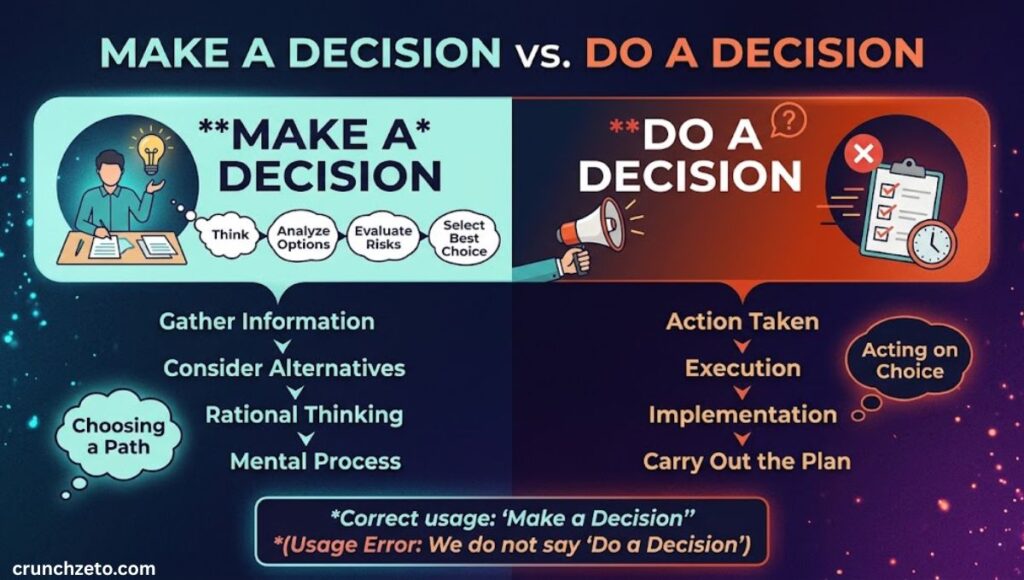
This one is simple. You can’t do a decision. It sounds wrong to native speakers. The right verb is make.
People searching do a decision or make a decision or make or do a decision often trust the wrong pull. Other languages use “do” in this spot. English doesn’t.
Why Make a Decision Is Correct
English uses collocations. These are word pairs that just belong together. “Make” goes with decision. “Do” goes with homework or chores.
That’s the correct usage of make a decision. It’s a habit of the language, not a hard rule. But breaking it sounds off.
When you hear “do a decision,” you know right away something’s wrong.
Examples of Correct Collocations
Here are phrases that sound natural:
- make a decision
- reach a decision
- take a decision (mostly British)
- come to a decision
- announce a decision
- reverse a decision
Pick one that fits your tone. They all beat “do a decision.”
How to Use Decision in a Sentence
Wondering how to use decision in a sentence? Think of it as a thing. You can make it, delay it, defend it, or regret it.
Here are examples of decision in sentences for every setting you might need.
Everyday Examples
Simple, daily lines help the word feel natural:
- I made the decision to walk to work.
- It was a quick decision, but a good one.
- She regretted her decision to skip breakfast.
Business and Leadership Examples
Work life is full of calls. Decision-making in leadership can shape a whole team. Strategic business decisions can shape a company.
- The manager’s decision saved the project.
- Leaders must own their decisions, good or bad.
- The CEO made a bold decision to open a second office.
Academic Examples
Schools and research use the word too. It often shows up in essays and reports.
- The court’s decision changed the law.
- Students studied how voters reach a decision.
- The study looked at decision-making under stress.
Decision Examples in Different Contexts
The word fits legal, medical, and personal talks. Here are a few more:
- The doctor explained each option before the decision.
- Their decision to adopt a dog made everyone smile.
- The referee’s decision was final.
Decision vs Choice vs Decide: Comparison Table
Here’s a quick side-by-side. Keep it handy.
| Word | Part of Speech | Meaning | Example |
| Decision | Noun | A conclusion reached after thought | Her decision was final. |
| Decide | Verb | To make up your mind | I’ll decide tonight. |
| Choice | Noun | An option, or the act of picking | I had two choices. |
| Decisive | Adjective | Firm and quick to act | He’s a decisive coach. |
See how each word has its own job? That’s the whole secret.
Quick Tips to Avoid Decision Spelling Mistakes
Want to stop making this mistake? A few small habits go a long way. Try these:
- Spell the verb first: decide. Then change the ending.
- Remember the chunks: DE-CI-SION.
- Compare it with vision and division. One “s” each.
- Use spell check, but don’t trust it blindly.
- Read your work out loud before you publish.
These tips fix most English spelling mistakes fast. They also help with other common spelling errors. Why not try them on your next draft?
Practice Exercises: Decision Spelling and Grammar
Ready to test yourself? Grab a pen. Answers come at the end, so no peeking. Practice builds correct English spelling habits, and it’s a handy way to lock in decision spelling exercises.
Fill in the Blanks
- She must ____ before noon. (decide / decision)
- The judge’s ____ surprised everyone. (decide / decision)
- A ____ leader acts fast. (decisive / decision)
Choose the Correct Spelling
- Which is correct? (a) descision (b) decision (c) decission (d) desicion
- Which is correct? (a) decicion (b) desission (c) decision (d) disicion
Sentence Correction and Error Detection
- Fix this: “I made a descision yesterday.”
- Fix this: “We need to do a decision by Friday.”
- Fix this: “His decission was clear.”
Context-Based Word Usage
- Pick the best word: “The ____ of the jury was unanimous.” (decision / choice)
- Pick the best word: “Pizza or pasta? It’s your ____.” (decision / choice)
Multiple-Choice Grammar Questions
- Which phrase is most natural in American English? (a) do a decision (b) make a decision (c) put a decision
- Decision is a: (a) verb (b) noun (c) adverb
Word Form Transformation
- Change “decide” into a noun.
- Change “decide” into an adjective.
Scenario-Based Practice
- Your boss asks for a final call on a vendor. Write one sentence using “decision.”
Advanced Paragraph Correction
- Fix every error: “After a long talk, the team had to do a descision. Their decission was to wait. It was a hard desicion.”
Decision-Making Grammar Challenge
- Choose the right form: “Good (decision making / decision-making) skills matter at work.”
- Write one sentence using “take a decision” in British style.
Answers and Explanations
- decide. You need a verb after “must.”
- decision. You need a noun after “judge’s.”
- decisive. It’s an adjective describing “leader.”
- (b) decision. The rest are misspellings.
- (c) decision. Same reason.
- “I made a decision yesterday.”
- “We need to make a decision by Friday.”
- “His decision was clear.”
- decision. A jury reaches a decision.
- choice. You’re picking between options.
- (b) make a decision.
- (b) noun.
- decision.
- decisive.
- Answers will vary. Example: “My decision is to choose the second vendor.”
- “After a long talk, the team had to make a decision. Their decision was to wait. It was a hard decision.”
- decision-making. Use the hyphen before a noun.
- Answers will vary. Example: “The committee will take a decision on Tuesday.”
Key Takeaways
Let’s wrap the big ideas in one place:
- Decision is the only correct spelling.
- Descission, decission, and desicion are all wrong.
- Decide is the verb. Decision is the noun.
- Use make a decision. Never “do a decision.”
- Take a decision is fine in British English.
- The word comes from Latin and means a cutting off.
- A good trick: if you can spell vision, you can spell decision.
Frequently Asked Questions
Is It Decision or Descission?
It’s decision. “Descission” isn’t a real word. It’s a mix-up caused by sound and typing speed.
What Is the Correct Spelling of Decision?
The correct spelling of decision is d-e-c-i-s-i-o-n. Remember the chunks DE-CI-SION. One “c,” one “s” in the middle.
Is Decission a Word in English?
No. Decission is a common misspelling. The double “s” is the error. Drop it and use decision.
What Is the Difference Between Decision and Decide?
Decide is a verb that means to make up your mind. Decision is a noun that names the result. One is an action. The other is an outcome.
Which Is Correct: Decision-Making or Decision Making?
Use decision-making with a hyphen when it comes before a noun, like “decision-making skills.” Many writers also use it as a noun. Pick a style and stay consistent.
Is It Correct to Say Made a Decision or Taken a Decision?
Both work. “Made a decision” is standard everywhere, especially in the US. “Taken a decision” is common in British English and sounds formal.
What Are the Four Cs of Decision-Making?
There’s no single official list. A popular version uses four steps: clarify the problem, consider options, choose one, and commit to it. Other teams use different Cs, so check the source you’re using.
What Is the Difference Between Decision and Choice?
A choice is an option you pick from. A decision is the thoughtful act of settling on one. Choices come first. Decisions follow.
Conclusion
So, decision vs descission isn’t a tough call after all. Decision wins every time. The other spellings are simply slips.
Remember the root verb decide. Chunk the word as DE-CI-SION. And say “make a decision” with confidence. Now it’s your turn. Try the practice section, then share this guide with a friend who struggles with spelling. Got a question? Drop it in the comments.

Oliver Matthew Wilson is a passionate English language and grammar writer who enjoys making grammar, spelling, vocabulary, and writing concepts simple and easy to understand. With a focus on clear explanations and practical examples, Oliver Matthew Wilson creates helpful content for students, writers, and everyday English learners. His goal is to make learning English more enjoyable, useful, and accessible to everyone.
