


Is it autumn or fall? Many people stop and wonder when they write about the season after summer. The two words look different, so it feels like only one can be right. That doubt can shake your writing, whether it is an email, a school paper, or a post for readers abroad.
Here is the good news. Autumn and fall are both correct. They mean the same season. Autumn is the common word in British English. Fall is the common word in American English. This guide explains autumn vs. fall so you can pick the right word.
Which Is Correct, Autumn or Fall?
Autumn and fall are both correct. They mean the same season. The main difference is where and how people use them.
In the United States, most people say fall in daily life. Autumn also appears in American writing, but it often sounds a bit more polished or poetic. In the United Kingdom, autumn is the normal word. Fall sounds American to British ears.
Neither word is a mistake. You only need to pick the one that fits your reader.
What Does Autumn Mean?
Autumn is the season that comes after summer and before winter. In the Northern Hemisphere, it runs from about September to November. Days get shorter. The air turns cooler. Leaves change color and drop from the trees.
The word is a noun. It names a time of year. You can also use it before another noun, as in “autumn leaves” or “autumn weather.”
People often link autumn with harvest time. Farmers gather crops before the cold arrives. That link goes back many centuries.
When Does Autumn Start?
Autumn has two start dates. One is astronomical autumn. The other is meteorological autumn.
Astronomical autumn starts on the autumnal equinox. On this day, day and night are almost equal. It falls around September 22 or 23 in the Northern Hemisphere. In 2026, it fell on those days.
Meteorological autumn is simpler. It starts on September 1 and ends on November 30. Weather experts use it to track seasonal change. It makes climate records easy to compare.
Autumn and Fall Synonyms and Related Words
Some words are close to autumn and fall. They help you avoid repeating the same word. They also make your vocabulary richer.
Useful related words are harvest season, autumnal, and fall foliage. Autumnal is the adjective form. Example: “an autumnal breeze.” Fall foliage means the colorful leaves on trees.
You can also say “the cooler months” or “leaf season.” Use these when you write about weather or travel. Just keep the meaning clear.
What Does Fall Mean?
Fall means the same season. It is short for an older phrase, “the fall of the leaf.” That phrase described leaves dropping from trees. Over time, people kept only the first word.
Fall has other meanings, too. It can be a verb, as in “Leaves fall in October.” It can also be a noun for a drop or tumble, as in “She had a bad fall.” Context tells you which meaning is meant.
When someone says “I love fall,” they mean the season. When someone says “I had a fall,” they mean an accident. The sentence around the word does the work.
Fall as a Season vs. Fall as a Verb
Fall has two jobs. It can name a season. It can also be a verb that means to drop down.
As a season, it is a noun. Example: “We visit the farm in the fall.” As a verb, it means to move down fast. Example: “Leaves fall from the tree.”
The verb forms are fall, fell, and fallen. Here is a tip. Look at the sentence. If it talks about weather or months, it means the season. If it talks about dropping, it means the action.
Read More: Trys or Tries: Which Spelling Is Correct? (Simple Grammar Guide)
Autumn vs. Fall Comparison Table
This table shows the main points side by side.
| Term | Correct? | Meaning | Common Use |
| Autumn | Yes | The season between summer and winter | Standard in British English. Used in American English, often in formal or poetic writing |
| Fall | Yes | The same season | Standard in American English. Sounds informal or American in British English |
| Autumnal | Yes | Describes something like autumn | Used in writing, such as “autumnal colors” |
| Fall (verb) | Yes | To drop down | Used everywhere, as in “Snow will fall soon” |
Where Did the Words Autumn and Fall Come From?
Autumn comes from the Latin word autumnus. It came into English through Old French around the 1300s. Before that, English speakers had a different word for the season. It was hærfest, the ancestor of the word harvest.
Over time, “harvest” started to mean the act of gathering crops. People needed a fresh word for the season itself. Autumn filled that gap.
Fall showed up later, around the 1500s. English speakers used “fall of the leaf” for this time of year. Then they shortened it. Both words were used in England for a while. Later, autumn became the usual choice in Britain. Fall stayed strong in North America, where many early English settlers had carried it.
So fall is not a new American invention. It is an old English word that kept going in the United States.
Should You Capitalize Autumn and Fall?
No. Do not capitalize autumn or fall in a normal sentence. All seasons use lowercase letters.
Example: “I love fall and autumn colors.” Both words stay small. This is the same for spring, summer, and winter.
There are two small exceptions. Capitalize the word at the start of a sentence. Also capitalize it in a title or a name. Examples are “Fall Festival” and “Autumn Sale.” These follow capitalization rules for proper names.
Is Autumn or Fall Used in American English?
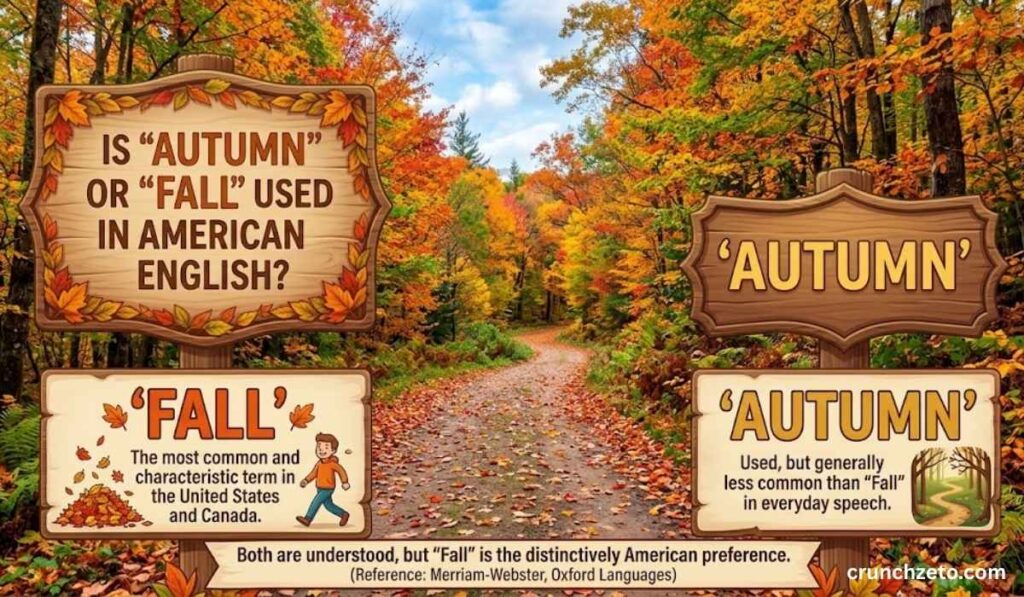
Yes, both are used in American English. Fall is the everyday favorite. You will hear it at school, at work, and in stores.
Here are a few places where fall is the standard choice in the United States:
- Fall semester
- Fall sale
- Fall foliage
- Fall festival
Autumn still has a place. Writers use it in poems, books, and magazines. It can give a sentence a softer, more graceful tone. The phrase “autumnal equinox” is also the standard science term for the date when day and night are nearly equal in length.
Canadians use both words. British, Irish, and Australian English lean toward autumn. Australia has the opposite seasons from the Northern Hemisphere, so autumn there runs from March to May.
How Do You Pronounce Autumn?
Autumn is pronounced AW-tum. The final “n” is silent. English has a few words like this, such as “column” and “hymn.”
Fall is easy. It rhymes with “ball” and “call.”
The adjective autumnal is different. Here the “n” is spoken. It sounds like aw-TUM-nul. This trips up many people.
What Are the Grammar Rules for Autumn and Fall?
Both words are common nouns. That means you do not need a capital letter unless the word starts a sentence or is part of a title. Write “I love autumn,” not “I love Autumn.”
Here are the main forms:
- Plural of autumn: autumns. Example: “We have had three warm autumns in a row.”
- Plural of fall: falls. Example: “Falls in the mountains can be cold.”
- Adjective form of autumn: autumnal. Example: “The room had an autumnal glow.”
- Verb form of fall: fall, falls, fell, fallen, falling.
Autumn is not a verb. You cannot say “The leaves autumn.” Fall is the only one of the two that works as a verb, and that is a different meaning from the season.
Both words can work like adjectives when they come before another noun. You can say “autumn colors” or “fall colors.” Both are fine.
Do you need a “the” or “in”? Use “in” for seasons. You can say “in autumn” or “in the fall.” Both patterns are natural. In American English, “in the fall” is more common than “in fall,” though “in fall” also appears in writing.
Common Idioms and Phrases with Fall and Autumn
Fall is in many idioms. An idiom is a phrase with a special meaning. It does not mean the exact words.
Here are some easy ones:
- Fall in love means to start loving someone.
- Fall behind means to be slower than others.
- Fall apart means to break or lose control.
- Fall short means to not reach a goal.
- Spring forward, fall back helps you change your clock.
Autumn has fewer idioms. One is “autumn years.” It means the later part of life. People use it in a kind and gentle way.
How Do You Use Autumn and Fall in a Sentence?

Here are natural examples for different situations.
Everyday talk:
“Fall is my favorite time to go hiking.”
Workplace email:
“Our new training program will begin in the fall.”
School or academic writing:
“Students must register for the fall semester by August 15.”
Business writing:
“The company will launch its autumn collection in September.”
Formal or literary writing:
“The autumn light settled softly over the hills.”
Casual message:
“Can’t wait for fall. Pumpkin everything is coming!”
The business example uses autumn because fashion brands often like its polished sound. The literary example uses autumn because it fits the gentle, artistic tone. Neither choice is required. They simply suit the mood.
What Mistakes Do People Make with Autumn and Fall?
These mistakes are common. They are also easy to fix.
Mistake 1: Saying one word is wrong
Incorrect: “Fall is not the right word for the season.”
Correct: “Fall and autumn both name the season.”
Both words are real English. Fall is not slang, and autumn is not old-fashioned.
Mistake 2: Saying the silent “n”
Incorrect: pronouncing it “aw-TUMN”
Correct: pronouncing it “AW-tum”
Only the adjective autumnal uses the “n” sound.
Mistake 3: Using autumn as a verb
Incorrect: “The leaves autumn in October.”
Correct: “The leaves fall in October.”
Autumn only names the season. Fall is the word for dropping.
Mistake 4: Mixing the words in a way that confuses readers
Incorrect: “Our fall sale ends before autumn arrives.”
Correct: “Our fall sale ends before the season is over.”
Mixing both words in one short text can make readers wonder if you mean two different things. Pick one and stay with it.
Mistake 5: Capitalizing the season
Incorrect: “I love Autumn.”
Correct: “I love autumn.”
Season names are lowercase in standard American English.
These are normal slips. Even native speakers make them.
Which Word Should You Choose: Autumn or Fall?
Think about your reader first.
If you write for readers in the United States, fall is usually the friendliest choice. It sounds natural and warm. It also fits school schedules, store sales, and job notices.
If you write for readers in the United Kingdom, Ireland, or Australia, autumn is the better choice. It is what those readers expect.
If your audience comes from many countries, autumn is the safest word. Everyone understands it. Fall is understood too, but some people outside North America may link it first to the verb.
If you want a soft, poetic feel, autumn often works best. If you want a casual, everyday feel, fall is a good pick.
Whichever word you choose, keep it steady through the whole piece. A small habit like that makes your writing feel clean and confident.
Do British People Say Fall or Autumn?
Most British people say autumn. They use it in British English every day. Fall sounds more American to them.
Long ago, people in England also said fall. It came from the phrase “fall of the leaf.” Over time, autumn became the usual word in the UK. In the US, fall stayed popular.
Canada uses both words. Australia and New Zealand mostly say autumn. So your audience and country decide the best word.
Autumn vs. Fall Practice Quiz
Try this short quiz. Pick the best word for each sentence. Answers are below.
- Many Americans say ___ for the season. (autumn/fall)
- Leaves ___ from the trees. (fall/autumn)
- We use lowercase in “I like ___ weather.” (Fall/fall)
- A UK writer would likely say ___. (autumn/fall)
- The adjective form is ___. (autumnal/fally)
Answers: 1) fall, 2) fall, 3) fall, 4) autumn, 5) autumnal.
FAQ About Autumn vs. Fall
Is it autumn or fall in American English?
Both are correct in American English. Fall is more common in everyday speech. Autumn appears often in formal writing, literature, and science terms like “autumnal equinox.”
Do autumn and fall mean the same thing?
Yes. Both name the season between summer and winter. The difference is in style and region, not meaning.
Do British people say fall?
Not often. Most British people say autumn in daily speech. Fall sounds American to them. They still understand it from movies and books.
Is fall older than autumn?
As a season name in English, autumn is older. It came from Old French and Latin. Fall came later from “fall of the leaf.” People shortened it over time.
Is autumn more formal than fall?
Many writers feel autumn is a bit more formal and poetic. Fall is casual and common. Both are correct. Choose by your tone and audience.
When does autumn start each year?
Astronomical autumn starts around September 22 or 23. Meteorological autumn starts on September 1. In 2026, the equinox fell around September 22 or 23.
Should I capitalize autumn and fall?
No. Use lowercase for both words. Capitalize them only at the start of a sentence or inside a title. This follows standard grammar rules.
Why do Americans say fall?
Fall comes from the old English phrase “fall of the leaf.” English settlers brought the word to North America. It stayed popular there while autumn became the normal choice in Britain.
Is “the fall” or “fall” correct without “the”?
Both work. “In the fall” is the more natural pattern in speech. Either is understood.
How do I use autumn in a sentence?
Use it like any other season name. Example: “We visit my grandparents every autumn.” You can also place it before a noun: “The autumn air felt crisp.”
Conclusion
Autumn and fall name the same season, so you cannot go wrong with either one. Pick fall for a friendly, everyday American tone. Pick autumn when you write for readers in the UK, or when you want a softer, more graceful feel. Say the word “AW-tum” without the last “n.” Most of all, stay with one word from start to finish. That small habit keeps your writing clear.

Oliver Matthew Wilson is a passionate English language and grammar writer who enjoys making grammar, spelling, vocabulary, and writing concepts simple and easy to understand. With a focus on clear explanations and practical examples, Oliver Matthew Wilson creates helpful content for students, writers, and everyday English learners. His goal is to make learning English more enjoyable, useful, and accessible to everyone.
