


You’re typing a note about your weekend on the slopes. Then you stop. Is it skied or skiied? Here’s the quick answer. Skied is the correct spelling of skied. The other form is a common misspelling, so skiied isn’t a real word. Many people ask, is skiied a word, and the answer is no. It’s an easy slip to make.
The past tense of ski follows a simple rule. You add “ed” and stop. That’s why ski becomes skied, and it shows you how to spell skied the right way every time. In this guide, you’ll see skied vs skiied side by side. You’ll also learn the skied spelling rule, its history, and real examples. Let’s clear it up together.
Skied or Skiied: Quick Answer
Let’s settle it fast. The correct spelling of skied has one “i” before the “e.” You write it as s-k-i-e-d.
The form with two “i” letters looks odd for a reason. English doesn’t ask you to double that vowel. We’ll get to the why soon.
Skied
Skied is the ski past tense and the past participle of ski. It works for any person and any number. You can say “I skied,” “she skied,” or “they skied.”
The ski verb is regular here. You simply follow the ski + ed pattern. Nothing tricky happens to the base word.
Skiied
Skiied shows up in drafts, texts, and search boxes. People type it by habit. It’s the skiied spelling that dictionaries don’t list.
If you wrote it, don’t worry. You’re in good company. Most writers who make this slip are thinking about the word “skiing.”
Quick Examples
Seeing the word in action helps. Here are a few fast examples of skied:
- We skied down the mountain before lunch.
- He had skied only once before this trip.
- My cousin skied across the frozen lake.
Now compare the wrong version. “We skiied all day” has the extra “i.” Fix it by deleting one letter.
Is Skied a Word?
Yes, it is. Skied is a real, fully accepted word. You’ll find it in major dictionaries and in everyday news writing.
So when people ask, is skied correct, the answer is a clear yes. And when they ask, is skiied a word, the answer is no.
Skied Meaning
The skied meaning is simple. It describes the act of gliding over snow on skis. It’s the past form of the action.
The skied definition can also stretch a little. You can say someone skied a slope, a trail, or a whole mountain. Each use points to the same idea.
Skied Pronunciation
Say it like “skeed.” The vowel sound is a long “ee.” The ending is a soft “d.”
The skied pronunciation matches the word “freed” or “need.” The skiied pronunciation would sound the same, which is part of why people mix them up.
Skied in a Sentence
These show skied in a sentence with different moods:
- Last winter, I skied with my brother in Colorado.
- She skied better after one good lesson.
- Have you ever skied at night?
Try writing your own. Pick a trip you remember. Then use the word once.
What Is the Past Tense of Ski?
Many learners search for the past tense of ski. They want one clean answer. Here it is: the past tense is skied.
The word follows the usual path for regular verb past tense forms. You add “ed” and you’re done.
Ski Past Tense and Past Participle
For this verb, the ski past tense and past participle look the same. Both are skied. That makes life easier.
Here’s how it plays out. “I skied yesterday” uses the simple past. “I have skied there before” uses the past participle.
Why Ski Becomes Skied
The ski grammar rule is plain. The word ends in the letter “i,” so you add “ed” and keep everything else. That gives you skied.
This answers the big question: why ski becomes skied. No extra letter is needed. English only doubles certain consonants, like in “stop” and “stopped.” It doesn’t double vowels this way.
Skied vs Skiied: Key Differences
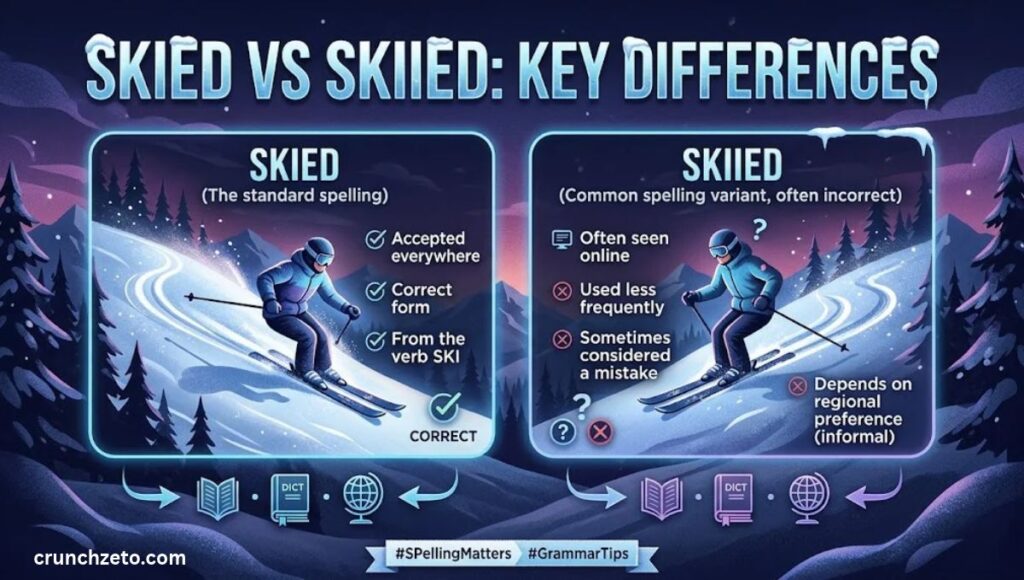
The two spellings look close. Only one is right. This section sorts them out so you can see the gap.
Think of it like a road sign. One points the right way. The other sends you in a circle.
Correct Spelling
The correct form of ski in the past tense is skied. Use it in school work, emails, blog posts, and reports.
This is the skied correct form in both American English spelling and British English spelling. No region changes it.
Read More: Training vs Trainning: Which One Is Correct?
Common Misspelling
The skiied misspelling comes from mixing two ideas. People remember “skiing” has two “i” letters. Then they paste that look onto the past tense.
It’s an honest slip. Still, spell check will flag it. Readers might notice it too.
Comparison Table
This table gives you a fast skied vs skiied view.
| Feature | Skied | Skiied |
| Correct spelling | Yes | No |
| In dictionaries | Yes | No |
| Pronunciation | skeed | skeed (but misspelled) |
| Used in formal writing | Yes | Never |
| Valid in Scrabble | Yes | No |
The table says it all. When you see skied or skiied in a draft, pick the first one.
Why Do People Spell It Skiied?
So why does the wrong version appear so often? The answer sits in the word “skiing.” It has two “i” letters side by side, and the eye remembers that shape.
That memory spills over into the past tense. It feels like the double “i” should travel with the word.
Another reason is sound. The word ends in a long “ee” and then “d.” Some writers hear a stretched vowel and try to show it on the page.
Autocorrect and fast typing add to the problem. A finger repeats a key, and a typo is born. If you ask why not skiied, the spelling rule for ski gives the answer. English doesn’t need that second “i.”
Here’s a handy trick. Say “ski” and “ed” as two parts. Then glue them together. You get ski + ed, and that equals skied.
The Origin and History of Skied
The word ski is old. It came into English from Norwegian. That word traces back to an Old Norse term for a piece of split wood or a stick.
People in Scandinavia used skis for travel long before sport. Hunters crossed deep snow with them. Soldiers used them too.
English borrowed the noun first. Later, speakers turned it into a verb. Once it became a verb, it took the normal ending “ed.”
That’s how skied joined the language. It didn’t need special treatment. It simply followed the same path as many other verbs.
Today, English verb conjugation treats it like any other regular verb. You get ski, skis, skied, and skiing. Each form has its job.
British English vs American English
Some words change across the Atlantic. Think of “color” and “colour.” So it’s fair to ask if this word does the same.
Good news: it doesn’t. Both sides use the same form.
Is Skied Different in British English?
No, it isn’t. Skied British English and skied American English are identical. Both use skied as the past form.
That means you can skip any worry about regional style. Pick skied and move on. It’s one of the easy ones.
Comparison Table
Here’s a quick look.
| Form | American English | British English |
| Past tense | skied | skied |
| Past participle | skied | skied |
| Present participle | skiing | skiing |
| Third person | skis | skis |
No differences show up. That keeps your writing simple for global readers.
Common Mistakes With Skied
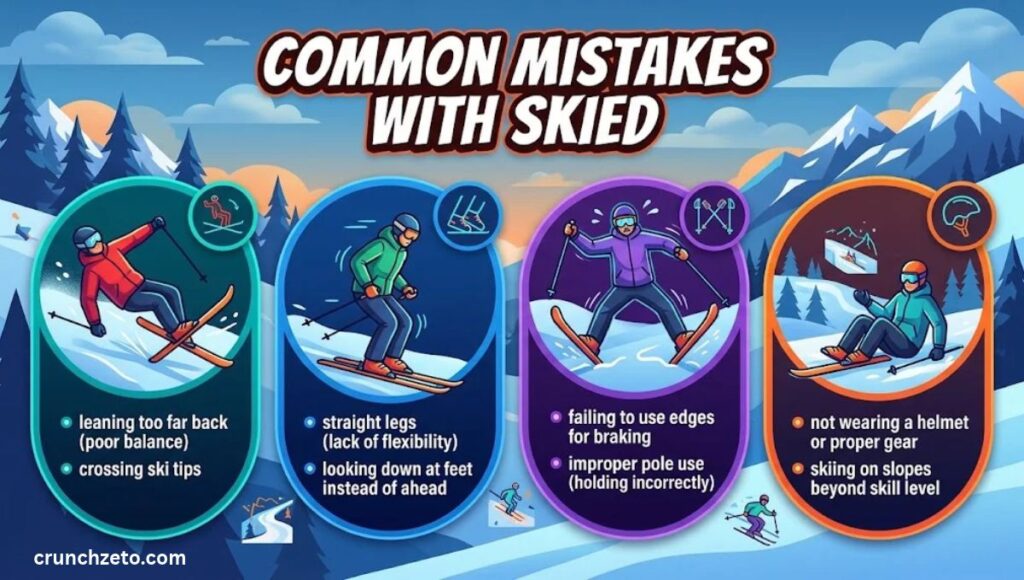
Spelling slips often come in groups. Once you know them, you can spot them in seconds. Let’s look at the top three.
These are the common mistakes with skied that I see most. They’re also the common mistakes when spelling ski.
Skiid vs Skied
Some writers shorten the error to skiid. They drop the “e” and keep two “i” letters. Sadly, that’s still wrong.
The is it skiid or skied question has a firm answer. Use skied. The “e” is needed.
Skied vs Skiing
The next mix-up is about tense. Skied points to the past. Skiing points to an action in progress or a general activity.
That covers the difference between skied and skiing. Compare “I skied on Friday” with “I’m skiing right now.” You can also say “I was skiing” for a past action that was ongoing. The skied vs was skiing choice depends on what you want to stress.
Here’s the tip. Use “skied” for a finished event. Use “was skiing” for the background of a story.
Skied vs Ski’d
Some people write ski’d with an apostrophe. They think it works like a contraction. It doesn’t.
The apostrophe isn’t needed for the plain past tense. Stick with skied. It looks cleaner and matches the dictionary.
Skied in Everyday Examples
Grammar sticks when you see it in real settings. So let’s walk through a few. These skied examples in everyday English cover different styles.
Notice the tone changes. The spelling doesn’t.
Skied in Emails
Emails are quick, so slips happen. A friendly note might say, “I skied with the team last weekend, and I’m still sore.” That works well.
A work note could say, “Our guests skied in the morning and joined the dinner at six.” Keep it short. Keep the spelling right.
Skied in News Writing
News stories often use skied in plain, factual lines. For example: “The athlete skied the course in record time.” The line is clear and tight.
Editors want clean copy. A wrong spelling can hurt trust. That’s why standard English spelling matters in print and online.
Skied in Social Media
Posts are casual. Still, the word keeps its shape. You might see “Just skied my first black diamond!” under a mountain photo.
People forgive typos online, but they do notice. A tidy post feels more polished, and it’s easy to do.
Skied in Formal Writing
In essays, reports, and travel guides, tone gets more serious. A line like “The expedition skied across the plateau over six days” fits well.
For formal English usage, avoid ski’d and skiied. Use skied every time. It’s the safe, standard choice.
Skied Meaning in Different Contexts
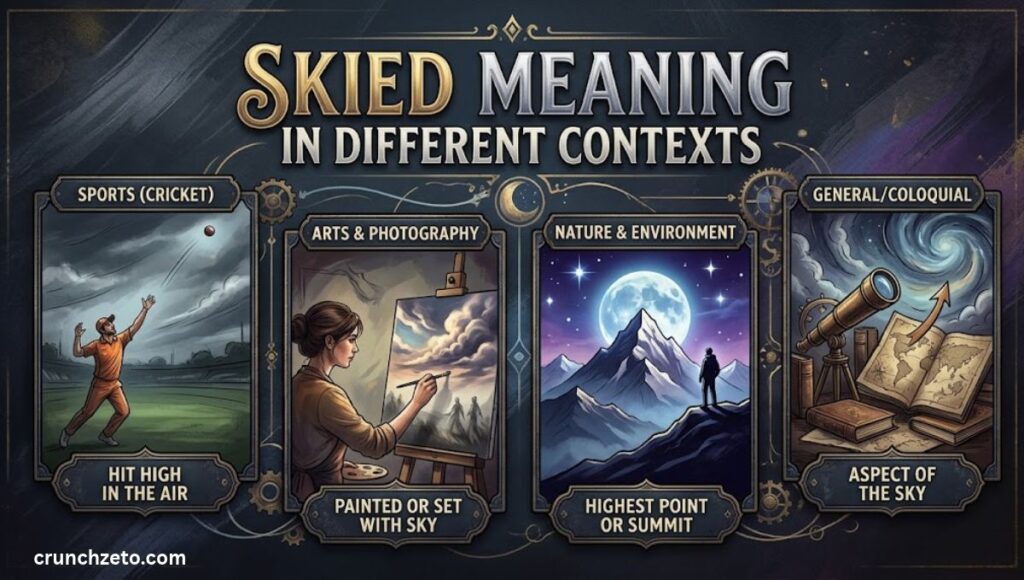
Words can wear many hats. This one does too. Beyond snow sports, it shows up in a few fun places.
Let’s look at two of them.
Skied It Meaning in Football
In football, the phrase “skied it” means someone kicked the ball very high. Often it goes up and away without much purpose. The ball “goes into the sky.”
For example: “He skied the shot over the bar.” The player aimed for the goal but sent the ball way too high. Cricket and golf fans use the word in a similar way.
Skied or Skiied Slang
Slang has its own flavor. The word skied still keeps its one “i” in casual talk. The skiied meaning doesn’t exist because the word isn’t real.
Snow fans have fun terms, though. A “ski bum” is someone who lives for the slopes. A “snow bunny” is a casual name for a newer skier. These are slang, so use them with care.
Is Skied a Scrabble Word?
Word game fans always ask about this one. Good news: skied is playable. It’s accepted in the major Scrabble word lists.
It scores nicely too. The letter K is worth five points. Add a double or triple word square, and you’ve got a strong play.
Is Skiied a Scrabble Word?
No, it isn’t. Skiied isn’t valid, so you’d lose a turn if challenged. Don’t risk it.
A good habit is to test spellings in a word list before play. That also builds your sense of English spelling rules.
Quick Rules to Remember
Let’s pull the past tense spelling rules into one simple set. These help with more than just this word. You can use them for many verbs.
- Add “ed” to most regular verbs.
- Don’t double a vowel when you add “ed.”
- Double the final consonant only when the pattern calls for it, like “hop” and “hopped.”
- When a verb ends in “e,” add only “d,” like “bake” and “baked.”
This is your grammar rule for skied in a nutshell. It also explains does ski take ed. Yes, it does.
Verbs Ending in I
The letter “i” at the end of a verb is rare. That’s why it feels odd. Still, the pattern is steady.
Look at the verbs ending in i. They take a plain “ed” or change the “y” to “i” first. Here are some adding ed to verbs examples: die died, tie tied, ski skied, and “taxi taxied.”
Notice something. None of them add a second “i” by itself. That’s the proof you need.
Easy Memory Tricks
Rules are great. Tricks are better. Here are three that work.
First, split it in two. Say “ski” and “ed.” Join them and stop. Second, picture the word “tied.” You’d never write “tiied,” so don’t write “skiied.” Third, remember that “skiing” is the only common form with two “i” letters in a row.
Practice helps. Write the word five times. Then use it in a sentence about your next trip.
Skied or Skiied: Frequently Asked Questions
Here are quick answers to the top questions. Each one is short and clear.
Is it skiid or skied?
It’s skied. The form skiid is a misspelling. Keep the “e” at the end.
What does skied mean?
Skied means someone traveled on skis in the past. It’s the past tense and past participle of the verb ski. You can also use it in sports talk, like a football kick that went way too high.
Is skied a Scrabble word?
Yes. Skied is valid in standard Scrabble lists. It’s a handy play when you have the right tiles.
Is skiied ever correct?
No. Is skiied ever correct? Not in any major dictionary, style guide, or game list. Use skied instead.
What is a slang word for a skier?
Common fun terms include “ski bum,” “shredder,” and “snow bunny.” Tone and context matter, so choose carefully. Some words can sound teasing.
What does bunny slope mean?
A bunny slope is a gentle hill for beginners. It’s usually short and not steep. Most resorts keep one near the base area so new skiers can practice safely.
Conclusion
So, skied or skiied? The answer is skied, every time. It’s the correct spelling of skied, and skiied is just a common misspelling. People make it because “skiing” has two “i” letters in a row, but the past tense of ski doesn’t need that extra letter.
Remember the ski grammar rule. You add “ed” to the ski verb, and you’re done. That’s why ski becomes skied, just like die died and tie tied. The skied spelling is the same in American English and British English, and it’s valid in Scrabble too. Whenever you doubt it, split the word into ski + ed and you’ll get it right.

Oliver Matthew Wilson is a passionate English language and grammar writer who enjoys making grammar, spelling, vocabulary, and writing concepts simple and easy to understand. With a focus on clear explanations and practical examples, Oliver Matthew Wilson creates helpful content for students, writers, and everyday English learners. His goal is to make learning English more enjoyable, useful, and accessible to everyone.
