


You are typing a sentence about the human body when you stop. Should the plural be bodies or bodys? Many writers freeze at this spot, and that is normal. The confusion around bodies vs bodys happens because most English plurals simply add an s. Body does not follow that pattern, and the odd spelling can look wrong even when it is right.
Bodies is the correct plural of body. Bodys is a spelling mistake in standard English. When a word ends in a consonant plus y, you change the y to ies. This guide explains that rule in plain words, shows real examples, and clears up body’s too. No grammar degree needed. By the end, you will spell it right every time.
Is It Bodies or Bodys? The Short Answer
Use bodies. It is the plural of body. You use it when you mean more than one body.
Bodys does not exist as a normal English word. Dictionaries do not list it as a plural. Most spell checkers will underline it in red.
So, in the bodies vs bodys debate, there is only one winner. Write “two bodies,” not “two bodys.”
What Does Bodies Mean?
Bodies is the plural noun for body. Body has several meanings, so bodies does too.
Here are the most common ones:
- The physical form of a person or animal. “Our bodies need sleep.”
- A dead person. “Rescue teams found two bodies.”
- A main part of something. “The bodies of the letters were short.”
- A group that works together. “Several governing bodies agreed on the plan.”
- A large amount of something. “Lakes and oceans are bodies of water.”
- A vehicle’s outer shell. “The shop repairs car bodies.”
The spelling stays the same in every case. Only the meaning changes.
Why Is Bodys Wrong?
Bodys breaks a basic English spelling rule. The word body ends in a consonant (d) followed by y. That pattern has a set plural rule.
The writer who types bodys is usually thinking of the simple “add an s” habit. That habit works for most nouns. Cats, books, and chairs all take a plain s.
But words that end in a consonant plus y act differently. They need a spelling change first. That is why bodys looks fine to the eye but fails the rule.
It is also a common typing slip. Fingers move fast. The mistake is easy to make and easy to fix.
There is one rare exception. A family named Body would be “the Bodys,” because names keep their y. That is a name, not the plural of the common noun.
The Consonant Plus Y Rule Explained
Here is the rule in one line: when a noun ends in a consonant plus y, drop the y and add ies.
Let us walk through body.
- Start with the singular: body.
- Check the letter before the final y. It is d, which is a consonant.
- Drop the y.
- Add ies.
- You get bodies.
The same rule works for many everyday words:
| Singular | Plural |
| baby | babies |
| city | cities |
| party | parties |
| story | stories |
| country | countries |
| company | companies |
| puppy | puppies |
Think of it this way. The y waves goodbye, and ies takes its seat. Once you see the pattern, you can spell hundreds of words.
What About Words With a Vowel Before the Y?
The rule only applies to a consonant before the y. A vowel before the y changes everything.
When a vowel comes before the final y, you just add s. The y stays.
| Singular | Plural |
| boy | boys |
| toy | toys |
| key | keys |
| day | days |
| monkey | monkeys |
| tray | trays |
Look at the letter before the y in each word. In boy, it is o. In key, it is e. Both are vowels, so the y stays.
Now look at body again. The letter before the y is d. A consonant. So it needs ies.
This is the whole trick. Check the letter before the y. Vowel means add s. Consonant means change to ies.
Read Related Post: Envisage vs Envision: Meaning, Difference, and Usage Explained
Bodies vs Bodys vs Body’s: Comparison Table
Three spellings cause most of the trouble. Only some of them are real. This table shows the difference at a glance.
| Term | Correct? | Meaning | Use |
| bodies | Yes | More than one body | “Both bodies were found.” |
| bodys | No | Not a standard word | Avoid it |
| body’s | Yes | Belongs to one body, or “body is” | “The body’s weight changed.” |
| bodies’ | Yes | Belongs to more than one body | “The bodies’ markings matched.” |
Notice that the apostrophe changes the job of the word. Bodies is a plain plural. Body’s shows ownership or shortens “body is” or “body has.”
Bodys has no job at all. That is why it never earns a “Yes.”
When Should You Use Body’s With an Apostrophe?
Use body’s when something belongs to one body. The apostrophe plus s shows possession.
Here are some examples:
- “The body’s natural defenses fight germs.”
- “A runner’s body’s needs change with age.”
- “Cold weather affects the body’s temperature.”
In each sentence, the body owns something. A defense, a need, a temperature.
Body’s can also be a short form of “body is” or “body has.” For example, “The body’s working hard after that race” means “The body is working hard.” And “The body’s been resting” means “The body has been resting.”
Here is a quick test. Replace body’s with “body is” or “body has.” If the sentence still makes sense, it is a contraction. If not, it is likely possessive.
The key point is simple. Body’s never means more than one body. For that, you need bodies.
What About Bodies’ With the Apostrophe After the S?
Sometimes you need a plural possessive. That means more than one body owns something. The form is bodies’, with the apostrophe after the s.
You get it in two steps. First, make the plural: bodies. Then, add an apostrophe after the s.
Examples:
- “The bodies’ temperatures were checked every hour.”
- “Both governing bodies’ rules were updated.”
This form is less common than body’s. You may only need it in science, medical, or legal writing. Still, it follows the same logic as other plural possessives. Plural first, apostrophe second.
How Do You Pronounce Bodies?
Bodies sounds like BAH-deez in American English. The stress falls on the first part. The ending sounds like “deez.”
The singular body sounds like BAH-dee. So the plural just swaps the “dee” ending for “deez.”
Here is a surprise. Bodies, body’s, and bodies’ all sound exactly the same when you say them aloud. They are homophones. That is one reason people mix them up in writing.
Speech cannot show the difference. Only spelling and punctuation can. So when you write, you must decide which job the word is doing.
Where Does the Word Body Come From?
Body comes from Old English. The early form was bodig. It first referred to the trunk or torso of a person, and later the whole physical form.
The origin before Old English is unclear. Experts do not agree on a firm older source, so it is best not to guess.
What we do know is helpful. The word has been in English for a very long time. As it changed over the centuries, the spelling moved to the modern body. The plural settled into bodies, following the same pattern as other words that end in a consonant plus y.
The word also grew new meanings. It came to describe groups, main parts, and large amounts of something. That is how we got phrases like “a body of work” and “a body of water.”
Bodies vs Bodys in Real Sentences
Seeing the right form in context makes it stick. Here are natural examples from different settings.
Everyday conversation
- “After the marathon, our bodies were sore for days.”
- “Kids’ bodies grow fast during the teen years.”
Workplace and email
- “Several oversight bodies will review the report.”
- “Please send the quote for the truck bodies by Friday.”
Academic writing
- “Researchers studied how human bodies respond to heat.”
- “The paper cites two large bodies of evidence.”
Formal writing
- “Regulatory bodies must approve the final plan.”
Casual writing
- “My phone’s body is cracked, but the screen is fine.”
Let us look at one example more closely. “Two large bodies of evidence” uses bodies because it means more than one body of evidence. The word “bodies” changes, but “of evidence” stays the same.
This is a good habit in bodies vs bodys questions. Find the noun that is plural, then fix it. Do not change the rest of the phrase.
Common Mistakes With Body, Bodies, and Body’s
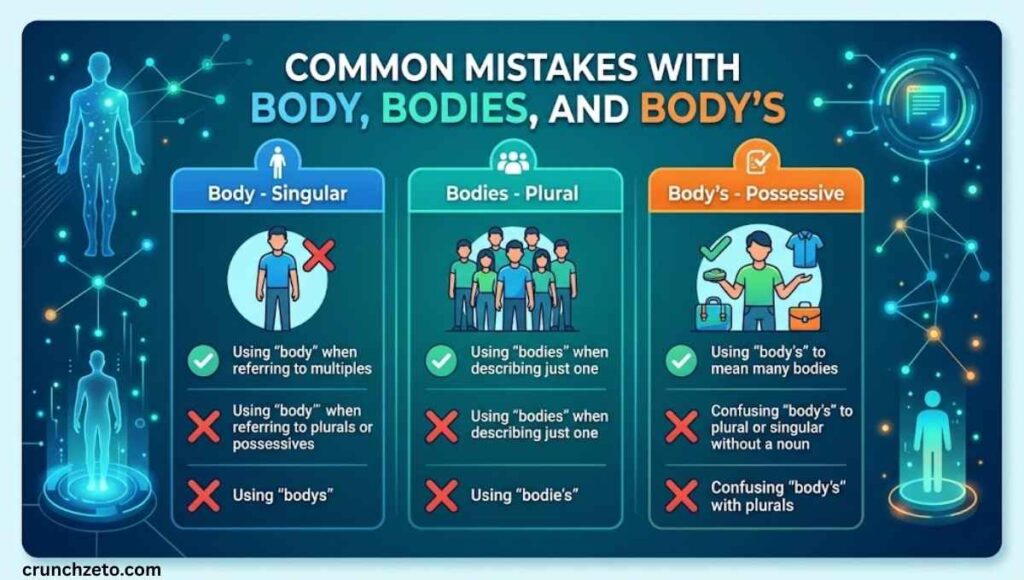
Everyone makes spelling slips. These are the ones people repeat most. None of them are a big deal once you spot the pattern.
Mistake 1: Adding only an s.
Incorrect: The two bodys were found near the lake.
Correct: The two bodies were found near the lake.
Body ends in a consonant plus y. So the y must change to ies.
Mistake 2: Using an apostrophe for a plain plural.
Incorrect: The two body’s were identical.
Correct: The two bodies were identical.
An apostrophe does not make a plural. Use it only for ownership or a contraction.
Mistake 3: Forgetting the apostrophe for ownership.
Incorrect: The bodies temperature rose quickly.
Correct: The body’s temperature rose quickly.
Here, one body owns the temperature. So the sentence needs body’s.
Mistake 4: Mixing up body’s and bodies in phrases.
Incorrect: Rivers and lakes are body’s of water.
Correct: Rivers and lakes are bodies of water.
The phrase means many bodies of water. It is a plural, not a possessive.
Each of these slips has one thing in common. The writer picked the right word but the wrong form. Slow down for a second and ask, “Is this plural, possessive, or both?”
American and British English: Any Difference?
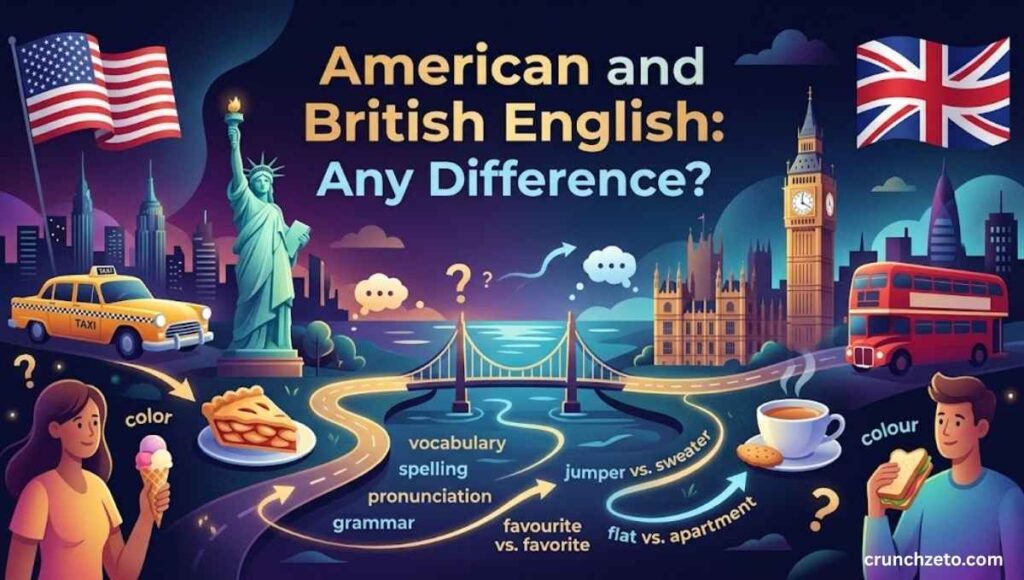
Good news for bodies vs bodys fans. There is no difference between American and British English here. Both use bodies for the plural. Both treat bodys as a spelling mistake.
Many other word pairs do split between the two. Think of color and colour, or center and centre. This one does not.
The y to ies rule is also shared. Cities, babies, and stories are spelled the same on both sides of the Atlantic.
So you can write bodies with total confidence. It works for readers in the US, the UK, Canada, and Australia.
How Can You Remember the Right Spelling?
A few quick tricks can lock this in.
Try the baby test. You would never write “babys.” You write babies. Body follows the same pattern, so write bodies.
Check the letter before the y. If it is a consonant, switch to ies. If it is a vowel, keep the y and add s. Body has d before the y. Boy has o.
Use the “more than one” check. Say the phrase in your head. If you mean more than one, use bodies. If you mean ownership, use body’s.
Read it aloud and then look at it. The sound of “deez” at the end should match the ies spelling. It will not match the s alone.
Practice with a few words. Try city, story, and country. Then try boy, key, and toy. After a few rounds, the rule becomes automatic.
Bodies vs Bodys FAQs
Is bodys a word?
No. Bodys is not a standard English word. It is a common misspelling of bodies. The only time you might see it is as a family name, such as the Bodys.
Is bodies correct?
Yes. Bodies is the correct plural of body. Use it any time you mean more than one body, such as “human bodies” or “bodies of water.”
What is the plural of body?
The plural of body is bodies. The y changes to ies because a consonant comes before the final y.
How do you spell bodies?
Spell it b-o-d-i-e-s. Drop the y from body and add ies. That is the same rule that gives you babies and cities.
What is the difference between bodies and body’s?
Bodies means more than one body. Body’s shows that one body owns something, or it is a short form of “body is” or “body has.” For example, “The bodies were cold” is plural. “The body’s heat faded” is possessive.
How do I use bodies in a sentence?
Use it as a plain plural noun. For example: “Athletes train their bodies for years.” In the bodies vs bodys choice, bodies is always the one that fits.
The Simple Takeaway on Bodies vs Bodys
The answer to bodies vs bodys is simple. Bodies is the only correct plural of body. Bodys is not a standard word, and most spell checkers will flag it. The reason is the consonant plus y rule: drop the y and add ies.
Keep the apostrophe in mind too. Use body’s for ownership, like the body’s natural cooling system. Use bodies for more than one. If you can say “more than one” in your head, choose bodies. That one check solves almost every case, and it works for babies, cities, and stories as well. Now you know the rule. Write it with confidence.

Oliver Matthew Wilson is a passionate English language and grammar writer who enjoys making grammar, spelling, vocabulary, and writing concepts simple and easy to understand. With a focus on clear explanations and practical examples, Oliver Matthew Wilson creates helpful content for students, writers, and everyday English learners. His goal is to make learning English more enjoyable, useful, and accessible to everyone.
