


Is it my parents’ house or my parent’s house? Many people stop and think before they type it. The apostrophe looks small, but it changes the meaning. That is why Parents’ vs Parent’s confuses students, workers, and even careful writers. The short answer is simple. Parent’s means one parent owns something. Parents’ means two or more parents share it.
This guide explains Parents’ vs Parent’s in plain words. You will also learn when to use plain parents with no apostrophe. Most mistakes happen because writers add an apostrophe to every plural. We will fix that habit step by step. Each rule comes with short examples. By the end, you can pick the right form in seconds.
Parents’ vs Parent’s: The Quick Answer
Parent’s shows that one parent owns or has something. Parents’ shows that two or more parents own or share something. Parents with no apostrophe only means more than one parent. It shows no ownership at all.
Here are three quick examples:
- A parent’s advice can stay with a child for years.
- The parents’ meeting starts at 6 p.m.
- Both parents came to the show.
The apostrophe does one job here. It shows ownership. Its position tells you how many owners there are. An apostrophe before the s points to one owner. An apostrophe after the s points to many owners.
What Does “Parents” Mean?
Parents is a plural noun. It means more than one parent. A parent is a person who raises a child. This can be a birth parent, an adoptive parent, a stepparent, or a guardian who acts as a parent.
You make the plural by adding an s to the word parent. Nothing else is needed. The apostrophe has no place here.
- My parents live in Texas.
- Parents must sign the form by Friday.
- Many parents help with school events.
The word parent can also be a verb. It means to raise a child. So parents can be a verb form too, as in “She parents two kids.” In that case, the s shows the verb is in third person singular. Still, no apostrophe is used.
What Does “Parent’s” Mean?
Parent’s is the singular possessive form. It shows that one parent owns something or is linked to something. The apostrophe plus s is added to a singular noun. This is the same pattern you use for dog’s, teacher’s, or neighbor’s.
- A parent’s job is never really finished.
- Please bring a parent’s signature to school.
- Her parent’s advice helped her choose a college.
Notice the key idea. Only one parent is involved in each sentence. If you mean one person, parent’s is the right choice.
Sometimes a name is clearer. “My mom’s house” is easier to read than “my parent’s house.” Both are correct. Use the one that fits your sentence best.
Read Related Post: Labelling vs Labeling: Which Spelling Is Correct?
Parents’ vs Parent’s Comparison Table
This table shows how each form works. All three forms are correct when used in the right place. The only incorrect form is the last one.
| Form | Correct? | Meaning | Example |
| parents | Yes | More than one parent | My parents called me. |
| parent’s | Yes | One parent owns something | A parent’s love is steady. |
| parents’ | Yes | Two or more parents own something | The parents’ car is new. |
| parents’s | No | Not used in standard English | Use parents’ instead. |
None of these forms is wrong on its own. They do different jobs. The mistake happens when a writer picks the wrong job for the sentence.
How to Choose the Right Form in Three Steps
Use this short test whenever you feel stuck on Parents’ vs Parent’s. It works for emails, homework, and work documents.
- Ask if anything belongs to the parents. If nothing does, write parents with no apostrophe.
- If something does belong to them, count the owners. One owner means parent’s.
- If there are two or more owners, write parents’.
Here is a second trick. Turn the phrase around with the word “of.”
- “The house of my parents” becomes “my parents’ house.”
- “The advice of a parent” becomes “a parent’s advice.”
If the “of” version sounds natural, you need a possessive. Then count the owners. This simple flip clears up most doubts.
The confusion is easy to explain. All three forms look alike. They also sound alike. The only clue is a tiny mark, and that mark is easy to miss.
How to Pronounce Parents, Parent’s, and Parents’
All three forms sound the same. Most Americans say them like “PAIR-unts.” The apostrophe is silent. You cannot hear it in speech.
This is why the mistakes show up in writing. When you talk, your listener understands you from context. When you write, the apostrophe is the only signal.
So do not rely on your ear here. Rely on meaning. Ask yourself two things: does it show ownership, and how many owners are there?
Where Does the Word Parent Come From?
The word parent came into English from Old French. The French word came from the Latin word parens. Latin parens comes from the verb parere, which means to bring forth or to give birth.
The apostrophe has its own story. In Old English, many nouns added an ending like -es to show ownership. Over time, the e was no longer pronounced. Around the 1500s and 1600s, writers began using an apostrophe to mark the missing letter.
Later, writers also used the apostrophe for plural nouns that end in s. That is why we write parents’ today. The rules were not fixed overnight. They settled slowly into the standard form we use now.
Real Life Examples of Parents, Parent’s, and Parents’
Real sentences make the rules easier to see. Here are examples from different settings.
At home
- My parents are visiting this weekend.
- I stayed at my parents’ house over the holiday.
- I borrowed my parent’s ladder. (This works if only one parent owns it.)
At school
- The school sent a note to all parents.
- The parents’ meeting begins at 6 p.m.
- Please attach a parent’s signature to the permission slip.
The last sentence uses parent’s because only one signature is needed. If the form asked for both, you would write parents’ signatures.
At work
- Our company offers support for working parents.
- We changed the schedule to fit each parent’s needs.
- The parents’ leave policy is posted on the intranet.
In emails
- Thank you for your parents’ kind words.
- Please confirm your parents’ contact details before Friday.
In academic writing
- The study looked at parents’ attitudes toward homework.
- A parent’s reading habits may shape a child’s interest in books.
Each example matches the rule. Ownership plus one person gives parent’s. Ownership plus many people gives parents’.
Common Mistakes With Parents’ vs Parent’s
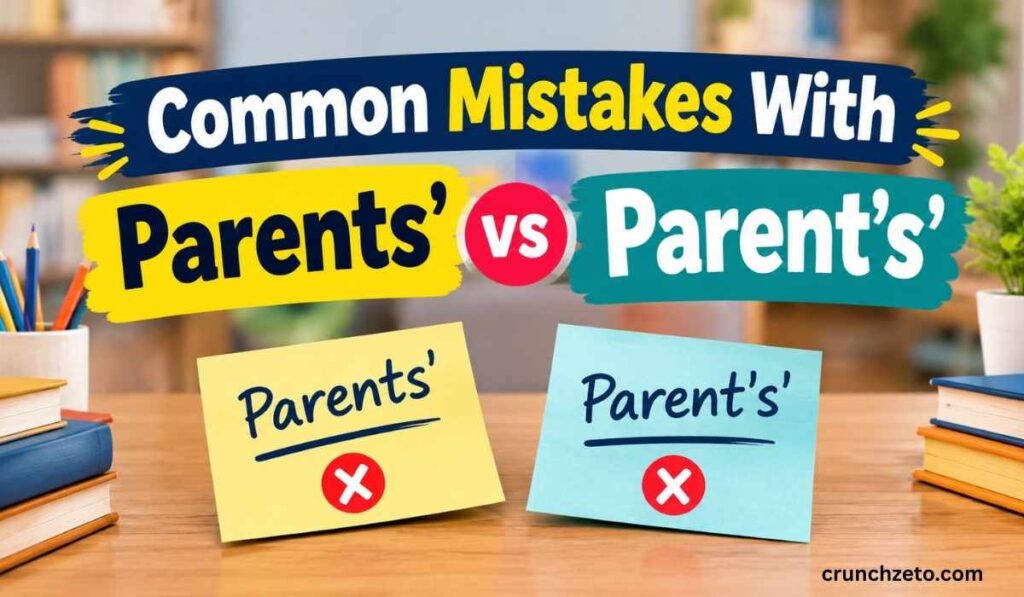
Almost everyone makes these mistakes at some point. They are normal. Here are the ones you will see most often.
Mistake 1: Adding an apostrophe to a simple plural
Incorrect: Both parent’s are coming to the show.
Correct: Both parents are coming to the show.
Nothing belongs to the parents here. So no apostrophe is needed.
Mistake 2: Using one parent when you mean two
Incorrect: My parent’s house is huge. (You mean both parents.)
Correct: My parents’ house is huge.
The apostrophe before the s points to one owner. Here you mean two.
Mistake 3: Adding an extra s
Incorrect: The parents’s meeting is tonight.
Correct: The parents’ meeting is tonight.
The plural already ends in s. You only add the apostrophe.
Mistake 4: Forgetting the apostrophe
Incorrect: The parents car was stolen.
Correct: The parents’ car was stolen.
Here the car belongs to the parents. The apostrophe shows that link.
Mistake 5: Putting an apostrophe in the subject
Incorrect: Parents’ are invited to the concert.
Correct: Parents are invited to the concert.
If the word is just the subject, it needs no apostrophe.
Keep this in mind when you check Parents’ vs Parent’s in your own writing. First look for ownership. Then count the owners.
What If Parents Share Something or Own Separate Things?
Some sentences need extra care. Here are the most common cases.
Shared ownership. When two parents share one item, use parents’ for a simple phrase: “my parents’ car.” You can also write “my mom and dad’s car.” The ’s goes on the last name only.
Separate ownership. When each parent owns a different item, use a possessive on both: “my mom’s and dad’s cars.”
Single-parent homes. If you mean only one parent, use parent’s or the person’s name: “my mom’s house.”
Parent or guardian. Forms often say “a parent’s or guardian’s signature.” That means one signature. If two people must sign, write “parents’ or guardians’ signatures.”
Parent used as a describing word. Sometimes parent acts like an adjective. Examples are parent company, parent volunteer, and parent-teacher conference. These take no apostrophe because they show no ownership.
Event names. Some schools write “Parents Night” with no apostrophe. This is a style choice for names and signs. In formal writing, keeping the apostrophe is the safer habit.
Easy Tricks to Remember Parents’ vs Parent’s
Here are three simple memory tricks. Pick the one that feels natural to you.
- Count the people first. One person gives you an apostrophe before the s. Many people give you an apostrophe after the s.
- Use “of.” Rewrite the phrase as “the [thing] of the parents.” If it works, you need a possessive.
- Picture a hook. Think of the apostrophe as a small hook. It hangs the item on its owner. Before the s, there is one hook for one owner. After the s, the hook holds items for the whole group.
Also remember one rule that helps in all cases. An apostrophe never makes a word plural. It only shows ownership or a missing letter.
Parents’ vs Parent’s Questions Answered
What is the difference between parents’ vs parent’s?
Parent’s shows that one parent owns something. Parents’ shows that two or more parents own or share something. Both are correct when they match the number of owners.
Is it “my parents’ house” or “my parent’s house”?
Write “my parents’ house” when both parents live there or own it. Write “my parent’s house” when you mean only one parent. Many writers say “my mom’s house” to be clearer.
Is parents’ singular or plural?
Parents’ is plural possessive. It refers to more than one parent. The apostrophe shows ownership, and the s at the end shows the plural.
Is “parents’s” ever correct?
No. Standard English does not use this form. The plural ends in s already, so just add an apostrophe: parents’.
Do I need an apostrophe in “parents evening”?
Standard grammar uses an apostrophe: “parents’ evening.” The evening belongs to the parents in the sense that it is held for them. Some schools drop the apostrophe in signs and event names. Formal writing should keep it.
How do I use parent’s in a sentence?
Use it when one parent owns or has something. For example: “My parent’s advice helped me prepare for the interview.” Only one parent is meant here.
Conclusion
Parents’ vs Parent’s looks tricky, but the rule is short. Check for ownership first. If nothing is owned, write parents. If one parent owns something, write parent’s. If two or more parents own something, write parents’.
Count the owners, then place the apostrophe. Before the s means one. After the s means many. Keep this one trick in mind, and you will get it right every time.

Oliver Matthew Wilson is a passionate English language and grammar writer who enjoys making grammar, spelling, vocabulary, and writing concepts simple and easy to understand. With a focus on clear explanations and practical examples, Oliver Matthew Wilson creates helpful content for students, writers, and everyday English learners. His goal is to make learning English more enjoyable, useful, and accessible to everyone.
