


You are writing a sentence and stop. Does the word have one L or two? Many writers freeze at this exact spot. Both spellings look right. Both show up online. So which one is correct?
Here is the good news. In the labelling vs labeling debate, both spellings are correct. One is American and one is British. Pick the one that matches your audience, and you are safe.
What Is the Quick Answer: Labelling or Labeling?
Use “labeling” in American English. Use “labelling” in British English.
That is the whole difference. The meaning is the same. The pronunciation is the same. Only the spelling changes.
If your readers live in the United States, write “labeling.” If your readers live in the United Kingdom, Australia, or New Zealand, write “labelling.” Canada often follows the British pattern, but Canadian writers use both.
The same rule works for the past tense. Americans write “labeled.” The British write “labelled.”
What Does the Word Label Mean?
A label is a small piece of paper, cloth, or plastic. It is attached to something. It tells you what the item is, what is inside, or who owns it.
Think of a food package. The label lists the ingredients. Think of a suitcase. The label shows the owner’s name.
The word has a second meaning too. To label someone means to describe them with a word or phrase. This use can be helpful or unfair, depending on the situation.
“Labeling” is the action of doing this. It also names the labels themselves, as a group.
Is Labeling a Noun or a Verb?
It can be both. That is why the word feels tricky at first.
As a verb form, “labeling” is the present participle of “label.” It shows an action in progress. Example: “She is labeling the boxes.”
As a noun, “labeling” names the act or the set of labels. Example: “The labeling on this bottle is clear.”
Here is a simple way to remember the forms:
- Label is the base verb and the noun.
- Labels is the plural noun and the third person verb.
- Labeled is the past tense in American English.
- Labeling is the “ing” form in American English.
The British versions are “labelled” and “labelling.” Only the doubled L is new.
Labelling vs Labeling Difference at a Glance
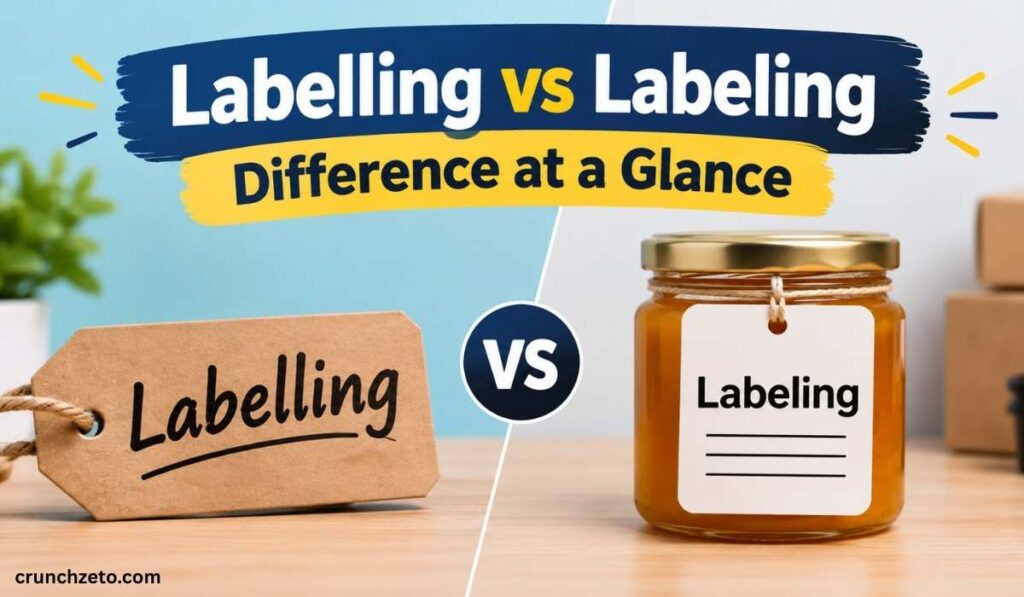
This table shows the two spellings side by side.
| Term | Correct? | Region | Best Use |
| Labeling | Yes | United States | US websites, schools, businesses |
| Labelling | Yes | UK, Australia, New Zealand, often Canada | British style writing |
| Labeled | Yes | United States | Past tense, US writing |
| Labelled | Yes | UK and similar regions | Past tense, British writing |
Notice the pattern. The American forms have one L before the ending. The British forms have two.
Why Do British and American Spellings Differ?
The split comes from a spelling rule. It is about doubling the last letter.
In British English, a word that ends in a single L usually doubles the L before “ing” or “ed.” This happens even when the last syllable is weak. So “label” becomes “labelling.”
American English is pickier. It doubles the last letter only when the last syllable is stressed. In “label,” the stress falls on the first syllable: LAY-bel. The last syllable is weak. So Americans keep one L.
Compare it to “begin.” The stress is on the last syllable: be-GIN. So Americans double the N and write “beginning.” The rule is the same. It just gives a different result for “label.”
Many people connect this split to Noah Webster. He was an American dictionary writer in the early 1800s. He pushed for simpler spellings in the United States. Many of those choices stuck.
Where Did the Word Label Come From?
The word “label” came into English from Old French. In that language, it meant a ribbon or a narrow strip. Early English speakers used it for a thin strip of cloth or paper attached to a larger object.
Over time, the meaning grew. A strip that carried a note became any tag that carried information. Then the word became a verb. People began to “label” things, and later, people.
The history helps explain the spelling choice. Nothing in the word’s origin demands one L or two. The rule belongs to modern spelling habits, not to the old word itself.
Read Related Post: Rehireable vs Rehirable: Which Spelling Is Correct?
How Do You Pronounce Labeling and Labelling?
Both spellings sound the same. Say it like this: LAY-buh-ling.
The first syllable gets the stress. The middle sound is soft, like the “uh” in “about.” The ending is “ing.”
No one can hear the second L when you speak. So this is purely a writing issue. If you only talk, you will never get it wrong.
How Do You Use Labeling in a Sentence?
Here are real examples from different settings. Each one uses the American spelling.
Everyday conversation:
“I’m labeling these jars so we know which jam is which.”
Workplace email:
“Please double check the labeling on the shipping boxes before pickup.”
School writing:
“The students practiced labeling the parts of a plant.”
Business writing:
“Clear product labeling helps customers make safe choices.”
Formal writing:
“Food labeling laws require companies to list common allergens.”
Now the British versions:
“I’m labelling these jars so we know which jam is which.”
“The labelling on the boxes was wrong.”
Why are these correct? The second L is simply the British habit. The grammar stays the same.
What About Labeled vs Labelled?
The past tense follows the same split.
American English: “She labeled the folder.”
British English: “She labelled the folder.”
You will also see the pattern in related words:
- Mislabeled (US) and mislabelled (UK)
- Unlabeled (US) and unlabelled (UK)
- Relabeled (US) and relabelled (UK)
Learn the main word, and the rest follow without effort.
What Are the Most Common Mistakes With Labelling vs Labeling?
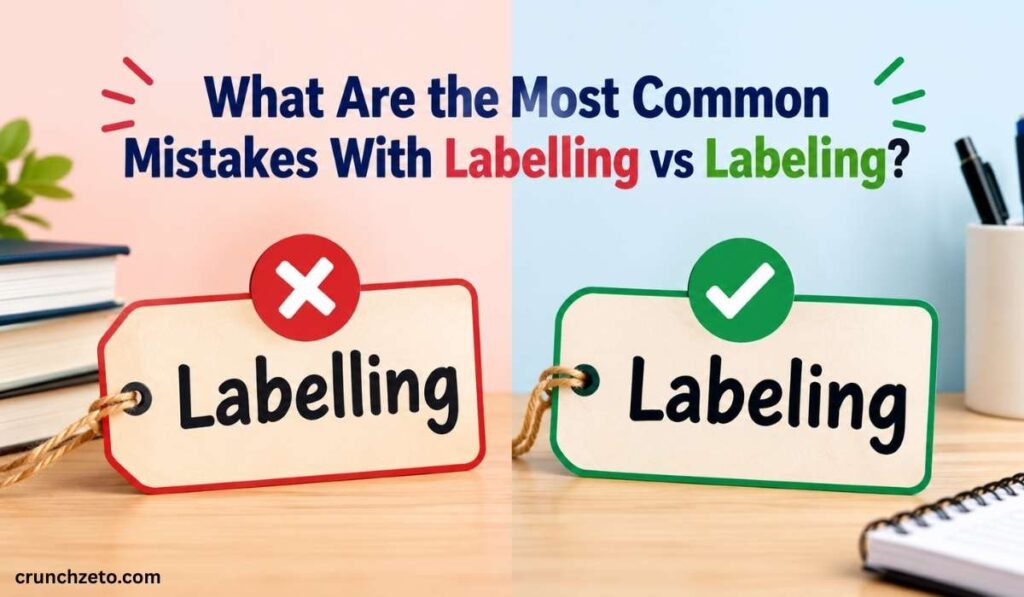
Most errors come from mixing the two styles. Nobody should feel bad about this. It happens to experienced writers every day.
Mistake 1: Mixing spellings in one document.
Incorrect: “The labeling was clear, but the labelled boxes were late.”
Correct: “The labeling was clear, but the labeled boxes were late.”
Pick one style and keep it. Mixing makes a document look careless.
Mistake 2: Using British spelling for a US audience.
Incorrect: “Our labelling rules protect US shoppers.”
Correct: “Our labeling rules protect US shoppers.”
A US reader may think you made a typo. Match the spelling to your reader.
Mistake 3: Calling one spelling wrong.
Incorrect: “Labelling is a spelling mistake.”
Correct: “Labelling is the standard British spelling.”
Neither form is an error. Each belongs to a different region.
Mistake 4: Writing three Ls.
Incorrect: “Labellling”
Correct: “Labelling” or “Labeling”
The word never needs three Ls. Check the spelling before you hit publish.
Which Other Words Follow the Same Spelling Pattern?
Many English words split the same way. If you learn one, you can guess the rest.
| American | British |
| traveling | travelling |
| modeling | modelling |
| canceled | cancelled |
| counseling | counselling |
| leveling | levelling |
| signaling | signalling |
| fueling | fuelling |
Each American word has one L. Each British word has two. The reason is the same: American English skips the doubled letter when the last syllable is not stressed.
A small warning helps here. Some words are tricky in the US. For example, many American writers use both “canceled” and “cancelled.” Dictionaries list both. For “label,” though, the single L is the standard choice in the United States.
Which Spelling Should You Choose for Your Writing?
Think about your reader first. This one choice settles most spelling questions.
Use labeling if you write for:
- American websites and blogs
- US schools and universities
- US companies and government pages
- Product packaging sold in the United States
Use labelling if you write for:
- UK newspapers and magazines
- British schools and businesses
- Australian and New Zealand readers
- Any style guide that asks for British spelling
Not sure who will read your work? Check the style guide, or look at similar pages from your target market. Also set your spell checker to the right language. It will flag the wrong version for you.
Remember this too: consistency matters more than anything else. Whichever side of the labelling vs labeling choice you make, stick with it from the first line to the last.
What Does Labeling Mean Beyond Packaging?
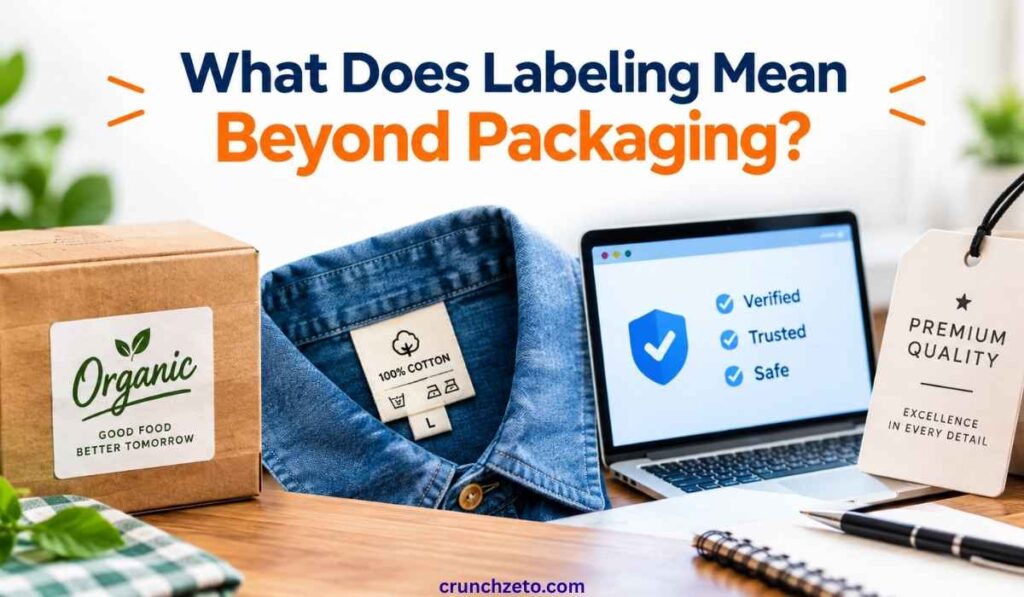
The word shows up in many fields. Knowing this helps you spot it in context.
- Food: Labeling tells shoppers what is in a product.
- Medicine: Drug labeling gives safe use directions.
- Psychology and sociology: “Labeling theory” looks at how names given to people can shape how they act. UK writers often spell it “labelling theory.”
- Music: A record label is a company that releases songs. The noun stays “label” in both regions.
- Technology: In data work, labeling means tagging data so a computer can learn from it.
In every case, the spelling rule is the same. American writers use one L. British writers use two.
Frequently Asked Questions About Labelling vs Labeling
Is labelling or labeling correct?
Both are correct. “Labeling” is the American spelling. “Labelling” is the British spelling. Choose the one that fits your readers.
What does labeling mean?
Labeling is the act of putting a label on something. It can also mean the labels themselves. It can mean describing a person or thing with a name or phrase.
Do Americans ever write labelling?
Rarely. You may see it in older texts or in writing by people trained in British English. In normal American writing, “labeling” is the standard.
How do I use labeling in a sentence?
Use it as a verb form or a noun. Example: “She spent the afternoon labeling the storage bins.” Another example: “The labeling on the box was easy to read.”
Is the spelling different in a search?
Search engines treat both spellings as the same idea. Still, your page should use one spelling that matches your audience.
What Is the Simple Rule to Remember?
Here is the one thing to take away. Americans write labeling and labeled. The British write labelling and labelled.
The meaning never changes. Only the second L does. So choose your audience, pick your spelling, and stay consistent. That is all it takes to settle the labelling vs labeling question for good.

Oliver Matthew Wilson is a passionate English language and grammar writer who enjoys making grammar, spelling, vocabulary, and writing concepts simple and easy to understand. With a focus on clear explanations and practical examples, Oliver Matthew Wilson creates helpful content for students, writers, and everyday English learners. His goal is to make learning English more enjoyable, useful, and accessible to everyone.
