


Ever typed “he trys his best” and then stopped, unsure if that spelling looks right? You are not the only one confused by trys or tries. This mix-up happens because English has a tricky rule for verbs ending in a consonant plus y, and most people never learned it clearly.
The good news is that the answer is simple: tries is the only correct spelling, and trys is always a mistake. In this guide, you will learn exactly why “tries” is correct, when to use it, and how to avoid this common error for good.
The Quick Answer: “Tries” Is Correct
Tries is the only correct spelling. It is the third person singular present tense form of the verb try, used with he, she, it, or a singular noun (for example, “he tries,” “the team tries”). Trys is not a recognized English word in any dictionary or style guide. If you see it in writing, it is a spelling mistake, not an alternate form.
What Does “Tries” Mean?
Tries means to attempt something or make an effort to do something. It comes from the base verb try, which means to make an attempt, test something out, or make an effort toward a goal.
You will see “tries” most often in sentences describing someone’s ongoing or repeated effort:
- She tries to run three miles every morning.
- He always tries his hardest, even when he is tired.
Why “Trys” Is Always a Misspelling
English has a reliable spelling rule for verbs that end in a consonant followed by y. When you add an s to make the present tense form for he, she, or it, you do not just add the letter s. Instead, you change the y to i and add es.
That rule turns try into tries, not “trys.” The same pattern applies to dozens of other common verbs, which is why this rule is worth remembering rather than memorizing word by word.
There is no dialect, register, or context, formal or informal, where “trys” is considered acceptable. It is not a British versus American English difference either. Both varieties of English use tries.
The Spelling Rule Behind “Tries”
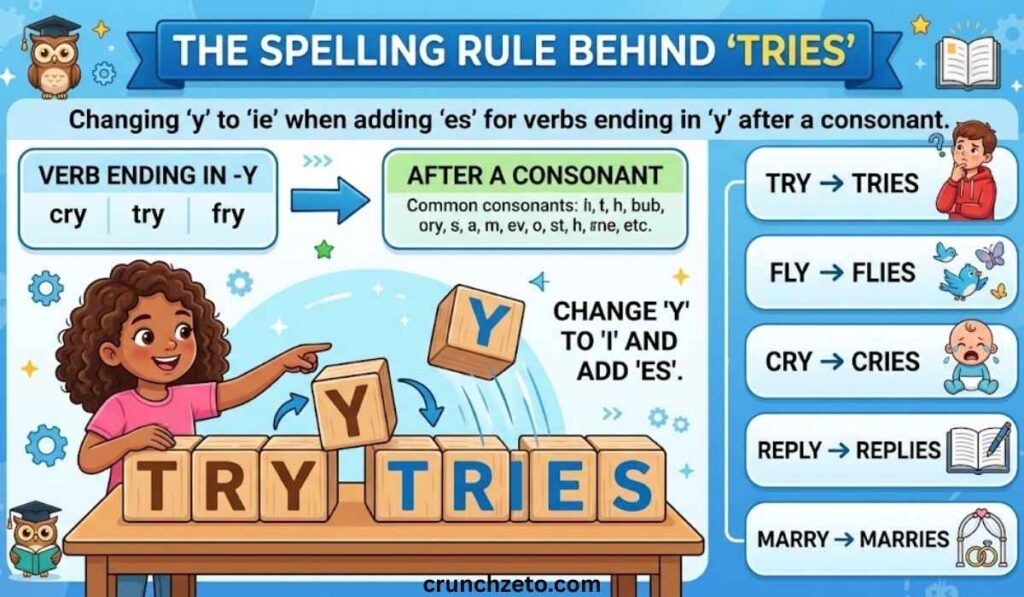
Here is the rule in plain terms:
If a verb ends in a consonant plus y, drop the y, add “ies” for the present tense (he/she/it form) or plural noun form.
Compare that to verbs ending in a vowel plus y, which simply add an s:
- Play becomes plays (vowel before y, just add s).
- Try becomes tries (consonant before y, change y to i and add es).
This distinction is the entire reason “trys” feels tempting to write. Your brain wants to apply the simpler “just add s” pattern, but try does not qualify for that shortcut because the letter before the y is a consonant (r).
Part of Speech and Grammar Details
Try functions as both a verb and a noun in English.
As a verb, its forms are:
- Base form: try
- Third person singular present: tries
- Past tense: tried
- Past participle: tried
- Present participle: trying
As a noun, “try” refers to an attempt (“give it a try”) or, in rugby, a scoring play. The plural noun form is also tries (“she made three tries at the puzzle” or “the team scored two tries”).
In both cases, whether verb or noun, the correct spelling with an added s sound is tries, never “trys.”
How to Pronounce “Tries”
Tries is pronounced like the word “try” with a “z” sound added at the end: /traɪz/. It rhymes with “size,” “prize,” and “eyes.” There is no separate syllable added, which sometimes surprises learners expecting an extra sound from the added letters.
Trys vs Tries at a Glance
| Term | Correct? | Meaning | Use |
| Tries | Yes | Third person singular of “try”; also plural noun form | Standard spelling in all forms of English |
| Trys | No | Not a recognized word | Common misspelling; avoid in all writing |
Using “Tries” Correctly in a Sentence
Seeing “tries” in different contexts makes the correct usage easier to remember.
Everyday conversation:
My dog tries to catch his tail every single day.
Workplace communication:
The support team tries to respond to every ticket within 24 hours.
Academic writing:
The study tries to explain the connection between sleep and memory retention.
Email:
Please let me know if the file tries to open in the wrong program again.
Business writing:
Our new software tries to reduce manual data entry by automating repetitive tasks.
Casual writing:
Every time he tries a new recipe, something catches fire.
In each example, “tries” follows a singular subject (dog, team, study, file, software, he), which is exactly when this verb form belongs.
Common Mistakes With “Tries”
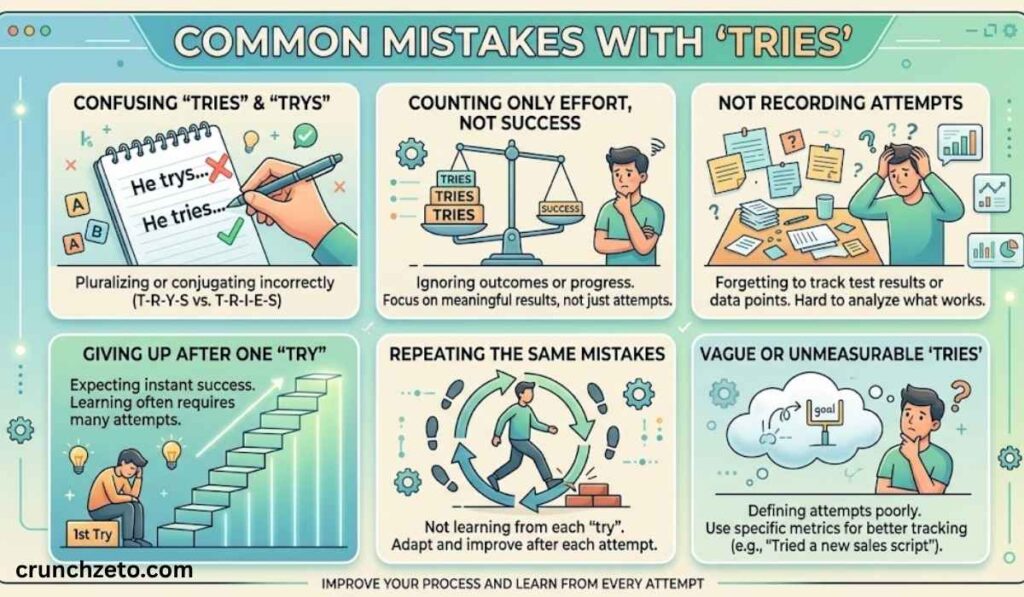
Incorrect: She trys to finish her homework before dinner.
Correct: She tries to finish her homework before dinner.
The subject “she” requires the consonant-plus-y spelling rule, so the y changes to i before adding es.
Incorrect: He always trys his best on exams.
Correct: He always tries his best on exams.
Same rule applies here: the base verb ends in a consonant plus y, so it becomes “tries,” not “trys.”
Incorrect: The company trys new marketing strategies every quarter.
Correct: The company tries new marketing strategies every quarter.
A singular noun subject, “the company,” takes the same third person singular verb form.
These mistakes are extremely common, especially among fast typists and English learners, and they do not reflect a lack of skill. The consonant-plus-y rule is simply easy to forget under one specific condition: when autocorrect does not catch it.
Words That Follow the Same Y-to-I Rule
Once you understand the pattern behind try and tries, you can apply it to many other English words:
- Cry becomes cries
- Fly becomes flies
- Carry becomes carries
- Study becomes studies
- Worry becomes worries
Notice that each of these words ends in a consonant directly before the final y, just like try. If you ever feel unsure about a word like this, check the letter right before the y. Consonant means change y to i and add es. Vowel means just add s.
American English and British English
There is no difference between American and British English on this point. Both varieties use tries as the correct spelling for the verb form and the plural noun. This is one of the more universal rules in English, unlike spelling differences such as “color” versus “colour.”
Tips to Never Misspell “Tries” Again
A few simple habits can help this spelling stick permanently:
- Say the word out loud. “Trys” does not sound like a natural English word once you say it slowly.
- Remember the rule with a short phrase: “consonant plus y, change to i and add es.”
- Compare it to a word you already spell correctly, like “flies” or “cries,” since they follow the identical pattern.
- Turn on spell check in your writing tools, since most programs flag “trys” automatically.
Frequently Asked Questions
Is “trys” ever correct?
No. Trys is not a recognized word in any standard or informal English dictionary. It is always a spelling mistake for tries.
What is the correct plural of “try”?
The plural noun form of “try” is tries, as in “she made several tries before succeeding.”
How do I use “tries” in a sentence?
Use “tries” with a singular subject, such as he, she, it, or a singular noun. Example: “The engine tries to start but stalls each time.”
Why do people misspell “tries” as “trys”?
People often apply the simple “add an s” rule that works for verbs ending in a vowel plus y, like “plays,” without realizing that verbs ending in a consonant plus y follow a different rule.
Does British English spell it differently?
No. British and American English both use tries with no variation.
Final Takeaway
Tries is the correct spelling, and trys is always a mistake, not an accepted variation. The confusion around trys or tries happens because verbs ending in a consonant plus y change to i before adding es, unlike verbs ending in a vowel plus y. Once you remember this one rule, you will never second guess yourself again. Whether you are writing an email, an essay, or a quick text, stick with tries, and your spelling will always be correct.

Oliver Matthew Wilson is a passionate English language and grammar writer who enjoys making grammar, spelling, vocabulary, and writing concepts simple and easy to understand. With a focus on clear explanations and practical examples, Oliver Matthew Wilson creates helpful content for students, writers, and everyday English learners. His goal is to make learning English more enjoyable, useful, and accessible to everyone.
